Best Bridge Building Kits for Schools: Hands-on Projects That Build STEM Skills
Educators and students can explore engineering concepts through engaging bridge-building kits. This guide highlights top options that align with classroom goals, from simple models to complex structures. Each kit emphasizes force, load, tension, compression, and real-world engineering principles, helping learners reason about design, stability, and function. Below is a quick summary of the chosen products to kick off your planning.
| Product | Brand | Key Focus |
|---|---|---|
| Thames & Kosmos Structural Engineering | Thames & Kosmos | 20 models; force, load, compression, tension |
| Learning Resources STEM Explorers Bridge Builders | Learning Resources | 9 STEM challenges; real-world engineering themes |
| Pathfinders STEM Bridge Kit | Pathfinders | Working lift bridge; gears and pulleys |
| V Generations Bridges & Buildings | V Generations | 250+ pieces; 15 models; forces and structures |
| K’NEX Architecture: Golden Gate Bridge | K’NEX | Large-scale replica; 1,536 pieces; long-span understanding |
Thames & Kosmos Structural Engineering: Bridges & Skyscrapers

The Thames & Kosmos Structural Engineering kit provides a broad set of learning opportunities through 20 models that explore force, load, compression, and tension. With more than 285 interchangeable pieces, students can experiment with different configurations to observe how structural elements respond under various loads. A 36-page illustrated manual guides experiments and assembly, making it suitable for classroom demonstrations and independent projects alike.
Learning Resources STEM Explorers Bridge Builders

This kit invites kids to design, construct, and test bridges and towers across 9 STEM challenges. It introduces real-world engineering concepts—from suspension to beam bridges—while fostering critical thinking and problem-solving as designs are tested and refined. The hands-on activities align with classroom pace, supporting both guided and independent learning paths.
ROBOTIME 3D Puzzle Bridge Construction Kit

This 3D wooden tower bridge kit combines puzzle solving with construction, offering a hands-on challenge that reinforces planning and spatial reasoning. The kit includes LED lighting for visual impact and an English instruction set, making it accessible for older students and makers in a classroom setting. It’s a compelling supplementary activity for design thinking units.
Pathfinders STEM Kit – Bridge Building
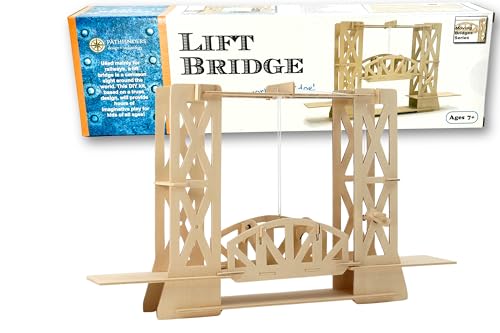
Pathfinders offers a working lift bridge model that demonstrates gears, pulleys, and counterweights. Designed for around a 60-minute build, it balances challenge and accessibility, making it suitable for a classroom intro to mechanical engineering. Clear illustrated instructions help keep projects frustration-free while promoting curiosity about how real bridges lift and stabilize.
V Generations Bridges & Buildings STEM Kit

With 250 pieces, this kit enables more than 15 model combinations, encouraging experimentation with structure types and load distribution. It emphasizes foundational science concepts—forces, load, compression, and tension—in a hands-on, age-appropriate way. The variety supports differentiated instruction and encourages iterative design in a classroom setting.
K’NEX Architecture: Golden Gate Bridge

K’NEX Architecture offers a long-span Golden Gate Bridge model with 1,536 pieces. This set provides a large-scale, tactile experience that helps students understand structural elements through a tangible build. Instructions are included, supporting independent or teacher-guided assembly, and the kit’s length and complexity make it suitable for advanced learners and STEM clubs.
Buying Guide: Key Purchase Considerations
When selecting bridge-building kits for schools, consider the following factors to match curriculum goals and student needs.
- Curriculum alignment: Look for kits that cover core concepts such as force, load, tension, compression, and structural elements like trusses and arches. Sequenceability matters for progression from simple to complex models.
- Hands-on opportunities: Ensure the kit provides ample manipulatives, parts, and clear instructions to support student exploration, testing, and iteration.
- Class size and adaptability: Choose kits that scale from small groups to whole-class activities, with materials that can be redistributed and reused across semesters.
- Assessment potential: Prefer kits with built-in challenges and rubrics or teacher guides to document design decisions, experiments, and outcomes.
- Safety and age appropriateness: Check recommended ages, materials (non-toxic, durable), and supervision requirements to fit your setting.
- Durability and storage: Consider storage solutions for pieces and potential wear from repeated use, especially in busy classrooms.
- Interdisciplinary value: Some kits tie in with math, physics, art, and engineering design thinking, broadening learning outcomes beyond pure engineering.
- Budget and durability: Weigh upfront cost against the number of lessons supported and the expected lifespan of components.
In classrooms, a mix of kits can address diverse learning styles. Start with a foundational kit to introduce concepts, then rotate to more complex models or weekend STEM projects. Organize students into design teams to encourage collaboration, documentation of designs, and peer feedback. Finally, incorporate reflection prompts that connect hands-on work to real-world bridge design and civil engineering challenges.