Best Stacking Toys for Toddlers to Boost Skills
Stacking toys support early development by encouraging fine motor skills, hand-eye coordination, color and shape recognition, and problem-solving. This guide highlights five top toddler stacking toys that blend learning with play, drawing on varied materials and design ideas—from wooden rings to nestable cups and spin-and-stack sets. Each option here offers multi-sensory engagement, durability, and age-appropriate challenges for toddlers ages 12 to 36 months. Explore practical choices that fit different play styles, spaces, and growth goals.
| Product | Brand | Age Range | Why It Stands Out |
|---|---|---|---|
| JUXUE Stacking Spinning Toy | JUXUE | 12+ months | Colorful discs, spin action, cause-and-effect learning |
| Sassy Stacks of Circles | Sassy | 6+ months | Texture variety with easy-grasp rings |
| LTKFFFdp Stacking Cups & Shapes | LTKFFFdp | 6+ months | Colorful cups, shapes, and habitats for sorting |
| Melissa & Doug Rainbow Stacker | Melissa & Doug | 2+ years | Wooden rings with a rocking base for stability |
| The First Years Stack & Count Cups | The First Years | 12+ months | Water play, counting, and color learning |
JUXUE Stacking Spinning Toy for Toddlers
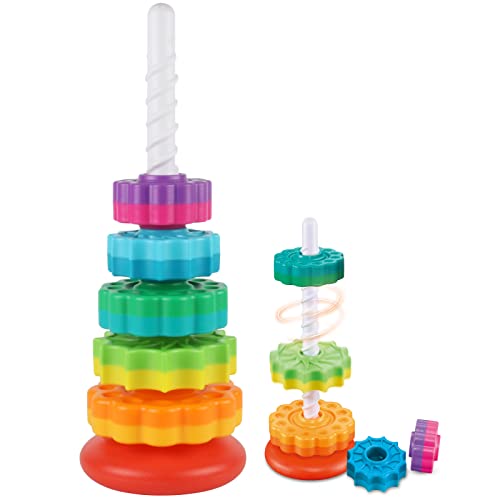
The JUXUE stacking spinning toy blends visual appeal with tactile exploration. It consists of a screw rod and rainbow-colored discs that can spin downward, providing a dynamic play experience. Each disc features two colors and can be rotated in multiple directions, making it simple for toddlers to grasp and manipulate. The design encourages stacking by size, color, or shape, and when complete, the base can be swapped to trigger spinning motion for a satisfying reveal. The toy also supports turn-taking and cooperative play, with the option to spin endlessly when held at both ends.
Educational value centers on hand-eye coordination, cause-and-effect awareness, and fine motor skills. As children sort and stack, they naturally practice color recognition and tactile discrimination tasks. The toy’s open-ended design invites extended play without a strict right-or-wrong outcome, which is ideal for toddlers who learn best through exploration. Durable materials and bold colors are crafted to withstand repeated stacking, spinning, and occasional drops typical of early play.
Sassy Stacks of Circles Stacking Ring

This 9-piece set from Sassy keeps stacking simple yet engaging for babies and toddlers. A straight post accepts rings of varying sizes, promoting incremental motor skill development as little hands grasp and place each piece. The large, chunky rings are easy for tiny fingers to grip, supporting precision and control as the child builds taller stacks. The different textures and weights of each ring add a tactile layer to play, while the textural variety is gentle for mouthing—a common behavior in early exploration.
As a developmental tool, the rings encourage hand-eye coordination, sequential thinking, and spatial awareness. Because each ring presents a distinct texture and weight, children experiment with balance and stability during stacking, which translates into early problem-solving abilities. The toy’s simplicity makes it suitable for a range of ages, from early graspers to growing toddlers refining their stacking and sorting skills.
LTKFFFdp Nesting Cups and Shape Sorter

LTKFFFdp offers a versatile set of eight colorful cups, four geometric blocks, a castle, rattling rabbit, and a free swimming frog. This stack-and-sort kit supports stacking, nesting, counting, and shape recognition, plus imaginative play in water or sand environments. The high-contrast colors and suitable hand sizes make it accessible for babies around 6 months and up, while the nested construction aids compact storage for families with limited space. It also serves as a handy travel toy, with multiple activities in one package to entertain toddlers during commutes or outdoor outings.
The set supports early math concepts such as size differentiation, order, and counting. It also fosters language development as caregivers label colors and shapes during play. The wooden blocks offer a tactile contrast to the plastic cups, enriching sensory exploration.
The First Years Stack & Count Cups

The First Years Stack & Count Cups emphasize color and counting, with eight cups designed for stacking and pouring in bath or playtime. The cups feature unique holes at the bottom to facilitate water play and discovery, merging stacking with experiment-based learning. Toddlers can arrange cups to form a rainbow, fit them by size, or flip them to reveal hidden spaces for small toys or treasures. The toy is well-suited for water-based play, which supports hydrodynamics awareness and fine motor skills as toddlers manipulate cups to pour, stack, and unstack.
Educational value includes early mathematical awareness, color recognition, and basic measurement concepts through pouring and filling activities. The cups’ bright hues and user-friendly size help maintain engagement as children learn through repetition and incremental challenge.
Buying Guide: Key Purchase Considerations
- Age appropriateness: Look for sets designed for early learners (6–36 months) to ensure safe sizing, grips, and challenge levels.
- Materials and durability: Wood can offer tactile variety and durability, while plastic pieces may be lighter and easier to clean. Check for smooth edges and non-toxic finishes.
- Skill development focus: Choose sets that target fine motor skills, hand-eye coordination, color and shape recognition, and early math concepts like counting and size order.
- Open-ended play: Prioritize toys that support imaginative use, not just fixed tasks, to encourage problem-solving and long-term engagement.
- Storage and space: Nested or stackable designs help keep play areas tidy and travel-friendly toys fit compactly in bags or bins.
- Multi-sensory elements: Textures, colors, and interactive actions (like spinning or rattling) enrich sensory learning and keep toddlers engaged.
- Care and cleaning: Consider how easy it is to clean after messy play, especially for toys used in water or outdoor settings.
- Budget and value: Compare sets that combine several activities (sorting, nesting, counting) to maximize learning opportunities without overwhelming costs.
- Safety standards: Ensure the toy complies with relevant safety guidelines and has no small parts that could pose choking risks for younger toddlers.