Best Math Manipulatives for Middle School: Hands-on Tools to Boost Mastery
If you’re helping middle schoolers build solid math foundational skills, tangible manipulatives can make abstract concepts concrete. This guide highlights five practical tools designed to strengthen computation, reasoning, and quick thinking. From fast-paced math games to durable dry-erase boards, these items support classroom activities and home practice alike. Each pick is vetted for educational value, ease of use, and broad applicability across algebra, fractions, and basic arithmetic.
| Product | Brand |
|---|---|
| Elevate Prep Target Math Game | Elevate Prep |
| Didax Algebraic Expressions & Equations Dominoes | Didax |
| Math Manipulatives White Board (9×12) | WEIZHEN |
| 9 Pcs Math Fidget Spinners | QETRABONE |
| Everything You Need to Ace Math in One Big Fat Notebook | Workman |
Elevate Prep Target Math Game

The Target Math Game offers a fast-paced, teacher-recommended approach to strengthening basic operations. It emphasizes addition, subtraction, multiplication, and division through quick rounds that encourage mental math fluency. Designed to scale with skill level, it includes three play modes and three difficulty settings, enabling teachers or parents to tailor challenges for individual students or entire groups. The structured yet adaptable format supports both independent practice and guided math centers, promoting confidence as students progress.
Didax Algebraic Expressions & Equations Dominoes
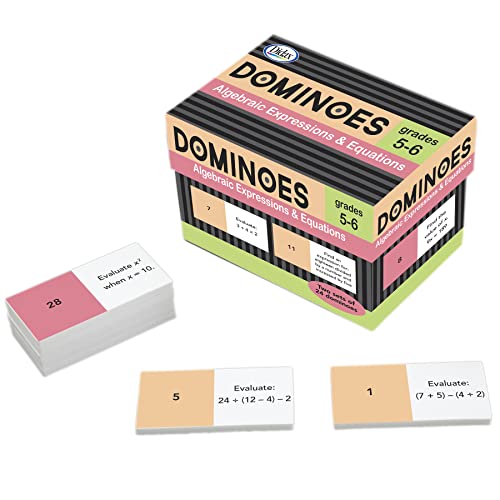
This foam domino set is a hands-on way to practice algebraic expressions and equations aligned to fifth- and sixth-grade standards. With two color-coded sets (48 pieces total), students build and solve problems by matching terms, coefficients, and variables. The durable foam design makes it suitable for classroom centers or small-group activities. Instructions are included to guide teachers in implementing varied games that reinforce key concepts like combining like terms and evaluating simple expressions.
Math Manipulatives White Board 9×12

This double-sided dry-erase whiteboard provides a versatile surface for practicing long division, multiplication, and multi-step problems. The 9×12 inch size is convenient for individual students or small groups, and the two sides offer space for organizing work across operations. Teachers can use these boards for quick checks, math stations, or partner activities that require students to compare strategies, track steps, and explain their thinking in real time.
9 Pcs Math Fidget Spinners

Turn practice into an interactive experience with a set of math-focused fidget spinners. These spinners are designed to engage learners while reinforcing operations like multiplication and division through quick, repeatable spins. The compact, portable design supports on-the-go practice during commute time or in stations where students rotate through quick challenges. The tactile element helps some students process numerical relationships more effectively than traditional worksheets alone.
Everything You Need to Ace Math in One Big Fat Notebook

This comprehensive middle school study guide collects essential math concepts across grades. The Big Fat Notebook presents ideas in approachable, kid-friendly language paired with visual reminders. While not a traditional manipulative, the resource supports kinesthetic learning when used with hands-on activities that model problem-solving steps. It can be a valuable reference during guided practice, homework help, or study sessions to reinforce steps for solving equations, ratios, and fractions.
Buying Guide
When selecting math manipulatives for middle school, consider how each item aligns with core standards and daily activities. Key factors include versatility, durability, and ease of integration into existing lesson plans. Look for multi-purpose tools that support operations practice, reasoning, and number sense. Durability is essential in busy classrooms or at-home setups, so choose items that withstand frequent handling. For younger middle school students, scaffolding features such as guided prompts or adjustable difficulty help ensure sustained engagement.
- Skill alignment: Prioritize manipulatives that reinforce fractions, decimals, ratios, algebraic thinking, and mental math. A mix of concrete tools and digital-friendly activities boosts transfer to abstract concepts.
- Engagement and accessibility: Choose products with clear visuals, bright colors, and easy-to-clean materials. Non-toxic, kid-safe designs support classroom use and home practice.
- Durability and maintenance: Durable foam, plastic, and dry-erase surfaces withstand daily use. Ensure erasable boards are easily cleaned, and that any stickers or game components remain intact over time.
- Teacher and student suitability: Prefer resources with teacher-friendly instructions, optional group activities, and a range of difficulty levels to accommodate mixed-ability classrooms.
- Integration with routines: Pick tools that fit into centers, stations, or short warm-ups. Quick-start activities and printable templates help maintain consistent practice without heavy preparation.
Across these choices, middle school students gain hands-on experience with computation and reasoning. The combined use of a fast-paced game, durable whiteboards, engaging manipulatives, and accessible reference guides supports varied learning styles and classroom formats. For educators and guardians, a balanced mix encourages both independent practice and collaborative exploration, promoting deeper understanding of mathematics and improved problem-solving confidence.