Best 3D Printer for Dollhouse Miniatures: Compact, Precise Options
For hobbyists building dollhouse miniatures, precision, safety, and ease of use matter as much as print speed. The following selections focus on small-format, high-detail capable machines suitable for tiny doors, windows, furniture details, and miniature accessories. Each option supports careful calibration, reliable layer resolution, and user-friendly interfaces ideal for homes, classrooms, or hobby spaces.
| Product | Brand | Key Benefit | Why It Fits Dollhouses |
|---|---|---|---|
| AOSEED 3D Printer For Kids (X-Maker Joy) | AOSEED | Beginner-friendly with a large design library | 0.05 mm accuracy and 1,500+ designs support tiny components |
| AOSEED AI-Powered 3D Printer (X-Maker Joy AI+) | AOSEED | AI-assisted modeling and fast speeds | High detail and smart prompts for custom miniatures |
| Upgraded Tina2S 3D Printer | HEPHI3D | Auto bed leveling and cloud print | Great for accurate base layers and repeatable small prints |
| TINA2 Mini 3D Printer | HEPHI3D | Fully assembled, auto leveling | Student-friendly with reliable start-to-print workflow |
| Creality K1 SE | Creality | High-speed, large build area, ready-to-use | Enclosed, fast prints with safe operation |
The following five products were chosen for their balance of safety, precision, and approachable software. They are positioned to help builders craft dollhouse components—from tiny window sashes to miniature flooring planks—without sacrificing finish quality or accessibility.
AOSEED 3D Printer For Kids: Beginner Friendly

The AOSEED model designed for beginners emphasizes a straightforward start-to-print experience. With a one-click creation flow through a dedicated app, it supports iOS, Android, and Windows to simplify setup. Its 0.05 mm precision at speeds up to 200 mm/s helps produce fine dollhouse details, such as tiny furniture legs or delicate latticework. A quick-release nozzle reduces downtime between projects, making it easier to iterate small parts. The inclusion of a vast design library with regular weekly updates ensures a steady supply of miniatures and accessory components for ongoing dollhouse projects. This machine prioritizes safety and simplicity, which is ideal for homes and classrooms targeting miniature arts and crafts.
Features alignment with dollhouse work:
- Broad compatibility across platforms for easy access to designs
- Very fine layer resolution suitable for tiny details
- Vast, regularly updated design library to spark creativity
- Quick-release nozzle for quick material changes
AOSEED AI-Powered 3D Printer With AI Design

This AOSEED model adds AI-driven design features to streamline miniatures creation. AI Doodle lets kids transform prompts—voice, text, or image—into 3D models, while AI MiniMe converts photos into stylized cartoon figures for imaginative scenes. The enclosed design and auto-leveling platform emphasize safety and reliability, crucial when working on intricate dollhouse components. Its higher speed range up to 250 mm/s (with bursts up to 400 mm/s) accelerates project timelines, useful when testing multiple tiny renderings like miniature chandeliers or furniture trim. Filament break detection helps avoid wasted prints, which is valuable for ongoing, detail-rich dollhouse builds.
Key dollhouse-friendly advantages:
- AI-assisted modeling boosts creativity without steep learning curves
- Enclosed safe design supports family use around curious kids
- Faster print speeds enable rapid prototyping of tiny parts
- Filament break detection safeguards ongoing projects
Upgraded Tina2S 3D Printer

The Tina2S model emphasizes cloud-based workflows and auto bed leveling, making it a practical choice for precise dollhouse details. The Poloprint Cloud app enables wireless printing from a smartphone or tablet, reducing the need for frequent computer connections. Open-source compatibility with Cura and PrusaSlicer supports broader design options and customization. A quiet operation profile and improved CPU performance help produce delicate components like window lattice, railings, and interior décor without disruptive noise. This machine suits both classrooms and homes that require dependable repeatability for small-scale builds.
Why it matters for miniatures:
- Auto bed leveling simplifies setup and improves first-layer success
- Open-source ecosystem supports detailed customization
- Quiet operation aids in shared living or learning spaces
- Compatibility with standard slicers keeps design options flexible
TINA2 Mini 3D Printer
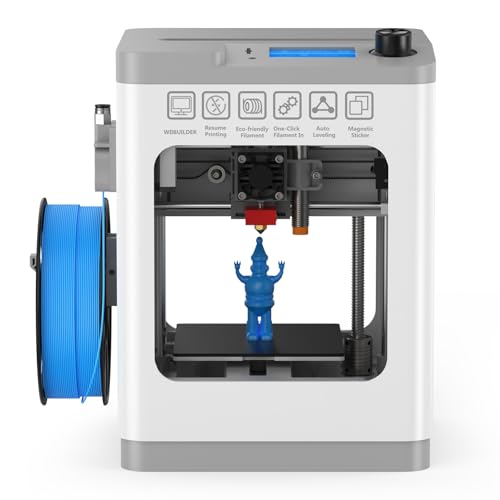
The TINA2 Mini from HEPHI3D arrives fully assembled and ready for immediate use, a strong plus for beginners focusing on tiny, precise components. Auto-leveling reduces manual calibration time, a critical factor when printing frequent, small-scale parts such as furniture hardware or miniature decor. The included 2.4″ LCD display and micro SD card with preloaded designs speed up the path from unboxing to printing. While compact, this model supports detailed, reliable results through a straightforward workflow, making it a solid option for families and educators looking to introduce kids to 3D printing at a miniature scale.
Notable dollhouse print considerations:
- Out-of-the-box usability with essential accessories
- Auto-leveling for consistent base layers
- Preloaded models and simple controls reduce setup friction
Creality K1 SE: Ready-To-Print Speed

The Creality K1 SE offers high-speed printing with Core XY architecture and an enclosed build chamber, supporting safer operation for household use. It delivers a rapid print experience with a claimed top speed of 600 mm/s, a substantial advantage when iterating multiple tiny parts for dollhouses. The all-metal structure contributes to robust performance and stable prints necessary for fine detailing such as miniature flooring textures or tiny furniture edges. Pre-assembled features reduce setup time, though some users may appreciate capacity for manual tweaks to optimize for tiny, high-detail prints.
Practical dollhouse benefits include:
- Enclosed design supports safer home use
- High-speed printing to accelerate design cycles
- Open and accessible upgrade paths for advanced users
Buying Guide: Key Considerations for Dollhouse Miniatures
When selecting a 3D printer for tiny, detailed dollhouse components, focus on print quality, ease of use, and safety. Consider the following perspectives:
- Print resolution and detail: Look for machines offering 0.05 mm layer height or better. Small features need fine layer steps to appear clean and crisp in miniature pieces.
- Build volume vs. part size: Tiny parts require high precision rather than oversized prints. Choose a compact printer with a suitable build area for dormers, furniture, and decorative items.
- Enclosed vs. open frame: Enclosures improve safety for homes with kids and reduce drafts that can affect fine prints.
- Auto bed leveling and reliability: Auto leveling minimizes user errors and increases first-layer success, which is essential for tiny objects that deform easily.
- Slicing software and ecosystem: Compatibility with Cura or PrusaSlicer and access to libraries of miniatures can speed up project timelines.
- Safety features: Look for filament run-out sensors, power-loss resume, and enclosed print areas to protect curious builders.
- Maintenance and consumables: Quick-release nozzles, standard filament availability, and clear repair paths help sustain long dollhouse projects.
- Learning curve and support: For families and classrooms, choose models with robust documentation, responsive customer support, and beginner-friendly interfaces.
- Cost-to-value balance: While premium features aid detail, the most important factor is consistent performance for small-scale prints over time.
- Upgradability: A platform that supports aftermarket upgrades (hotends, extruders, or build plates) can extend the printer’s usefulness as needs evolve.