Best Electronic Toys for Eight-Year-Olds: Engaging STEM Gadgets That Spark Creativity
Finding electronics-based toys for eight-year-olds involves balancing safety, learning value, and screen-free fun. The following selections emphasize hands-on experimentation, problem solving, and creative play. Each product helps young learners explore basic circuitry, robotics, memory games, and programmable motion in a developmentally appropriate way. The list below highlights five compelling options that align with common interests at this age.
| Product | Brand | Key Focus | Typical Interest |
|---|---|---|---|
| Snap Circuits Jr. SC-100 | Snap Circuits | Electronic circuit projects | STEM exploration |
| Smartivity Robotic Hand Kit | Smartivity | Mechanical engineering | Hands-on construction |
| KingsDragon Gesture RC Robot | KingsDragon | Remote control with gesture sensing | Robotics play |
| QXHOL Gesture RC Stunt Car | QXHOL | Gesture control and 4WD action | Action play |
| PlayRoute Electronic Brain Cube | PlayRoute | Memory and brain games | Mental agility |
Snap Circuits Jr. SC-100 Electronics Exploration Kit

The Snap Circuits Jr. kit introduces young builders to the basics of electrical engineering in a safe, hands-on way. With more than 100 projects and a colorful instruction manual, kids can assemble gadgets by snapping parts into place. The kit contains 28 parts and is designed for ages 8 and up, offering clear, modular experiments that illustrate circuitry principles.
Projects range from simple light circuits to more complex devices, encouraging experimentation and problem solving. The modular design makes it easy to expand with additional Snap Circuits sets for even more configurations. The product emphasizes practical skills and fosters early confidence in engineering concepts.
What to know: this kit is ideal for independent play or guided activities with a parent or teacher. Because projects are widely varied, it supports different learning speeds and interests, from basic circuits to imaginative gadgets like a flying saucer. Consider adding a few compatible expansion kits to broaden the learning journey.
Smartivity Robotic Mechanical Hand

This hands-on STEM kit helps kids ages 8 and older build a functional mechanical hand. The step-by-step manual provides a structured assembly process while enabling creativity in how the hand can perform tasks. The kit emphasizes engineering concepts such as levers, joints, and motion transmission, encouraging extended play and experimentation.
In addition to construction, children learn about precision and planning as they follow the instructions to assemble the mechanism. The parts are designed for durability, and a lifetime supply of replacement components ensures ongoing use without interruption. The activity is suitable for solo play or group projects, fostering collaboration and critical thinking.
Consider this kit for families seeking a robust, screen-free activity that still delivers engaging, lasting value. It pairs well with other build-at-home kits to create a broader DIY engineering station in a playroom or classroom.
KingsDragon Gesture RC Robot

This gesture-sensing robot combines remote control with hand-gesture input for a dynamic play experience. The robot can respond to commands like turn, move forward, and avoid obstacles, with LED eyes lighting up as it moves. It offers a programmable action mode where kids can input a sequence of moves to see the robot execute them in order.
Made from non-toxic ABS plastic with multi-joint articulation, the robot is designed for durability and varied play patterns. The combination of physical manipulation and AI-inspired behavior introduces young learners to basic robotics concepts such as input control, feedback, and motion planning.
Users can grow into more complex routines by exploring how different gestures alter the robot’s behavior, making it a strong option for ongoing learning and imaginative play.
QXHOL Gesture RC Stunt Car

This 4WD stunt car uses gesture sensing for intuitive control and can perform impressive moves on varied terrains. The car features cool lights and music to enhance the driving experience, and it comes with two high-capacity batteries to extend playtime. Children can practice coordination and spatial awareness while experimenting with speed, turns, and stunts.
With multiple control modes and responsive feedback, the car offers engaging challenges that can appeal to a wide age range within the target group. It is suitable for indoor or outdoor play, depending on space, and can be enjoyed as a standalone toy or alongside other remote-control devices for comparative play.
PlayRoute Electronic Brain Cube
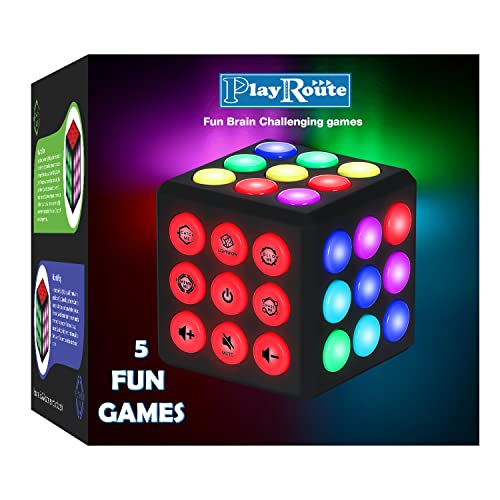
The PlayRoute Brain Cube combines five brain-training games in a handheld format designed to engage memory, focus, and quick thinking. Its lightweight design makes it ideal for travel, and the bright LED display provides immediate feedback during play. The cube’s games are built to challenge pattern recall, sequencing, and concentration without relying on screens.
This toy supports cognitive development by offering varied activities that can be solved solo or with friends. It is a versatile choice for car rides, quiet times, or classroom stations, providing a compact, portable option for ongoing mental exercise. The variety of games helps keep children motivated while strengthening attention and memory skills.
Buying Guide: Key Purchase Considerations
When selecting electronic toys for eight-year-olds, consider safety, educational value, and durability. Look for components that are age-appropriate and come with clear, easy-to-follow instructions. Toys that encourage experimentation and gradual skill-building tend to hold attention longer and promote lasting learning.
Important factors include: safety certifications, non-toxic materials, and sturdy construction to withstand frequent handling. Assess the level of parental involvement required and whether the toy supports independent play or collaborative activities. Check for expansion options that allow you to grow the set as the child’s skills improve.
Learning outcomes to prioritize: understanding basic circuitry, robotics concepts, motor planning, memory and concentration, planning and problem solving, and persistence through challenges. A mix of open-ended and structured projects can provide a balanced learning experience.
Consider play preferences: do they enjoy building and engineering challenges, racing and action, or puzzle-style brain games? Selecting a blend of products that address different interests helps maintain engagement and broadens the skill set. Finally, verify compatibility with any existing kits you own to maximize reuse and value.