Best Color Blocks for Kids: Colorful Building Toys for Learning and Play
Colorful building blocks foster creativity, fine motor skills, and early math concepts. This guide highlights five kid-friendly options in vibrant hues and durable designs, helping parents pick safe, engaging toys that grow with children from toddlers to early elementary years. Each selection emphasizes color recognition, stacking, and open-ended play to support developmental milestones.
| Product | Brand | Key Color/Shape Variety | Notable Benefit |
|---|---|---|---|
| Melissa & Doug Wooden Building Blocks | Melissa & Doug | 4 colors, 9 shapes | Montessori-inspired motor and math skills |
| Apluses 42PCS Magnetic Blocks | Apluses | 6 colors, 3D magnetic cubes | Spatial thinking and creative STEM play |
| Feoxialy Magnetic Blocks | Feoxialy | Bright colors, magnetic cubes | Strong magnets and durable ABS construction |
| WOODENFUN 32 Pcs Rainbow Blocks | WOODENFUN | Rainbow colors, geometric shapes | Open-ended construction and parent-child interaction |
| Dinhon 23PCS Sensory Blocks | Dinhon | Translucent rainbow colors | Sensory-friendly, large grip for little hands |
Melissa & Doug Wooden Building Blocks

This 100-piece set provides four colors and nine shapes, enabling stacking, sorting, and imaginative play. The blocks are lightweight yet durable, and the included sturdy cardboard box simplifies storage and transport. The Montessori-inspired design supports fine motor development, hand-eye coordination, and early math concepts such as counting and comparing shapes and colors. Ideal for toddlers and preschoolers, these blocks encourage open-ended play and repeat building sessions.
Apluses 42PCS Magnetic Blocks

Featuring 42 magnetic pieces in six colors, this set emphasizes 3D construction. The blocks come with an idea booklet and storage bag, guiding children to build varied geometric structures. Designed to support early grasping skills and spatial thinking, the magnetic cubes promote exploration, counting, and color recognition. It is positioned as beneficial for children in the 3- to 6-year range, particularly for developing focus and creative problem solving.
Feoxialy Magnetic Blocks

These 32 large magnetic blocks provide enduring color appeal and strong magnet mechanisms. The set emphasizes safe, durable ABS plastic with rounded edges and a 1.42-inch block size for easy handling by younger children. The design aims to minimize block loss and maximize creative stacking opportunities, enabling children to construct simple towers, houses, and abstract sculptures while reinforcing color and shape recognition.
WOODENFUN 32 Pcs Rainbow Blocks
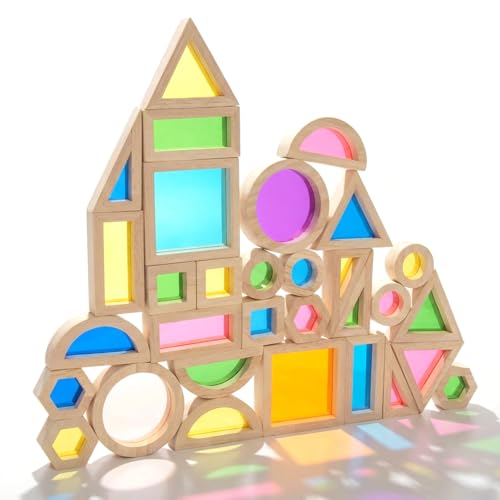
This set delivers 32 colorful wooden blocks in a rainbow palette, offering a variety of shapes to spark creative play. The natural wood build and smooth, burr-free edges promote safe, screen-free exploration. Children can imagine castles, towers, and cities while practicing color identification, measurement concepts, and pattern creation. It also supports bonding experiences between parents and children during building sessions.
Dinhon 23PCS Sensory Blocks

This large-block set combines a pine wood frame with high-transparency acrylic cores to create translucent, rainbow colors. The blocks are designed for open-ended, sensory-rich play and are suitable for ages 1-3 and up to 8 years old. Their enlarged grip and safe construction reduce choking risk while encouraging stacking, color exploration, and early geometry concepts. The set is described as Montessori-friendly and classroom-ready, adaptable for various learning styles.
Buying Guide: Key Purchase Considerations
- Age appropriateness: Look for block sets labeled for your child’s age range to ensure appropriate size, weight, and safety.
- Material and safety: Prioritize non-toxic finishes, smooth edges, and durable construction (wood, ABS plastic, or magnetic components) to minimize splinters and breakage.
- Open-ended play: Favor sets that encourage creativity without fixed outcomes to support problem solving, spatial reasoning, and hand-eye coordination.
- Color and shape variety: A broad palette and diverse shapes help with color recognition, patterning, and early math skills.
- Storage and portability: Consider sets with sturdy containers or boxes for easy cleanup and on-the-go play.
- Magnetic versus non-magnetic: Magnetic sets offer quick, intuitive builds but may require supervision to avoid pinched fingers; non-magnetic wooden sets emphasize traditional stacking and balance skills.
- Maintenance: Look for blocks that are easy to clean and resist fading with typical indoor play and occasional rough-and-tumble use.
- Educational value: Some kits include learning prompts, idea booklets, or guided activities to extend play into early literacy or math concepts.
Comparative Perspectives
When selecting color blocks for children, parents should balance durability, safety, and educational value. Wooden blocks excel in tactile feedback and long-lasting durability, while magnetic blocks spark rapid assembly and visual-spatial engagement. Foam blocks are excellent for safe, soft-stack play and sensory exploration, especially for younger toddlers. A mixed approach, combining a wooden foundational set with a magnetic or foam add-on, can cover a broad range of developmental skills and play styles.
Usage Scenarios
- At-home play: A small corner with a compact storage bin keeps blocks readily accessible for spontaneous sessions.
- Preschool classrooms: Sets with a variety of shapes and colors support structured activities like color sorting and pattern building.
- Travel and waiting times: Smaller, light sets fit into backpacks for on-the-go learning and entertainment.
- Group activities: Magnetic blocks encourage collaborative design challenges and shared problem solving among peers.