Best Astronomy Kits for Kids: Top Hands-on Space Learning Sets
Parents and educators seeking engaging, educational ways to spark kids’ curiosity about space will find a wide range of science kits that blend astronomy with hands-on activities. The following selections emphasize experiments, model-building, and interactive learning to help children explore planets, stars, and the cosmos. Each kit below offers age-appropriate projects that support STEM skills while delivering hours of observational fun.
| Product | What It Teaches | Ideal For |
|---|---|---|
| Discovery Galactic Space Science Kit | 61 experiments across astronomy, chemistry, archeology | Curious ages 8+ |
| National Geographic Mega Space Activity Kit | Glow craft, constellations, rocket launch | Imaginative space explorers |
| Science Can Solar System | Talking solar system model, projections | Early learners, bilingual options |
| 4M Solar System Planetarium | Glow-in-the-dark planets, wall chart | Creative builders |
| Wow in The World Telescope Kit | Beginner astronomy, star gazing basics | Ages 6+ |
Discovery Galactic Space Science Kit

The Discovery Galactic Space Science Kit provides a comprehensive, STEM-focused introduction to space exploration. It ships with 61 space-themed experiments and activities, including 21 guided experiments and 40 at-home projects that span astronomy, chemistry, and archeology. A DIY paper telescope offers practical, hands-on optics experience, alongside lunar rock excavation, glacier crystal growth, and learning modules on moon phases, meteor showers, and constellations. The kit also features experiments that demonstrate reactions, states of matter, and other core science principles through engaging activities such as galaxy slime and erupting gas balloons. This set is designed to nurture curiosity and critical thinking, with clear, structured learning paths and plenty of opportunities for independent inquiry. Suitable for ages 8 and up, it supports classroom and home learning alike.
National Geographic Mega Space Activity Kit

The National Geographic Mega Space Activity Kit bundles over 100 pieces into a single, versatile space-themed project set. It emphasizes hands-on crafts and experiments that bring space concepts to life. Children can launch a foam rocket as a practical physics exercise, while glow-in-the-dark stars and constellation cards enable the creation of glowing night-sky displays. The kit’s breadth supports creative storytelling about space and helps kids visualize celestial patterns, making it a strong option for curious learners who enjoy interactive art alongside science. Suitable for various ages, it encourages collaborative play and independent exploration.
Science Can Solar System

The Science Can Solar System model introduces children to a talking, illuminated solar system, providing an interactive way to learn the eight planets and their orbits. The device projects planetary images onto walls or ceilings, turning bedrooms into a personal planetarium. It includes bilingual options (English and Spanish) for broader accessibility and features 24 space exploration slides that showcase planets, spaceships, astronauts, and celestial bodies. The model’s simple operation and engaging visuals support early science literacy, making it a suitable choice for elementary-aged kids who want to explore space with a friendly, narrative-driven tool.
4M Solar System Planetarium
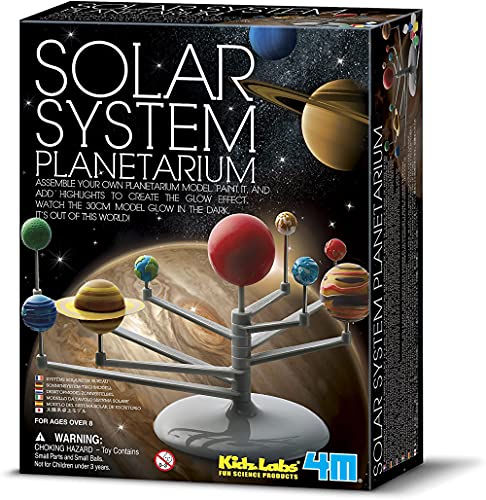
The 4M Solar System Planetarium kit focuses on a tangible, craft-based learning experience. Children assemble, paint, and display a scaled solar system, completing the set with stencils, glow-in-the-dark paint, rods, and a wall chart with educational prompts. The included quiz questions provide a structured way to assess understanding and retention. This kit is well suited for classroom corners or home desks where kids can progressively build and decorate a planetary display while learning key facts about each world in our solar system.
Wow in The World Telescope Kit

The Wow in The World telescope kit introduces early astronomy with practical observing tools and engaging learning materials. It features a refractor telescope suitable for beginners, offering 25x and 50x magnification and a sturdy adjustable tripod up to 48 inches. An 8-page illustrated guide explains telescope functions and how to identify lunar features, planets like Mars, Jupiter, and Saturn, and notable stars and constellations. The kit emphasizes guided discovery and friendly, accessible instruction for budding stargazers, including accompanying audio content to enhance exploration and retention.
Buying Guide: Key Purchase Considerations
- Age and learning stage: Choose kits that align with a child’s age, reading level, and interest in hands-on activities. Some sets emphasize crafts and art (great for younger kids), while others focus on in-depth experiments and model-building (better for older children).
- Learning objectives: Identify whether you want a kit that covers astronomy basics, planetary recognition, telescope use, or interdisciplinary science (e.g., chemistry, physics, meteorology). Look for clear educational goals and beginner-friendly guides.
- Hands-on potential: Some kits emphasize building and constructing (telescope, models, or dioramas), while others center on experiments and exploration. Consider what motivates the learner—crafts, engineering, or data-driven observation.
- Visual and interactive features: Glow-in-the-dark elements, projections, or star maps can enhance engagement and help children retain concepts through visuals and story-rich content.
- Multilingual options: If applicable, kits with bilingual guidance or bilingual audio can support diverse families and language learners.
- Storage and organization: Look for kits with clearly labeled components and a storage solution to keep small parts organized between sessions.
- Safety and assembly: Ensure pieces are age-appropriate and include clear assembly instructions and safety warnings where relevant.
- Expandable learning: Consider kits that can be complemented by additional experiments or accessories to sustain long-term interest in astronomy.
- Budget and value: Compare the number of activities and included tools versus price. A larger set may offer more extensive learning opportunities but with more components to manage.
In selecting an astronomy kit, consider both immediate learning benefits and long-term curiosity. The products listed above vary in format—from interactive projections and glow-in-the-dark displays to hands-on planetarium projects and portable telescopes—allowing you to tailor choices to a child’s interests and attention span. Whether your goal is to spark a lifelong interest in space or simply provide a memorable, science-rich activity, these kits offer reliable avenues for exploration and discovery.