Best Alphabet Toys for 5 Year Olds: Engaging Letter Games and Pre‑Reading Activities
Finding effective alphabet toys for five-year-olds supports early reading, spelling, and letter recognition while keeping learning fun. The following selections emphasize hands-on interaction, memory skills, and collaborative play. Each product includes durable construction, clear letter focus, and activities that appeal to preschool and early elementary learners. The curated range covers wooden letters, interactive electronic tools, and memory-based matching games designed for ages 5 and up.
Summary of Selected Products
| Product | Brand | Key Focus | Learning Benefit |
|---|---|---|---|
| BEESTECH Alphabet ABC Learning Toys | Beestech | Wooden letters and flash cards | Letter matching, word building, fine motor skills |
| LeapFrog Mr Pencil’s Scribble Write and Read | LeapFrog | Writing letters and tracing numbers | Uppercase/lowercase practice, phonics, name writing |
| School Zone Go Fish Alphabet Game Cards | School Zone | Letter recognition through matching | Memory, speed, word-picture connections |
| LIWIN LET’S GO! | LIWIN LET’S GO! | Matching letter game | Memory, spelling, word recognition, social play |
| HOPEEYE Montessori Matching Letter Game | HOPEEYE | Enlarged letters, cards, and storage | Word recognition, spelling, cognitive development |
Best Alphabet ABC Wood And Card Matching For Toddlers And Kids

BEESTECH’s Alphabet ABC Learning Toys combine sturdy wooden letters with flash cards to support early literacy. Suitable for ages 2 through 5, this set encourages children to place the correct wooden letters onto corresponding cards, reinforcing letter–sound awareness and word-building skills. The items are polished with rounded edges for safe handling, and a storage bag helps keep the pieces organized for home and classroom use. This activity emphasizes hands-on letter matching and fine motor coordination.
LeapFrog Mr Pencil’s Scribble Write and Read

LeapFrog Mr Pencil’s Scribble Write and Read blends writing practice with interactive storytelling. Kids learn uppercase and lowercase letters step-by-step, while the digital animations transform letters into animals and objects. The toy includes dotted-line tracing for numbers and supports personalized practice by entering a child’s name, providing a motivating incentive to write and spell their own name. This activity supports handwriting readiness, phonemic awareness, and early math concepts through counting.
Go Fish Alphabet Game Cards

School Zone’s Go Fish Alphabet Game Cards offer a colorful, engaging way to practice letter recognition and early reading skills. The set features bold letters and playful animal illustrations, making it an accessible memory and matching activity for preschoolers and early elementary learners. While there is a focus on letters, the cards also encourage word-picture associations, supporting vocabulary development and visual discrimination in a social, turn-taking format.
LIWIN LET’S GO! Matching Letter Game
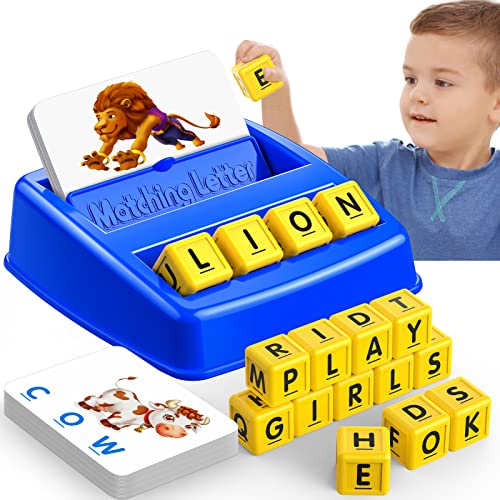
LIWIN LET’S GO! offers a robust matching letter game designed for kids ages 3–8. The set focuses on memory development, spelling, and word recognition through tactile card play. It fosters social interaction and turn-taking as players search for matching letters, making it suitable for family game nights or classroom centers. The durable components and clear letter presentation support repetitive practice and incremental skill building in letter identification and phonics.
HOPEEYE Montessori Matching Letter Game

HOPEEYE’s Montessori Matching Letter Game emphasizes an organized, classroom-friendly approach. The set includes an enlarged blue tray, bigger letter cubes, and double-sided cards featuring a range of CVCC and CCVC word patterns. This layout supports precise word matching, spelling practice, and early reading skills, with the durable storage solution enabling easy cleanup and independent use by children aged four and older. It is well suited for small group activities and home learning alike.
Learning Resources Mini Letter Scoops

Learning Resources Mini Letter Scoops blends letter matching with imaginative play. Children scoop and match uppercase to lowercase letters, then use the scoops as stacking toys to practice coordination and fine motor skills. The set doubles as pretend-food play, expanding the potential for role-play activities that reinforce literacy concepts in a playful context. This approach supports multisensory learning and practical letter discrimination in a social setting.
Electronic Alphabet Wall Chart

The Electronic Alphabet Wall Chart from GaHoo offers an interactive learning poster experience. It introduces ABCs and numbers through touch-activated audio and songs, with additional learning cards for counting and matching. The device includes clear audio with adjustable volume, a lightweight design for portability, and a kid-friendly form that supports early literacy and number sense. It’s suitable for individual use, classroom centers, and travel learning.
Buying Guide: Key Considerations For Alphabet Toys
- Age-appropriateness and skill progression: Look for toys that match a five-year-old’s growing abilities—uppercase and lowercase recognition, simple word-building, and handwriting preparation.
- Tactile and multisensory engagement: Wooden letters, cards, and interactives that combine touch, sound, and visuals help reinforce memory and phonics.
- Durability and safety: Choose sturdy materials with smooth edges and non-toxic finishes, especially for small parts that younger kids might handle aggressively.
- Storage and organization: Systems with bins or bags reduce clutter and support independent cleanup, reinforcing responsibility and order.
- Social play opportunities: Games that involve family or small group interaction promote turn-taking, communication, and collaborative problem-solving.
- Progress tracking: Toys that provide feedback (sound, animation, or word-building cues) help caregivers monitor literacy progress and set goals.
- Portability and setup: Consider whether the toy travels well for car rides or classroom use, and whether it’s quick to set up for short learning sessions.
- Cost and value: Compare durability, number of activities included, and potential for multiple learning modes to assess long-term value.
Selected alphabet toys for five-year-olds emphasize letter recognition, basic spelling, and word-building through a mix of wood, board cards, and electronic tools. When choosing, balance hands-on manipulation with opportunities for guided practice and independent exploration to support literacy development across settings.