Best Brick Blocks for Kids: Top Cardboard and Plastic Sets for Open-Ended Play
Finding the right brick blocks for kids means balancing safety, creativity, and durability. This guide highlights five top options that support STEM learning, fine motor skills, and imaginative building. From jumbo cardboard bricks to classic LEGO-style sets, each pick offers unique benefits for indoor play, group activities, and classrooms. Read on to compare features and find the best fit for your child’s age and interests.
| Product | Brand | Key Features |
|---|---|---|
| NATIONAL GEOGRAPHIC Kids Jumbo Cardboard Building Blocks | Blue Marble | 3 sizes; 40 bricks; durable heavy-duty cardboard; includes game spinner and activity cards |
| Lillian Vernon Primary Building Bricks | Lillian Vernon | Set of 24 large cardboard blocks; sturdy for adults to stand on; easy to tote and stack |
| aotipol Building Blocks for Kids Toddlers | aotipol | Baseplate included; 101-piece set; compatible with major brands; large, easy-to-handle pieces |
| LEGO Classic Large Creative Brick Box 10698 | LEGO | 33 colors; 8 window/door types; 2 baseplates; promotes pretend play and imaginative building |
| Building Blocks for Toddlers 150 Piece Set | aotipol | 150 blocks in 5 colors/4 shapes; classic baseplate; big, choking-hazard-reducing pieces |
NATIONAL GEOGRAPHIC Jumbo Cardboard Blocks

These jumbo cardboard blocks come in three sizes and a vibrant color set—red, blue, yellow, and green—encouraging kids to build towers, forts, and tunnels. The blocks are lightweight, making them easy for little hands to stack and rearrange, while their heavy-duty cardboard construction provides stability during play. A game spinner adds a social element, turning solo building into group challenges during family game night or classroom activities. The set is designed to support open-ended play and early STEM concepts such as balance, symmetry, and spatial reasoning.
Lillian Vernon Primary Building Bricks

Ideal for younger builders, this set includes 24 large cardboard bricks that are sturdy enough for adults to step on yet light enough for toddlers to handle. The oversized blocks promote extensive, imaginative construction projects—think huge forts or oversized houses—while their corrugated cardboard construction reduces risk during active play. Easy setup means minutes of playtime with minimal preparation, allowing children to focus on problem-solving, balance, and cooperation as they collaborate to design their latest megastructure.
aotipol Building Blocks with Baseplate
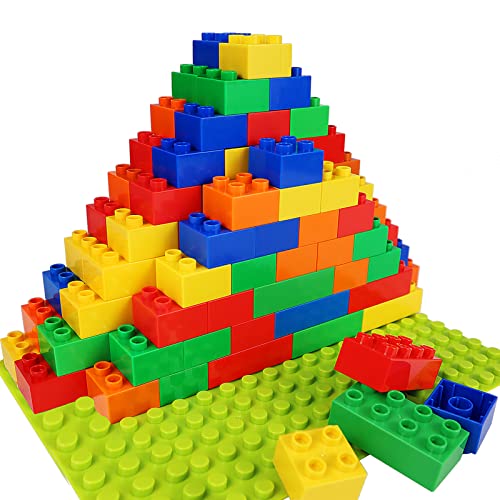
The aotipol 101-piece set emphasizes large, easy-to-fit pieces that click together firmly for years of use. A baseplate expands play options, enabling organized displays and complex structures. The bricks are sized to reduce choking hazards and are compatible with other major brands, making it simple to mix and match with existing collections. This set is suitable for kids aged 2–4, supporting early construction play and foundational STEM skills such as spatial awareness and hand-eye coordination.
LEGO Classic Large Creative Brick Box 10698

LEGO’s Classic Brick Box provides a broad color palette and a selection of specialized pieces, including windows, doors, baseplates, and wheels. This set encourages pretend play and storytelling, enabling kids to construct houses, vehicles, and imaginative creations. The inclusion of color variety and accessory pieces supports color and shape recognition while fostering repetition as kids recreate familiar scenes or invent new ones. It’s a versatile option for home use or classroom centers.
Building Blocks for Toddlers 150 Piece Set

This 150-piece set by aotipol offers a wide assortment of colors and shapes, including large 2×2 and 2×4 blocks along with curved pieces, all built on a sturdy baseplate. The sizable blocks promote early engineering concepts like balance and structural integrity, while the varied shapes help children explore geometry and spatial reasoning. The materials emphasize safety and long-lasting use, with smooth edges and tight-fitting connections that remain intact after repeated play.
Bankers Box at Play Cardboard Blocks

Though listed here as a broader option, Bankers Box at Play offers a durable 40-pack set with a mix of large and medium blocks. The blocks are designed for collaborative building—titting tall towers or expansive forts while withstanding active play. Their lightweight yet sturdy construction supports constructive play in family rooms, daycares, or classrooms, and the blocks’ size range helps children develop spatial planning and cooperative building skills.
Cartboatoy Cardboard Building Blocks 48-Pack

Cartboatoy offers a 48-pack set with multiple sizes and colors, designed to be light yet durable for rough play. Flat surfaces aid stacking, and the assortment supports balance and construction exploration for kids of various ages. The set’s simplicity makes it a strong option for quick setup in classrooms or playrooms, encouraging teamwork and sequential problem-solving as children build together.
Buying Guide: Key Considerations And Comparisons
- Material and safety: Cardboard blocks are lightweight and great for indoor use, while plastic sets tend to be more durable and reusable. Look for non-toxic materials, rounded edges, and choking-hazard considerations for younger children.
- Age appropriateness: Larger blocks with simple shapes suit toddlers and preschoolers, while smaller bricks and more complex sets support elementary and imaginative play. Consider the age range indicated by each product.
- Durability and reuse: Cardboard blocks are eco-friendly and easy to store but may wear faster with heavy use. Plastic or LEGO-compatible bricks offer longer lifespans but can be heavier and more expensive.
- Open-ended play vs. guided play: Sets with creative prompts (like LEGO or bases for structures) support storytelling and role-play, while pure building blocks emphasize spatial reasoning and motor skills.
- Compatibility and expansion: If you already own a brick system, choose sets that are compatible with major brands to allow expansion and mix-and-match possibilities.
- Storage and setup: Consider how easily the blocks store and how quickly you can set up play tables or centers. Baseplates and organized boxes add efficiency for classrooms and busy households.
- Group play and shared activities: Some sets are better suited for group challenges (like building a structure together or timed tasks), while others are ideal for individual creativity or one-on-one play.
In choosing among these options, consider the child’s age, play style, and the setting where play will occur. Cardboard sets excel in light, imaginative play and quick setup, while LEGO-compatible and larger block sets offer long-term versatility and deeper construction opportunities. A mixed collection—one cardboard set for quick play and a LEGO-compatible option for extended projects—often provides the best balance of accessibility and challenge for families and classrooms.