Best Rock Kits for Kids: Top Geology Sets for Young Scientists
Discover engaging rock kits that spark curiosity in budding geologists. The selections below span from geode cracking to gemstone digs, offering hands-on learning, real specimens, and age-appropriate challenges. Each kit provides learning guides, excavation tools, and storage solutions to build a kid-friendly rock collection at home or in the classroom.
| Product | Brand | Highlights |
|---|---|---|
| National Geographic Rock Collection Box for Kids | National Geographic | 300+ specimens, geodes, learning guide |
| National Geographic Gemstone Dig Kit | Blue Marble | 10 real gems, excavation tools, magnifier |
| National Geographic Rocks & Mineral Collection | Blue Marble | 15 specimens, storage box, learning guide |
| NATIONAL GEOGRAPHIC Mega Gemstone Dig Kit | Blue Marble | 15 gemstones, chisel, brush, magnifier |
| Dan&Darci Rock Collection for Kids | Dan&Darci | 250+ rocks, fossils, learning mat |
Rock Collection Box For Kids From National Geographic

The National Geographic Rock Collection Box offers a massive 300+ piece assortment of genuine rocks, minerals, and crystals from around the world. It comes with two premium geodes to crack open, revealing crystal interiors for a tangible geology experience. A full-color Learning Guide and a magnifying glass help kids identify minerals such as amethyst, pyrite, rose quartz, and tiger’s eye, fostering observation and best practices in rock science.
Gemstone Dig Kit From National Geographic

Kids excavate 10 real gemstones and crystals with a dedicated digging kit. An identification sheet helps learners quickly match each gem to its properties, while the included excavation tool, brush, and magnifying glass mimic a real geologist’s workflow. The kit blends hands-on digging with educational facts to deepen understanding of mineral forms and crystal growth.
Rocks & Minerals Collection From National Geographic
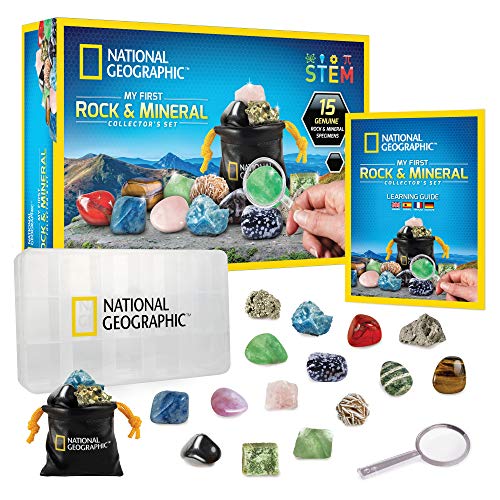
This 15-piece collection highlights a diverse set of rocks and minerals, including desert rose, tiger’s eye, red jasper, rose quartz, and pyrite. A clear storage box, a storage pouch, and a full-color learning guide accompany the specimens, enabling ongoing exploration and easy organization as kids build a personal geology library.
Mega Gemstone Dig Kit From National Geographic

The Mega Gemstone Dig Kit brings a broader gem hunting experience with 15 real gemstones and crystals. A complete learning activity includes a dig brick, a chisel, a brush, and a magnifying glass, turning excavation into an extended educational project. The kit emphasizes discovery, exploration, and the chance to assemble a personal gem collection.
Dan&Darci Rock Collection For Kids

This bulk collection contains 250+ rocks, minerals, gemstones, and fossils, designed for extended study and discovery. A jumbo learning mat helps kids compare findings to reference images, while a magnifying glass, fossil display case, and storage pouch support hands-on investigation and organized display of specimens.
Buying Guide: Rock Kits For Kids
- Age and skill level: Select kits with appropriate complexity, safety tools, and learning guides for the child’s age and curiosity.
- Number of pieces: Larger collections offer variety but may require more storage; smaller kits can be ideal for introductory exploration.
- Educational value: Look for learning guides, fact sheets, and activity ideas that align with school science topics like mineral identification and crystal formation.
- Tools and safety: Check for kid-friendly excavation tools, goggles, brushes, magnifiers, and sturdy storage boxes to encourage safe, repeatable use.
- Storage and organization: Kits with dedicated storage containers help keep specimens protected and the collection easy to expand over time.
- Authenticity and variety: Genuine crystals, minerals, and geodes provide authentic learning experiences; a mix of rock types supports broader geological understanding.
- Engagement beyond play: Consider kits that include experiments or projects (e.g., identifying minerals, charting growth) to build scientific thinking.
- Maintenance and care: Some kits require minimal upkeep (dry storage, gentle cleaning); others may need more care to preserve fragile specimens.
- Futureproofing: If a child shows sustained interest, choose kits that scale with additions or expansions to grow the collection.