Best Humanoid Robot Kits for Adults: Top Picks for Education, Hobbyists, and AI Experiments
For adults exploring robotics, humanoid and humanoid-inspired kits offer hands-on learning across programming, AI, and mechanical design. The following selections showcase a range of capabilities—from AI vision and voice interaction to advanced gait and inverse kinematics—so you can compare platforms, control methods, and assembly complexity. This guide highlights five kits that balance education with real-world applicability, helping enthusiasts build functional robotics projects at home or in a makerspace.
| Product | Brand | Key Feature |
|---|---|---|
| Tonybot Standard Kit | LewanSoul | ESP32-powered, AI vision, voice interaction, automatic stand-up |
| AiNex ROS Education Kit | HIWONDER | ROS-based, Raspberry Pi 5, inverse kinematics gait |
| AiNex 4GB ROS Education Kit | HIWONDER | ROS with Raspberry Pi 4B, advanced AI vision |
| Freenove Hexapod Kit | FREENOVE | Multi-legged walking platform with camera and sensors |
| Mecha MOC Building Kit | WANZPITS | Armed mech bricks, collectible display and play |
These selections offer a mix of ready-to-run robotics experiences and highly modular builds. They emphasize safety features, extensive tutorials, and community support—great for hobbyists delving into AI, computer vision, or automated motion. Each kit provides a different balance of hardware, software, and learning curves, enabling comparative analysis for future projects or gifts.
Tonybot: AI Vision & Voice Interaction Kit

This LewanSoul Tonybot kit centers on a high-performance humanoid design powered by an ESP32 microcontroller and intelligent servos. It supports different control modes via a companion app, enabling walking, dancing, kicking, and self-stand (stand-up) features. The 17 degrees of freedom offer expressive movement suitable for demonstrations, education, and basic robotics research. With three programming options—Arduino, Python, and Scratch—users of varying backgrounds can engage with AI learning and practical robotics use cases. The included AI vision and voice interaction module supports object recognition and voice-command-driven interactions, making it feasible to train the robot as an assistive or educational aid.
Key considerations:
– Hardware compatibility with common microcontrollers and software stacks (Arduino, Python, Scratch)
– AI features and voice-command capabilities for interactive projects
– Assembly complexity and maintenance for adult learners
AiNex ROS Education Humanoid Robot (Raspberry Pi 5)

HIWONDER’s AiNex ROS Education kit emphasizes ROS (Robot Operating System) integration on a Raspberry Pi 5/B 24-servo configuration and a movable mechanical hand. Its dual hip joint design supports improved gait and omnidirectional turning via inverse kinematics. The system supports multiple control pathways, including the WonderROS app (iOS/Android), a wireless controller, and PC software, which provides flexibility for researchers, educators, or hobbyists testing cross-platform control schemes. The advanced gait planning enables more natural movement, while the robust hardware supports experimental AI perception tasks.
Key considerations:
– ROS ecosystem familiarity and cross-platform control
– Inverse kinematics and gait flexibility for realistic humanoid motion
– Hardware expansion potential for labs and classrooms
AiNex 4GB ROS Education Humanoid Robot Kit
This variant expands on the AiNex platform with a Raspberry Pi 4B 4GB core, offering a deeper ROS-based environment and more memory for AI vision tasks. The kit maintains the 24-servo layout and HD camera, enabling more complex gesture emulation and object tracking. Its OpenCV-driven perception tools enable reliable vision-based interactions, including target recognition and tracking. The combination of ROS, expandable hardware, and robust software suites makes it suitable for more advanced students, researchers, and serious hobbyists seeking scalable AI experimentation.
Key considerations:
– More memory for concurrent AI processing
– Vision-based projects with OpenCV and ROS
– Suitability for advanced coursework or prototyping
Freenove Hexapod Robot Kit

The Freenove hexapod offers multi-legged locomotion, camera integration, and ultrasonic ranging for distance sensing. While not a humanoid, its 6-legged design provides exposure to kinematics, balance control, and multi-axis motion planning. The kit emphasizes offline Python programming and a strong tutorial library, with compatibility across several Raspberry Pi models (Pi 5/4B/3B+, etc.). Assembly is required, and Raspberry Pi is not included. This kit is valuable for learners exploring legged robotics, control algorithms, and sensor fusion in a hands-on way that complements humanoid projects.
Key considerations:
– Legged locomotion versus bipedal walking
– Sensor fusion and real-time control
– Suitable as a bridge between humanoid and non-humanoid robotics
Mecha Robot Building Kit (1883 Pieces)

This MOC-style mecha kit emphasizes modular assembly and JSON-guided electronic instructions, allowing builders to convert bricks into a visible humanoid-leaning armored frame. It appeals to adult model-builders and hobbyists who enjoy engineering challenges and display-worthy creations. While not autonomous, it fosters iterative design, mechanical customization, and fine-grained control in a brick-built platform. The sizeable piece count and durable ABS plastic provide long-term durability for enthusiast collections and tactile problem solving.
Key considerations:
– Brick-based construction with detailed build guides
– Emphasis on display value and mechanical customization
– Not an autonomous or programmable platform by default
Mecha Robot Building Kit (1603 Pieces)

Similar to the 1883-piece version, this MOC kit offers another scale of brick-based construction with a 1603-piece count. It emphasizes the same principles—creative MOC building blocks, armored mecha aesthetics, and guided assembly via electronic instructions. This option provides a compact yet detailed build path for adults who appreciate modular design and precision. It’s well-suited for display, gifting, or hobbyist milestones, though it remains non-autonomous without additional electronics.
Key considerations:
– Moderate piece count with robust build quality
– Suitable for collectors and hobbyists
– Non-autonomous, relies on manual assembly
ELEGOO Conqueror Robot Tank Kit
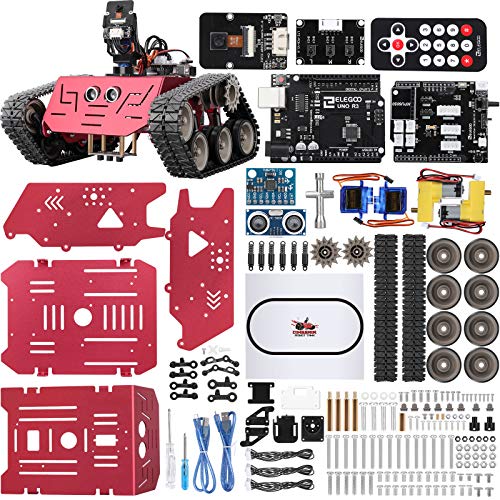
The ELEGOO Conqueror tank kit provides Arduino-based robotics development with a focus on hands-on coding and project-based learning. The kit emphasizes graphical programming and a range of car-like functions, which can complement humanoid projects by teaching essential control theory, sensor integration, and real-time debugging. It’s a practical starter kit for those transitioning from basic electronics to more complex robotic systems, suitable for classroom or home experimentation.
Key considerations:
– Arduino-centric hardware with broad resource library
– Graphical programming options to spark creativity
– Project-based learning for core robotics fundamentals
ACEBOTT Smart Robot Car Kit (8–12)

ACEBOTT’s kit integrates a 3MP camera for real-time streaming and supports Arduino and Scratch, making it approachable for beginners and seasoned learners alike. Although marketed toward kids and teens, the combination of a camera, app and remote control features means adults can leverage it for experiments in computer vision, IoT projects, and remote surveillance prototypes. It also provides a path toward more advanced robotic challenges, enabling expansion with additional sensors or robotic arms.
Key considerations:
– Real-time camera streaming for image processing projects
– Scratch and Arduino compatibility for progressive learning
– Extensible platform for STEAM-focused experiments
Buying Guide: Key Purchase Considerations And Comparisons
When selecting a humanoid or humanoid-inspired robot kit for adults, consider these dimensions to align with learning goals and project scope:
- Hardware core: Determine whether you want a Raspberry Pi-based system, ESP32, or Arduino-centric design. Raspberry Pi stacks generally offer richer AI and vision capabilities, while ESP32 and Arduino provide compact, low-power control.
- Motion and biomechanics: Evaluate the gait options and degrees of freedom. Inverse kinematics and multi-joint control yield more natural movement, which matters for realistic demonstrations and research.
- AI and vision: Look for kits with built-in AI vision, OpenCV compatibility, and object tracking. This accelerates perception-based projects and reduces setup time.
- Control options: Consider app-based control, PC software, wireless handheld controllers, and ROS compatibility. Cross-platform control increases flexibility for experiments and education.
- Community and tutorials: A robust library of tutorials, sample projects, and active user communities shorten learning curves and enable troubleshooting.
- Expandability: Check for compatibility with additional sensors, arms, or wheels. Scalable platforms support long-term growth and advanced experiments.
- Assembly and maintenance: Review instructions and required assembly effort. Some kits are plug-and-play, while others demand substantial building time and mechanical alignment.
- Safety and reliability: Look for components with clearly labeled safety guidelines and stable servo control to avoid damage during testing and demonstrations.
For educators and hobbyists, a balanced approach is to start with a ROS-based or AI-capable kit (like AiNex variants) to explore perception and control, and supplement with module-based kits (like Freenove hexapod or ACEBOTT) to practice concrete software-to-hardware integration. This combination supports progressive skill-building—from hardware basics to advanced motion planning and AI-driven interactions—while keeping options open for future upgrades or experiments.