Best Bilingual Toys for Toddlers: Dual Language Learning Tools for Young Minds
Parents and caregivers increasingly seek toys that support early bilingual development. This guide spotlights five engaging options designed for toddlers to build Spanish and English vocabulary through interactive play. From flash cards and books to touch-and-learn tablets and wall charts, these tools promote cognitive growth while keeping learning fun and developmentally appropriate.
| Product | Key Benefit |
|---|---|
| Airbition Bilingual Flash Cards | Two-language exposure with clear voice guidance |
| LeapFrog 100 Words Book (Frustration Free) | Over 100 words with interactive sound effects |
| PLAY Bilingual Learning Tablet | Interactive quizzes and language practice |
| AHJ Bilingual Flash Cards | 112 double-sided cards with 224 words |
| Gufino Alphabet Wall Chart | Touch-enabled alphabet learning at a glance |
Airbition Bilingual Flash Cards For Toddlers

Airbition’s bilingual flash cards are designed to introduce Spanish and English simultaneously, fostering appreciation for diverse cultures. The cards cover a range of topics—numbers, shapes, colors, animals, transportation, and more—supporting early cognitive development. A clear voice with a standard American accent guides children through the content, helping pronunciation and listening skills in both languages. Suitable for toddlers in the 1-3 age range, these cards encourage interactive, independent exploration as part of a language-rich routine.
LeapFrog 100 Words Book (Frustration Free)
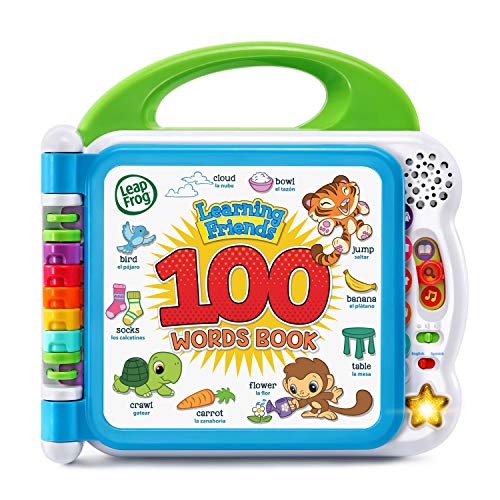
This LeapFrog book introduces more than 100 words through interactive features. Organized into kid-friendly categories such as pets, animals, food, colors, and activities, the book uses touch-activated words to trigger sounds, vibrations, and light-up cues. Children explore vocabulary with a playful, story-like interface, while parents can rely on expert-selected content to align with early literacy goals. The Frustration Free packaging emphasizes a simple, frustration-free unboxing experience.
PLAY Spanish & English Learning Tablet

The PLAY bilingual learning tablet offers a structured path through the alphabet, words, colors, and shapes in both Spanish and English. Designed for toddlers 18 months and up, it features larger buttons, soothing visuals, and kid-friendly content designed to support early literacy, memory, and logic skills. The tablet’s quizzes and interactive elements help engage children in a self-guided learning journey while reinforcing vocabulary in both languages.
AHJ Spanish & English Talking Flash Cards

AHJ’s talking flash cards provide a robust set of 224 words across topics like animals, transportation, food, and people. The device reads words aloud in both English and Spanish, with three audio modes that allow switching between language blends. This tool is suitable for early phonological development and speech therapy contexts, offering a portable, engaging way to practice bilingual vocabulary. The system requires proper card insertion to function, and it supports a broader classroom or home learning setup with visual and auditory cues.
Gufino Alphabet Wall Chart

The Gufino alphabet wall chart combines bilingual exposure with interactive touch buttons for independent and guided learning. This visual poster supports preschool activities, homeschool settings, and Spanish classroom routines. The touch-responsive features promote cognitive flexibility, memory retention, and letter recognition in a bilingual context. The poster’s design emphasizes smooth interaction, reducing potential frustration and encouraging consistent practice with letters and sounds.
Buying Guide: Key Considerations For Choosing Bilingual Toys
- Language balance: Look for tools that provide strong exposure to both languages—English and Spanish—through audio, visuals, and interactive prompts.
- Age appropriateness: Confirm the product is designed for toddlers (roughly 1-3 years) or early preschoolers to align with motor and cognitive milestones.
- Mode options: Devices offering multiple modes (e.g., bilingual, all-English, all-Spanish) support progressive learning and tailoring to child needs.
- Educational content: Prioritize materials with categorized vocabulary (animals, colors, numbers, transport) and real-life relevance to foster practical language use.
- Interactivity and engagement: Buttons, touch responses, audible feedback, and visual cues sustain attention and encourage longer learning sessions.
- Durability and safety: Choose sturdy, child-safe materials with rounded edges and non-toxic finishes; check for small parts if the child is younger.
- Portability: Consider compact, travel-friendly options for learning on the go, especially for flash cards and handheld devices.
- Adaptability: Some tools can be used in multiple settings (home, classroom, therapy), providing consistent bilingual exposure across environments.
- Parental controls and guidance: Look for features that allow parents to monitor progress, set difficulty levels, and align with developmental goals.
- Price-to-value: Evaluate long-term value beyond initial price—durability, content breadth, and the potential for continued learning as language skills grow.
These considerations help ensure that a chosen toy not only introduces bilingual vocabulary but also supports ongoing cognitive development, fine motor skills, and early literacy in a structured, enjoyable way.