Best 3D Printers for Teens: Fun, Safe, and Educational Choices
Finding the right 3D printer for teens combines safety, ease of use, and robust features for learning projects. The following selections emphasize beginner-friendly setups, classroom-friendly reliability, and growing capabilities for creative teens. Each option supports mild guidance at home or in school and offers features that help young makers explore design, prototyping, and hands-on learning. This guide compares five teen-focused printers to help caregivers choose with confidence.
| Product | Brand | Key Benefit |
|---|---|---|
| 3D Printers Tina2 Basic | Entina | Fully assembled, auto leveling for easy setup |
| FLASHFORGE Adventurer 5M | FLASHFORGE | One-click auto leveling, high-speed coreXY design |
| Fully Assembled Mini 3D Printer | Asani | All-in-one starter kit with auto leveling and dual Z-axis |
| TRONXY Crux 1S | TRONXY | Mini, beginner-friendly with quick assembly |
| Bambu Lab A1 Mini | BAMBULAB | Multi-color printing, full auto calibration, quiet operation |
3D Printers Tina2 Basic By Entina

The Tina2 Basic is a compact, fully assembled 3D printer designed for beginners and kids. It arrives ready to use, with a 2.4″ LCD screen and offline printing via MicroSD. It supports resume printing after power outages and offers a removable magnetic platform for easy model removal. Build volume is 100x105x100mm, making it ideal for small school and home projects. The included model on its TF card helps new users start quickly.
FLASHFORGE Adventurer 5M 3D Printer

The Adventurer 5M delivers hassle-free printing with one-click automatic bed leveling for flawless first layers. Its CoreXY all-metal structure supports high-speed operations up to 600mm/s travel and 20000mm/s² acceleration, enabling rapid prototyping. A 280°C direct extruder with a 3S detachable nozzle ensures versatility for a range of materials. Quick nozzle changes, a high-flow nozzle, and fast warm-up contribute to efficient classroom or home projects. Dual-sided PEI platform aids easy part removal.
Fully Assembled Mini 3D Printer For Kids And Beginners

This fully assembled mini printer is a complete starter kit for kids and beginners, including a mini printer, 10 meters of PLA filament, a microSD card pre-loaded with designs, and essential accessories. The compact footprint (8.3” x 8.3” x 11.4”) suits home, classroom, and dorm use, delivering reliable, high-quality prints. It features auto leveling and a dual Z-axis rail for improved precision, along with a 2.4” LCD screen and a flexible magnetic build plate for easy model removal.
TRONXY Crux 1S High-Speed Mini 3D Printer
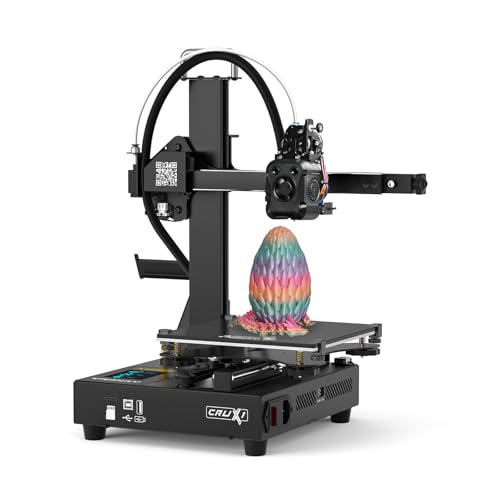
The Crux 1S targets beginners and teens with a compact 180x180x180mm build size and a user-friendly interface. It emphasizes speed, offering up to 300mm/s printing and a quick assembly process. A pre-installed focus on ease of use makes it a practical choice for teens exploring design ideas, art projects, and simple mechanical prototypes. The 0.4mm nozzle provides a reliable balance of speed and detail for school tasks.
Bambu Lab A1 Mini 3D Printer

The Bambu Lab A1 Mini combines high-speed precision with smart automation. It offers full auto calibration and area-wide compensation for consistent prints. Multi-color printing via AMS lite expands creative possibilities, while quiet operation keeps environments conducive to study. Acceleration reaches 10,000 mm/s², enabling fast turnarounds on projects and assignments, with reliable results in a compact package suitable for teens in both home and classroom settings.
Buying Guide
Choosing a 3D printer for teens involves balancing safety, ease of use, and growth potential. Consider these factors when evaluating options:
- Ease of setup and use: Look for models that are fully assembled or have robust auto-leveling, straightforward interfaces, and offline printing options to minimize complexity.
- Build volume: Teens typically benefit from a modest build area for school projects, art pieces, and prototypes. Start with a printer in the 100–180 mm range.
- Material compatibility: PLA is beginner-friendly and safer for home use. Check if the printer supports PLA and other kid-friendly filaments, and whether it can handle basic PETG or ABS with supervision.
- Safety features: Enclosed or semi-enclosed designs, power-loss resume, and low-temperature extruders are helpful safety measures for younger users.
- Maintenance and support: A reliable customer support channel, clear manuals, and readily available replacement parts reduce downtime and frustration.
- Software and education resources: Access to beginner-friendly slicers, starter projects, and design tutorials can accelerate learning and engagement.
- Noise and footprint: Quiet operation and a compact footprint are valuable for shared spaces like classrooms or bedrooms.
- Future-proofing: A printer with auto calibration, reliable bed leveling, and easy upgrades helps accommodate more complex projects as teens gain experience.
When comparing the five picks, these teen-focused options emphasize safe handling, quick learning curves, and the potential to grow into more advanced design and prototyping tasks as skills develop. Consider your teen’s interests—art, engineering, or STEM exploration—and choose a unit that aligns with those goals while providing room to expand capabilities over time.