Best Counting Cubes for Math: Top Manipulatives to Boost Early Math Skills
Counting cubes, also known as linking cubes, offer a hands-on way to develop core math skills for young learners. This guide highlights five leading sets that support counting, sorting, patterning, and basic operations. Each product page covers key features and how they can fit into classroom or homeschool activities. Use these manipulatives to build number sense, eye-hand coordination, and mathematical confidence from preschool through early elementary years.
style=”font-weight:bold;”>Summary: Chosen Counting Cube Sets
| Product | Brand | Colors / Count | Key Benefits |
|---|---|---|---|
| MathLink Cubes — Set Of 100 | Learning Resources | 100 cubes, 10 colors | One-to-one counting, number sense, basic operations, graphing |
| MathLink Cubes Big Builders | Learning Resources | 200 cubes, 10 colors | Patterning, counting, sorting, STEM play |
| Math Linking Cubes — SpriteGru | SpriteGru | 100 cubes, 10 colors | Counting, sorting, place value, early STEM |
| edxeducation Math Cubes (100) | edxeducation | 100 cubes, 5 shapes, 10 colors | Shape sorting, color coding, counting |
| QUYSK 300 Pcs Linking Cubes | QUYSK | 300 cubes, 10 colors | Large set for complex patterns, storage included |
Below you’ll find five product sections detailing each counting cube set, followed by a buying guide to help compare options and choose the right set for different learning contexts.
Learning Resources MathLink Cubes — 100 Count

The 100-count MathLink Cubes from Learning Resources provide a versatile base for early math skills. Children practice one-to-one counting, counting to 100, skip counting, comparing quantities, and basic addition and subtraction. The cubes also support color and shape identification, patterning, and graphing activities. With durable construction and snap-together sides, students can build patterns, ten-frames, and simple constructions to visualize math concepts. This set is suitable for classrooms, homeschooling, and teacher-led activities, promoting school readiness and hands-on exploration of counting and operations.
Learning Resources MathLink Cubes Big Builders

Big Builders expands the classic counting cubes with 200 cubes in ten vibrant colors. These versatile linking blocks help children practice counting, sorting, and patterning while enabling more advanced constructions. The included activity guide supports教師-led lessons and independent play, encouraging creativity and imaginative games. The set is particularly effective for STEM-focused activities, spatial reasoning, and early engineering concepts as learners plan, build, and test different configurations.
SpriteGru Math Linking Cubes

SpriteGru offers a 100-piece set in ten colors, designed to engage early learners in counting, sorting, and basic arithmetic. The color-coded cubes help children visualize quantities, place value, and simple equations. They are easy to link and pull apart, supporting fine motor development while enabling imaginative constructions such as names or simple machines. The versatility supports preschool, kindergarten, homeschooling, and classroom activities with a focus on foundational math concepts.
edxeducation Math Cubes (100) Set

The edxeducation set features 100 counting cubes with five geometric shapes on their sides to inspire shape-sorting activities alongside counting. The design emphasizes a soft click connection and easy separation, supporting fine motor skills and classroom-friendly use. With ten colors, students can create patterns and color-coded groupings to explore addition, subtraction, and early patterning in engaging ways. The durable plastic construction is well-suited for frequent classroom or homeschool use.
QUYSK 300 Pcs Linking Cubes
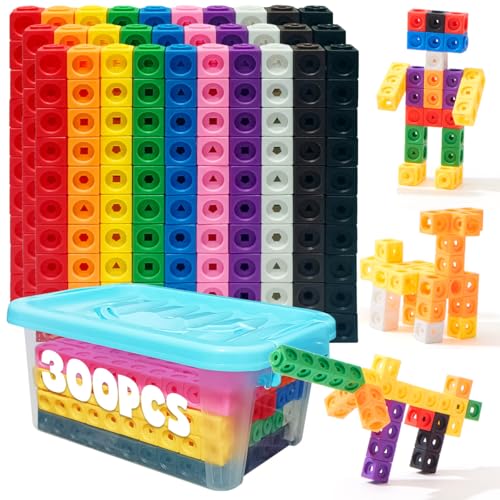
QUYSK offers a large 300-cube set with ten colors and a bundled storage box for easy organization. This multi-pack supports extensive pattern building, advanced counting activities, and more complex constructions such as robots or windmills. The size makes it suitable for small group activities or classrooms that require multiple centers working with math manipulatives. The set promotes fine motor development, spatial reasoning, and creative problem-solving in STEM contexts while keeping materials neatly stored between sessions.
Buying Guide
Key factors to consider when selecting counting cubes include quantity, color variety, connect-and-build reliability, and age suitability. For younger learners, sets with 100 cubes and a simple 10-color palette typically balance engagement with manageability. For classrooms or homeschooling environments with higher activity levels, larger sets (200–300 cubes) provide more flexibility for group work and extended activities.
– Count and color coding: Multi-color cubes help differentiate groups, place value, and color-based sorting.
– Durability and feel: Look for thick plastic with smooth edges and secure connections to withstand frequent use.
– Shape variety: Some sets include additional shapes or cutouts on cube sides to support patterning and geometry activities.
– Storage and portability: A sturdy storage box or bin keeps cubes organized and portable for classroom centers or home use.
– Included guidance: Activity guides or lesson ideas can help teachers and parents maximize learning outcomes and structure sessions.
In choosing the right set, consider the learning goals (counting to 100, patterning, basic arithmetic, or place value), the number of students, and the space available for hands-on activities. All five featured options support a developmentally appropriate approach to math through tactile exploration and constructive play.