Best Building Kits for 13 Year Olds: Solar Robots, STEM Sets and More
Choosing the right building kit for a 13-year-old involves balancing challenge, educational value, and hands-on fun. The following selections emphasize STEM learning, solar-powered play, and engaging robotics projects that suit preteen interests. Each kit encourages problem-solving, mechanical skills, and curiosity about how things work—without requiring screens for every activity.
Summary of chosen products:
| Product | Brand | Key Benefit | Pieces / Scope |
|---|---|---|---|
| Lucky Doug Solar Power Kits | Lucky Doug | 12-in-1 solar robot projects with sunlight-powered play | 12+ projects, solar powered |
| Henoda Robot Toys | Henoda | 468+ pieces, remote/app control, multiple modes | Remote/app control, 4 modes |
| Sillbird 12-in-1 Solar Robot Kit | Sillbird | Solar-powered robotics with outdoor versatility | 12+ projects, sun-powered |
| Cheffun 5-in-1 RC Robot Kit | Cheffun | Five robot models with simple remote control | 5 models, 2.4GHz RC |
| Lucky Doug 12-in-1 STEM Solar Robot Kit | Lucky Doug | Advanced solar robot builds with robust parts | 12+ projects, solar powered |
These selections emphasize hands-on building, solar energy concepts, and programmable features that challenge a 13-year-old’s growing skills. Each kit is designed to be explored with family or friends, offering clear instructions and scalable difficulty to match advancing abilities.
Lucky Doug Solar Power Kits: 12-in-1 STEM Robot Kit
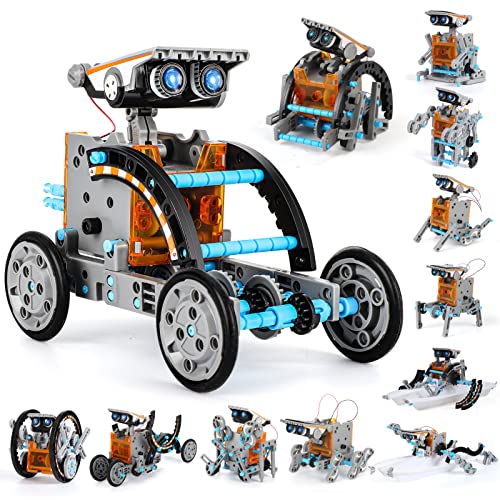
Powered by the sun, this Lucky Doug kit teaches renewable energy concepts while offering multiple robots in one set. The 12+ build options help kids understand how different mechanisms translate solar energy into movement, sound, and almost every motion a basic rover or creature might need. Clear instructions support independent assembly, with parents encouraged to join for the first build to reinforce learning goals. With disassembly-friendly parts, repeat builds reinforce memory, planning, and following schematic steps.
Key features include: 12-in-1 STEM robot configurations, solar-powered operation without batteries, and straightforward assembly guidance. The kit’s emphasis on solar energy introduces basic environmental science alongside engineering challenges. For 13-year-olds exploring early robotics, this set provides a solid foundation in mechanism design and energy conversion while encouraging hands-on experimentation.
Henoda Robot Toys For Older Kids: APP & Remote Control
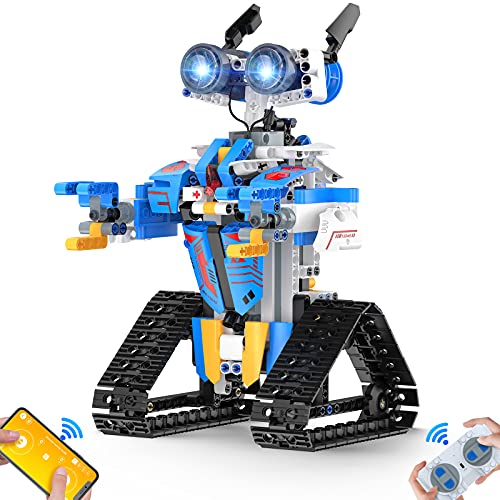
This Henoda kit combines 468+ construction pieces with multiple control methods, including a smartphone app and a 2.4 GHz remote. It encourages kids to design, build, and program robotic moves, including multi-directional movement and 360-degree rotation. The diverse control options support different play styles and learning paces, from straightforward manual operation to more complex app-based programming. The model’s modular design supports experimentation with stability, balance, and steering, fostering engineering intuition.
Important considerations include compatibility with mobile devices, the reliability of Bluetooth connectivity, and the durability of moving joints. It’s suitable for ages 8 and up, but older tweens may appreciate the higher piece count and advanced control features. The kit’s interactive modes promote problem-solving, spatial reasoning, and motor skills, while encouraging collaborative play between siblings or friends.
Sillbird 12-in-1 Solar Robot Kit
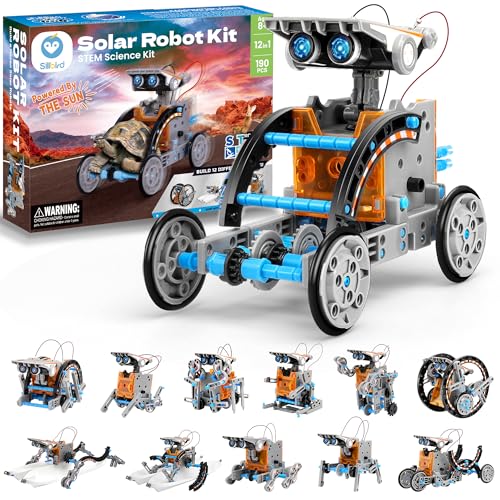
The Sillbird kit centers on solar-powered robotics with a strong emphasis on outdoor play. With 190 pieces, it offers multiple build options that teach basic engineering concepts, energy conversion, and problem-solving. The sun-powered operation allows extended outdoor sessions, while assembly teaches planning, sequencing, and precision with small components. The kit’s solar approach also aligns with environmental science topics by illustrating renewable energy in action.
For 13-year-olds, this kit balances challenge and accessibility, offering enough complexity to stay engaging without overwhelming younger builders. Clear instructions, a focus on hands-on experimentation, and the opportunity to explore how sunlight translates into motion make it a practical addition to any young maker’s toolkit.
Cheffun 5-in-1 Remote Control Robot Kit

The Cheffun kit challenges builders with five distinct robot models that transform to match different play scenarios. A 2.4 GHz remote controller provides stable signals and immediate feedback, reducing the need for programming knowledge. With 724 high-quality pieces, the set emphasizes durability and safe construction. This kit supports creative play while teaching mechanical concepts like gearing, leverage, and joint articulation. Parents can guide the initial builds to reinforce reading comprehension and measurement skills.
Key points include versatile model options, straightforward remote control, and robust parts. It’s well-suited for a 13-year-old who enjoys speed, action, and experimentation with robotics without requiring coding. The range of models supports varied interests, from mechanical dinosaurs to aircraft, encouraging imaginative scenarios alongside engineering practice.
Lucky Doug 12-in-1 STEM Solar Robot Kit

This Lucky Doug option offers 12+ solar-powered robot configurations in one kit, expanding the scope beyond basic movement to more complex mechanisms. It emphasizes solar energy and renewable resources, reinforcing science concepts while the disassembly-friendly parts support iterative building. Clear, parent-friendly instructions help families work together on the first build, making it an excellent choice for shared learning experiences and introducing iterative design thinking.
Considerations for this kit include the breadth of project options, the durability of components under outdoor use, and how easily a child can follow the assembly steps. For older tweens, this kit provides a broad platform to explore mechanical design, geometry, and energy flow through a variety of robot configurations, sustaining interest across several weeks of projects.
Buying Guide: Key Purchase Considerations And Comparisons
When selecting a building kit for a 13-year-old, consider the following factors:
- Complexity and learning curve: Choose kits with multiple models or stages to match growing skills. Look for clear instructions and optional extensions to avoid frustration.
- Energy source: Solar-powered sets teach renewable energy concepts and offer outdoor play benefits, but check for indoor lighting options or battery compatibility if weather is inconsistent.
- Durability and safety: Quality materials and sturdy joints ensure lasting use. Check age recommendations and supervision needs for the youngest in the target group.
- Programming and control: Some kits include remote controls or app-based control. Consider what fits the recipient’s interest—hands-on assembly vs. coding or app interactions.
- Educational depth: Look for kits that cover principles such as mechanics, geometry, energy conversion, and problem-solving strategies beyond simple assembly.
Buying considerations also include value for time versus payoff in learning outcomes. Kits with modular parts and clear progression help maintain engagement longer, while those with interdisciplinary elements—engineering, science, and environmental topics—offer broader educational benefits. For families, kits that facilitate collaborative building encourage communication, teamwork, and critical thinking, reinforcing STEM skills in a practical, enjoyable way.