Best Balance Board for Toddlers: Safe, Fun Ways to Build Balance and Coordination
Parents and educators seek durable, engaging balance boards that help toddlers develop motor skills while encouraging imaginative play. This guide showcases five top options, highlighting how each board supports balance, coordination, and gross motor development in young children. The selections emphasize natural materials, kid-friendly designs, and versatility for indoor and outdoor use. Explore how these boards can become a staple in playrooms, classrooms, or family spaces, fostering active learning and healthy movement from early ages.
| Product | Brand | Key Benefit |
|---|---|---|
| Gentle Monster Wooden Wobble Balance Board, 35 Inch | Gentle Monster | Open-ended play and fitness potential for all ages |
| Siairo Wobble Balance Board | Siairo | Colorful design with versatile stand & wobble use |
| DaWikity Kids Balance Board | DaWikity Kids | Compact, durable, multi-use as rocker, bridge, and more |
| INFIDEZ Panda Balance Board | INFIDEZ | Kid-friendly panda design to motivate play |
| WALIKI Wood Balance Board | WALIKI | Classic wooden board for toddlers and kids |
Gentle Monster Wooden Wobble Balance Board
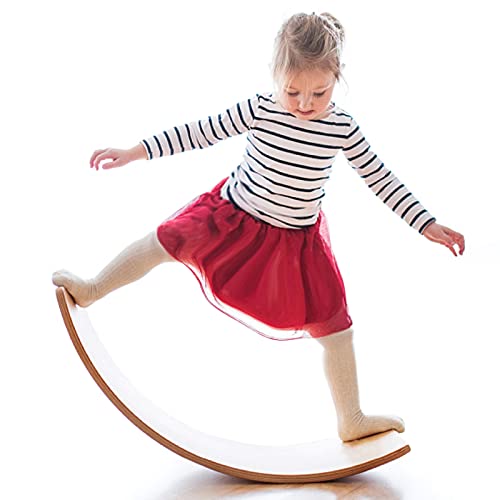
The Gentle Monster balance board offers a large 35-inch wooden rocker designed for open-ended play. Its natural wood finish and broad surface support a wide range of activities—from balancing and stretching to pretend play as a bridge or rocker. The design fosters vestibular development and posture awareness, benefiting both kids and adults who want a low-impact way to exercise or practice balance. The board’s versatility makes it suitable for classrooms, therapy spaces, and home playrooms, encouraging creative movement and fitness routines.
Siairo Wobble Balance Board

This wooden rocker features a playful monkey pattern and a sturdy stand-and-wobble design. It’s easy to clean and built to withstand active play indoors or outdoors. The board’s practical load distribution and minimal maintenance make it a reliable option for developing balance, coordination, and spatial awareness in toddlers. It supports barefoot or shoe-assisted use and offers a compact footprint for small play areas or classrooms.
DaWikity Kids Balance Board

DaWikity’s compact balance board emphasizes a curved, shorter profile for an optimal wobble that supports motor skill development and core strength. With a weight capacity up to 480 lbs, it accommodates both children and adults for family play. Beyond balance, the board doubles as a versatile trainer for exploration—serving as a rocker, bridge, book stand, or even a slide. Its wood construction highlights durability and eco-friendliness for long-term use in homes and classrooms.
INFIDEZ Panda Balance Board

The INFIDEZ Panda Balance Board features a cute panda design to attract kids to balance activities while promoting agility and coordination. Constructed from high-quality plywood, it is built to endure active play and provide long-lasting use. The panda motif adds an appealing visual element that encourages kids to explore balance through guided or self-directed activities, making it suitable for therapy settings, classrooms, or home play spaces.
WALIKI Wood Balance Board

The WALIKI balance board offers a classic wood design tailored for toddlers and children aged 3-8. Its dimensions and solid wood construction make it a reliable choice for developing gross motor skills, balance, and coordination. The simple, timeless design fits well into playrooms, early education settings, and homes seeking a durable, non-distracting balance activity that supports ongoing motor development.
Buying Guide: Key Considerations For Choosing A Toddler Balance Board
When selecting a balance board for toddlers, consider safety, durability, size, and versatility. A larger board can offer a wider wobble range and longer play sessions, but must fit your space. Look for non-slip surfaces, rounded edges, and sturdy supports to prevent slips or tipping during use. Weight capacity matters; boards that accommodate adults can be useful for family activities but ensure the design remains safe for younger children. Material choice matters: natural wood is durable and eco-friendly, while coatings should be child-safe and non-toxic. Finally, assess potential for imaginative play: boards that double as bridges, chairs, or mini stages encourage extended use and creative exploration in daily routines.
Safety tips include supervising toddlers during first use, starting on a flat, non-slip surface, and gradually introducing more challenging poses as balance improves. For classrooms, integrate balance boards into structured activities that target motor skills, coordination, and spatial awareness, while limiting continuous heavy use to prevent fatigue. Consider versatility: a board that transforms into a seating or climbing option can maximize play opportunities without cluttering space. In sum, the best balance boards combine durable construction, age-appropriate design, and wide play potential to support healthy development in toddlers.