Best Robot Toys for 9 Year Olds: Top Picks for STEM Fun and Creative Play
Finding the right robot toy for a 9-year-old means balancing learning with engaging play. The picks below cover programmable, remote-controlled, solar-powered, and gesture-sensing robots designed to boost STEM skills, imagination, and problem-solving. Each option here emphasizes hands-on building, programming, and interactive features suitable for children aged roughly 8–12. The goal is to spark curiosity, develop motor skills, and encourage experimentation without screens for extended periods.
Summary of selected products
| Product | Key Benefit | Age Range | Power/Control |
|---|---|---|---|
| Henoda Robot Toys | 468+ pieces; app or remote control; multi-mode learning | 8–16 | Bluetooth app + 2.4 GHz remote |
| SONOMO Toys | Gesture sensing with programmable actions | 6–9 | 2.4 GHz remote; gesture control |
| Ruko 1088 Smart Robots | Large, expressive, programmable with voice and app | 4–9 | App control + voice |
| KingsDragon RC Robot | Gesture control; 50 action modes | 3–8 | Infrared remote; gesture sensing |
| Lucky Doug Solar Power Kit | 12-in-1 solar robot kits; renewable-energy lessons | 8–13 | Solar power (sun) and batteries |
Henoda Robot Toys for 8-16 Year Olds
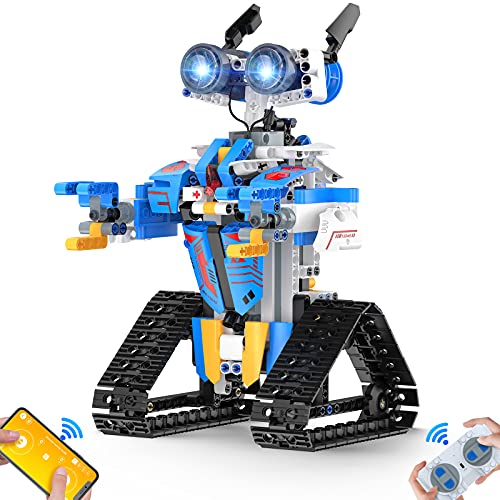
Henoda offers a 468+ piece STEM-building block set with transformative robot figures that move in multiple directions, including a 360-degree spin. This kit emphasizes manual dexterity and spatial reasoning as kids assemble components and customize expressions. It includes both remote control and app-based operation, broadening how a child can interact with the robot. The versatile features support guided learning and exploratory play, helping children practice problem solving while keeping engagement high.
Key features include intelligent motion, glowing eyes, flexible joints, and four control modes: app Bluetooth, remote control, voice control, and stem programming. The remote control distance can extend beyond 20 meters, which enables dynamic outdoor play or open-space demonstrations. Suitable for ages 8–16, it also serves as an appealing gift for birthdays or holidays, providing a scalable STEM experience as a child grows.
SONOMO Toys: Gesture-Sensing Programmable Robot
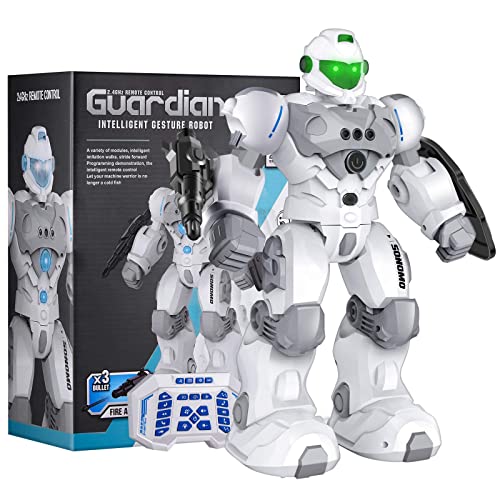
SONOMO’s robot targets early programming concepts paired with quick, engaging feedback. The device uses a 2.4GHz remote and also supports gesture sensing so kids can instruct the robot with hand motions. The robot can be programmed to perform sequences such as turning, sliding, and step movements, encouraging creative storytelling and planning. This model is well-suited to children who enjoy hands-on control and want to see immediate results from their instructions, blending physical interactivity with basic programming logic.
The toy emphasizes durability and approachable mechanics, making it a practical entry point into robotics. The combination of remote programming and gesture-based commands fosters experimentation and iterative learning, which is ideal for curious 9-year-olds who are ready to explore more structured sequences and longer action routines without overwhelming complexity.
Ruko 1088 Smart Robots for Kids

Ruko 1088 is a large programmable interactive robot designed to thrill children with expressive features and robust functions. Standing closer to 15.8 inches, it offers a strong visual presence and a range of activities, including storytelling, dancing, and music playback, in addition to basic programming. The robot supports app control, voice commands, and various pre-set expressions, helping kids explore logic, sequencing, and creative expression. Its multi-modal capabilities make it a compelling choice for families seeking a high-engagement STEM toy that grows with the child.
The robot’s inclusion of multiple expression types and songs adds a performing-art dimension to playtime, while the programming aspects introduce core computational thinking. This makes Ruko 1088 a well-rounded option for households emphasizing both entertainment and foundational coding concepts. It’s particularly suited for children who enjoy long-form play sessions and desire a more “robot companion” experience.
KingsDragon RC Robot: Gesture & Sensing

KingsDragon focuses on gesture and infrared remote control combined with a variety of action modes. The robot responds to hand gestures for movement—left, right, forward, and backward—while also offering an infrared remote for traditional control. An engaging feature is the ability to program up to 50 actions, which the robot can playback in sequence, building a kid’s ability to design and recall choreographed routines. The robust plastic build with multi-joint articulation supports a broad range of motion and experimentation, making it a resilient pick for active play and learning.
Additional features include light-up eyes and obstacle avoidance, enriching the robot’s interactive experience. This model suits learners who enjoy pattern creation, sequencing, and testing how small changes affect outcomes. It’s a strong choice for imaginative play that doubles as a practical introduction to robotics fundamentals such as control schemes, motion planning, and basic programming logic.
Lucky Doug Solar Power Kit
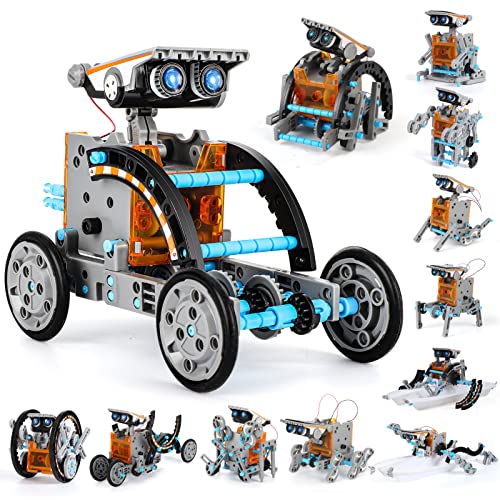
Lucky Doug’s solar-powered kit lets kids build and test more than a dozen distinct robots, all driven by sunlight. The 12-in-1 concept supports exploration of renewable energy concepts while fostering mechanical reasoning and creativity. Assembling solar-powered devices teaches basic engineering skills, including designing for energy transfer and motion. The kit is designed with clear instructions, which helps parents and children collaborate on the build, reinforcing teamwork and shared problem-solving skills.
Because the kit relies on solar energy, it naturally encourages outdoor experimentation and environmental awareness. It’s a practical choice for sunny days and a gateway to discussions about energy sources, efficiency, and real-world science principles. The versatility of the 12 different configurations ensures ongoing interest as children grow more confident in their building and testing capabilities.
Buying Guide: Key Considerations When Choosing a Robot Toy
- Age-appropriateness: Look for age ranges that start near 8 and extend into early teens to ensure challenges scale with skill level while staying approachable.
- Power and control: Decide between remote control, app-based control, gesture sensing, or solar power. Multi-mode options offer flexibility, while single-mode toys often keep the experience simpler.
- Programming complexity: Introductory linear programming is suitable for younger kids, while modular or branching programming supports deeper logical thinking as children grow.
- Mechanical durability: Check materials, joints, and build quality to withstand frequent handling by active kids and to ensure long-term use.
- Educational value: Favor toys that explicitly teach STEM concepts—circuitry, sensors, programming logic, energy transfer, and problem-solving strategies.
- Creative potential: Choose robots that enable customization, storytelling, or variable configurations to sustain curiosity and imaginative play.
- Safety: Ensure non-toxic materials, smooth edges, and compliance with safety standards appropriate for children in the target age group.
- Upgradability and support: Look for kits that offer replacement parts or additional modules, so the toy remains engaging as skills progress.
- Outdoor vs. indoor use: Solar-powered models work best in sunny outdoor spaces, while app-controlled or gesture-based units suit indoor environments.
Comparative highlights
- Gesture and app integration: Henoda and SONOMO provide multi-mode control, combining physical and digital interaction for broad appeal.
- Size and presence: Ruko 1088 offers a larger, more expressive presence, which can be compelling for kids who enjoy “robot companion” experiences.
- Programming depth: KingsDragon and Ruko3500-category styles emphasize action sequences and repeatable routines, supporting developing coding concepts.
- Energy source: Lucky Doug introduces renewable energy with solar power, offering an environmental learning angle.