Best Toys for Deaf Children: Engaging, Accessible Picks for Learning and Fun
Finding toys that engage deaf and hard-of-hearing kids while supporting communication, sensory exploration, and cognitive development is crucial. This guide highlights five carefully chosen products that emphasize visual cues, interactive features, and approachable learning tools. Each item below links to Amazon for easy checking, with images to help you preview style and function. The selections balance tactile play, sign language support, and screen-free options to suit diverse environments—from classrooms to home playrooms.
| Product | Brand | Key Benefit |
|---|---|---|
| ArtCreativity Light Up Transparent Sensory Car Toy | ArtCreativity | Engaging LEDs, music, and bump-and-go action |
| My Feelings and Emotions ASL Cards | Amonev | ASL visuals to support speech delay and deaf children |
| Hubble Bubble Kids ASL Cards | Hubble Bubble Kids | 180 beginner ASL signs with visual cues |
| Iabedi Busy Board | Iabedi | Tactile switches and LEDs for hands-on learning |
| TEKFUN LCD Writing Tablet | TEKFUN | Mess-free drawing and writing with visual feedback |
Each section that follows presents a practical, appealing option that can support communication, sensory exploration, and early learning in a way that resonates with deaf and hard-of-hearing children. All five selections are designed to be engaging without relying solely on spoken language, emphasizing visual, tactile, and interactive elements.
ArtCreativity Light Up Transparent Sensory Car Toy

This light-up car toy blends kinetic play with visual stimulation, offering a transparent plastic body that reveals moving gears. The unit features LED effects, music, and a bump-and-go mechanism that changes direction upon contact. For deaf children, the visual gears and LED cues provide immediate feedback and cause-and-effect understanding, while the multi-mode on/off control lets caregivers tailor play. The “learning through motion” design encourages curiosity about mechanical processes as gears spin in bright colors, reinforcing cause-and-effect sequences in a clear, manipulative manner.
Key features drawn from the listing include a three-mode power switch to manage lights, motion, and sound; automatic direction changes after obstacles; and engaging sensory gear movements. The toy is well-suited to small-group play or quiet solo sessions, offering a hands-on experience that supports visual tracking, motor planning, and early engineering concepts. Battery access and modular gears add to its longevity as a pocket-sized STEM starter.
My Feelings and Emotions ASL Cards
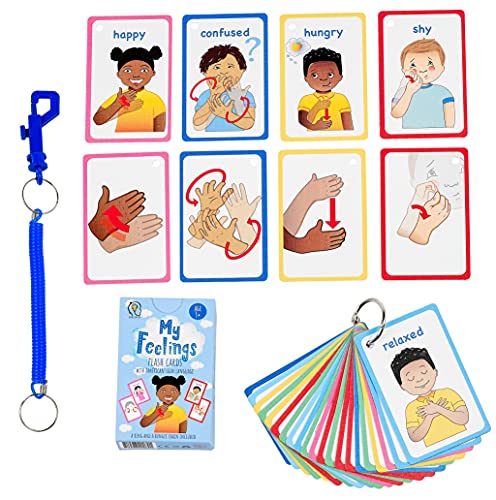
These ASL cards are designed to support speech delay and deaf children by pairing clear illustrations with simple, actionable cues. The set emphasizes language development through visual prompts, promoting empathy and social understanding in a format that’s easy to scan, sort, and reuse. Double-sided design provides two contexts: a focused close-up and a broader word-picture pair, making it simple to practice signs alongside spoken language or captions. This approach helps families and educators build foundational signing attention and turn-taking skills during interactive activities.
Designed for practical use, the cards reinforce key concepts like emotions, needs, and social scenarios, while supporting confidence-building through predictable visuals. They pair well with guided storytelling, role-play, or daily routines, giving children a reliable reference to express feelings and respond to others without relying solely on verbal cues. The cards are portable, durable, and adaptable for individual or group activities, making them a versatile learning tool for home schooling or classroom settings.
Hubble Bubble Kids ASL Cards for Beginners

This 180-card ASL set provides a broad foundation for beginners, covering common words and early vocabulary in American Sign Language. Each card presents a clear written cue on one side and an illustrated sign on the other, enabling visual learning and sign imitation in a structured format. The cards measure a comfortable 3 x 5 inches and are built from durable laminated cardstock, making them suitable for frequent handling in classroom, therapy, or home environments. They support quick reference during lessons and play-based learning, helping children build a portable library of signs and routines.
The cards’ comprehensive scope supports incremental learning—from basic signs to everyday terms—while offering a tactile, hands-on approach that aligns with many deaf learners’ preferences for visual cues. Classroom activities, matching games, and storytelling prompts are natural ways to incorporate this resource into daily practice, making sign language more approachable and engaging for young learners and their families.
Iabedi Busy Board

The Montessori-inspired Busy Board offers a tactile, multi-sensory experience that promotes fine motor skills, color recognition, and cause-and-effect understanding. With 10 separate switches and corresponding LED lights, children can explore different textures, colors, and light patterns in a compact, travel-friendly design. A master switch allows caregivers to power down all LEDs quickly, conserving energy and reducing overstimulation. The board’s portability makes it ideal for car trips or waiting rooms, and its open-ended nature supports independent exploration as well as guided activities.
Designed for early learners aged around one year and up, the Busy Board encourages hands-on problem solving, sequencing, and attention to detail. Before use, caregivers should provide basic guidance on switch operation and safety, ensuring age-appropriate supervision. The included notes suggest this tool can assist in developing tactile discrimination and hand-eye coordination, offering a practical, durable option for ongoing sensory play and learning in various settings.
Carson Dellosa American Sign Language Flash Cards

Carson Dellosa’s ASL flash cards provide a compact toolkit for introducing signing to kids aged four and up. The set includes 105 cards with double-sided signs, totaling 122 signs, along with a resource card for quick reference. The emphasis is on basic communication, numbers, alphabet letters, sight words, and everyday sign usage, making it suitable for classroom warm-ups, at-home practice, and early literacy activities. Cards feature rounded corners for easy sorting and flipping, supporting durable, repeated handling during learning games and role-play scenarios.
Educators and caregivers can leverage these cards to support early language development, social interaction, and collaborative play. The visual cues reinforce memory and recognition, while the signs themselves become practical tools for real-time communication during activities, prompting children to participate in conversations and classroom routines without requiring verbal emphasis.
Buying Guide: Key Considerations for Deaf-Accessible Toys
Choosing toys for deaf or hard-of-hearing children involves balancing visual, tactile, and cognitive elements. Consider the following factors to maximize learning, inclusion, and enjoyment:
- Visual Cues: Prioritize items with clear, labeled visuals, lights, or color-coded components to support comprehension and engagement without relying on spoken language.
- Sign Language Support: Include tools that expose or reinforce sign language, such as ASL flash cards, sign prompts, or interactive games that invite gesture-based participation.
- Motor and Fine Skills: Look for toys that encourage hand-eye coordination, finger dexterity, and spatial awareness, such as busy boards, manipulatives, and moving parts.
- Safety and Age Appropriateness: Check for durable materials, non-toxic finishes, and appropriate complexity for the child’s age and development level.
- Portability: For travel and classroom use, select compact, durable options that tolerate frequent handling and transport.
- Discrete Supervision: Some toys include small parts or electronics; ensure supervision aligns with the child’s age and setting.
- Multi-Sensory Balance: Combine visual, tactile, and auditory elements where appropriate, while recognizing that many deaf children benefit from visually oriented play.
- Durability and Longevity: Choose items that withstand repeated use, cleaning, and classroom or home environments to maximize long-term value.
In summary, the five selected products offer a spectrum of learning modalities—from sign language practice with ASL card sets to tactile exploration with busy boards, to visually engaging light-up toys. When assembled into a balanced play routine, these options can foster communication, motor skills, and social interaction in a way that aligns with the needs and preferences of deaf and hard-of-hearing children.