Best Telescopes for Adults to See Planets: Clear, Budget-Friendly Options
Exploring the planets requires a telescope with enough light-gathering power and straightforward setup. The following selections are tailored for adults who want sharp views of Mars, Jupiter, Saturn, and beyond without a steep learning curve. Each option balances aperture size, magnification versatility, ease of use, and portability, making them suitable for beginners and enthusiasts alike.
| Product | Brand | Aperture | Focal Length | |
|---|---|---|---|---|
| MEEZAA 90mm Refractor | MEEZAA | 90 mm | 800 mm | Multi-coated optics; includes AZ mount, phone adapter |
| Dianfan 90mm Refractor | Dianfan | 90 mm | 800 mm | Coated optics; versatile magnification; upright terrestrial viewing |
| ToyerBee 70mm Refractor | ToyerBee | 70 mm | 300 mm | Portable; 15X-150X; includes phone adapter and wireless remote |
| EACONN 80mm Refractor | EACONN | 80 mm | 600 mm | Rough adjustment with gimbal; included phone adapter |
| Dianfan 150EQ Reflector | Dianfan | 150 mm | 650 mm | German Equatorial Mount; 26X-130X; moon filter |
Note: The selections above focus on practical performance for planetary viewing, with considerations for ease-of-use, mounting options, and upgradable components. The list avoids high-end professional gear in favor of accessible, learning-friendly models that still deliver sharp planetary detail.
MEEZAA 90mm Refractor Telescope

The MEEZAA 90mm refractor combines a moderately large aperture with a forgiving focal length, helping observers capture brighter planetary views and brighter lunar details. Its fully multi-coated optics improve brightness and contrast, while the AZ mount supports straightforward aiming. The included 10 mm and 25 mm eyepieces, plus a 3X Barlow lens, provide a practical magnification range (32X–240X) suitable for lunar craters and planetary bands. A phone adapter enables easy image capture for sharing views with others. This setup is appropriate for adults starting their celestial journey and expanding into more detailed planetary observations.
Dianfan 90mm Portable Refractor

Dianfan’s 90mm refractor emphasizes bright, vivid planetary and lunar views through a fully coated 90 mm objective lens. With two eyepieces and a 3× Barlow lens, observers can reach higher magnifications (32X–240X) to examine lunar maria, craters, and planetary details. The 45° zenith diagonal provides upright images for terrestrial viewing as needed.Quick setup and intuitive focusing make this telescope friendly for beginners and families exploring the night sky together, yet it also satisfies adults seeking more detailed planetary observation.
ToyerBee 70mm Refractor

The ToyerBee 70mm model emphasizes portability without sacrificing planetary detail. A 70 mm aperture provides bright enough views of the Moon, planets, and star clusters under typical suburban skies. The kit includes two eyepieces (15X-150X range via 3X Barlow) and a phone adapter, plus a wireless remote for capturing moments at the eyepiece. An adjustable tripod supports comfortable viewing from various heights, making it convenient for adults and families who want to travel with their telescope.
EACONN 80mm Beginner Telescope

EACONN’s 80 mm telescope blends a larger aperture with a practical travel profile. The 80 mm objective gathers substantial light for brighter planetary views, while multi-coated optics improve contrast. Rough adjustment and a positioning gimbal help users track objects with ease, and the included finder scope accelerates alignment. A dedicated mobile phone adapter is provided to capture and share views. This model suits beginners who want a stable platform with straightforward manual controls for planetary and lunar observation.
Dianfan 150EQ Equatorial Telescope
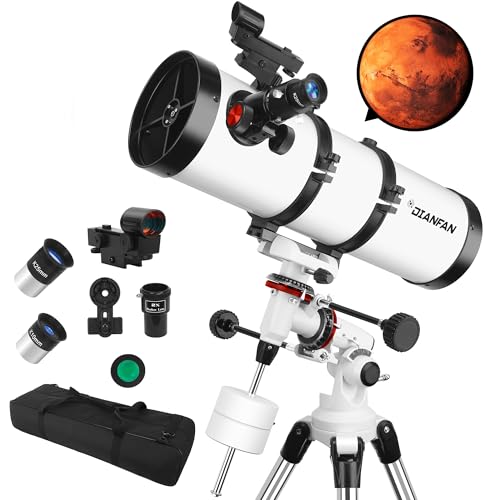
The 150EQ from Dianfan offers a larger 150 mm aperture and a 650 mm focal length, delivering stronger light gathering for planetary details and lunar textures. With two eyepieces and a 2× Barlow lens, magnification ranges from 26X to 130X, enabling detailed lunar and planet observations. The German-style equatorial mount provides smoother, slower tracking for precise aiming across the sky, supporting more serious planetary study while remaining approachable for beginners and families. A Moon filter helps manage glare during brighter observations.
Buying Guide: Key Purchase Considerations And Comparisons
When selecting a telescope for planetary viewing, consider these factors to match your goals and environment:
- Aperture size: Larger apertures gather more light, improving planetary details. For beginners, 70–90 mm is a practical starting point; 150 mm offers more detail but requires more setup and space.
- Optical quality and coatings: Fully multicoated optics improve brightness and contrast, especially important for faint planetary features and subtle bands on gas giants.
- Mount and stability: Alt-azimuth mounts are easy to use, while German equatorial mounts provide smoother tracking for longer observing sessions, advantageous for planetary scanning and alignment.
- Magnification range: Look for kits with 2 eyepieces plus a Barlow lens to cover a practical range (roughly 30X–130X or higher). Higher magnification helps on the Moon and planets, but image brightness and stability are critical.
- Portability and setup time: If you plan to travel or observe from varied locations, lighter setups with straightforward assembly are beneficial.
- Accessories: A sturdy tripod, a smartphone adapter for imaging, a finder scope for quick locating, and a moon filter for reduced glare during bright lunar observations add real value.
- Future-proofing: Some models include a rich accessory set or a compatible mount, allowing upgrades (new eyepieces, additional holders, or a more robust mount) as skills grow.
Depth of observing planets increases with practice and stable viewing conditions. For adults new to astronomy, starting with an 80–90 mm refractor or a compact 70–90 mm reflector provides a solid balance of brightness, ease of use, and affordability, making planetary details like Jupiter’s bands and Saturn’s rings accessible with modest equipment.