Best Wooden Calendars for Kids to Learn Seasons and Time
Finding a wooden calendar that engages children while teaching them about days, months, seasons, and time can boost early learning at home or in the classroom. The following selections combine durable wood construction, interactive pieces, and clear visuals to support hands-on, screen-free learning. Each option helps kids plan, predict, and discuss upcoming events, holidays, and weather, building essential executive skills in a fun, tactile way.
| Product | Brand | Notes |
|---|---|---|
| Blue Ginkgo Wooden Kids Calendar | BLUE GINKGO | Perpetual magnetic calendar with seasonal and holiday coins. |
| Melissa & Doug My First Daily Magnetic Calendar | Melissa & Doug | Classroom-style magnets for date, weather, and activities. |
| SkoolHQ Wooden Calendar for Kids | SkoolHQ | Solid wood calendar with moon-phase board included. |
| TOOKYLAND Kids Daily Calendar | TOOKYLAND | Wooden learning calendar with weather and time features. |
| Mondily Interactive Calendar for Kids Ages 3-8 | Mondily | All-in-one wooden calendar with extensive activity set. |
Blue Ginkgo Wooden Kids Calendar

The Blue Ginkgo calendar is designed as a durable, perpetual learning tool suitable for preschoolers and homeschool settings. Its magnetic components include days, months, seasons, and holiday coins, allowing repeated use without repainting or replacing pieces. The wooden construction provides a sturdy, tactile experience that supports fine motor development while inviting conversation about time concepts and seasonal changes. Teachers and parents can guide children to set up the calendar for each day, discuss upcoming holidays, and plan activities, reinforcing planning skills and vocabulary related to time and events. Its compact size makes it suitable for kitchen counters, desks, or classroom tables.
Melissa & Doug My First Daily Magnetic Calendar

This classroom-style calendar uses magnets to help kids update the date, weather, and daily activities, fostering routine and independence. The kit includes 80 magnetic pieces—covering years, months, days, holidays, and various emotions—plus two fabric dry-erase boards for easy storage and reuse. It supports language development as children describe weather and daily plans, while building time concepts through hands-on interaction. The magnets and boards encourage screen-free play and collaborative routines, making it a versatile choice for homes with multiple children or classroom use with small groups.
SkoolHQ Wooden Calendar for Kids
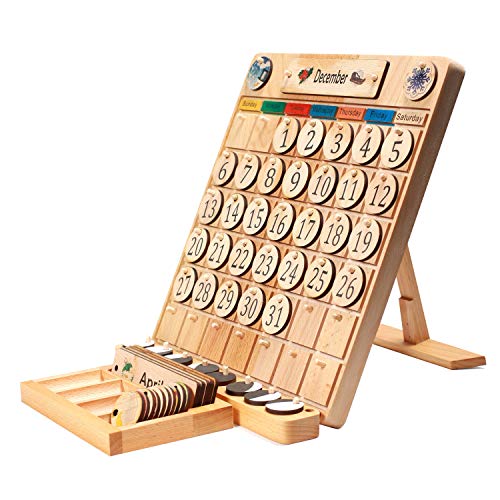
SkoolHQ presents a handcrafted wooden calendar that emphasizes family time and proactive learning. Includes a moon-phase board to explore cycles of the moon, enhancing space for discussion about time, astronomy, and daily routines. The calendar is built from solid maple or beech wood with a stand and wall-hanging hardware, offering flexibility for desks, shelves, or wall displays. It teaches days, dates, months, weather, holidays, and seasons through tactile pieces, supporting hands-on problem solving, memory, and communication skills in both home and classroom settings.
TOOKYLAND Kids Daily Calendar

TOOKYLAND offers a wooden calendar board that covers date, days of the week, month, weather, and time. Its design emphasizes hands-on learning with a rotating clock pointer and moveable sliders, promoting interactive dialogue about daily schedules and seasonal changes. The colorful, friendly visuals are intended to capture a child’s attention, while the durable construction provides long-term use in busy homes and classrooms. The calendar aids in developing time-telling skills and weather awareness, supporting early math concepts and social routines without screens.
Mondily Interactive Calendar for Kids Ages 3-8

This all-in-one wooden calendar supplies a broad learning toolkit for homes and classrooms. The set includes time cards, year, month, day, and season cards, plus weather, emotions, holidays, and activity cards. Materials come with a wooden storage box, stand, and bag for organization, making it easy to keep pieces accessible and tidy. Movable pieces support hands-on learning of calendar concepts, counting, and early literacy, while the included storage keeps contents contained between lessons. The comprehensive design helps educators and parents tailor circle time or independent work to individual learning goals.
The Peanutshell Learning Calendar Wall Chart

The Peanutshell calendar is designed as a pocket chart-style learning tool for circle time, classrooms, and homeschool settings. It supports teaching days, months, weather, and seasons with bright, easy-to-read labels. This option emphasizes accessibility and engagement for younger learners, helping build routines and time awareness. While not a wooden calendar, its visually intuitive layout makes it a practical addition for introductory calendar activities and daily check-ins within a busy classroom or family setting.
Buying Guide: Key Purchase Considerations And Comparisons
Material and build quality: Wooden calendars endure daily use and rough handling. Look for solid wood construction, smooth finishes, and safe, painted surfaces. Lightweight or composite pieces may wear quicker or break under repeated handling by young children.
Scope of learning: Consider whether the calendar covers dates, months, seasons, weather, holidays, time, and moon phases. An all-in-one system reduces clutter and keeps activities cohesive, while modular subsets let you scale learning to a child’s pace.
Interactivity: Magnetic pieces, rotating hands, pockets, and movable tiles support hands-on learning and fine motor development. Classrooms with multiple students benefit from larger, organized systems with clear labeling and storage.
Storage and portability: A stand, wall-mount option, and included storage bags or boxes help maintain order. Larger systems may require more space; compact designs fit smaller desks or kitchen counters.
Age appropriateness: Choose calendars with age-appropriate visuals, fonts, and colors. Simple, high-contrast designs work well for younger children, while more complex setups suit early elementary learners.
Educational goals: Align product features with your objectives—time-telling practice, vocabulary development, weather literacy, or holiday planning. A versatile calendar supports multiple disciplines, including math, language, science, and social-emotional learning.
Maintenance: Opt for pieces that are easy to clean and maintain. Magnetic or dry-erase components should be durable and resistant to frequent use, especially in busy environments.
Value and longevity: A higher upfront cost can be offset by longer use across multiple children and years. Perpetual calendars typically offer ongoing relevance, making them a solid long-term investment for families and classrooms.
Accessibility and inclusivity: Consider features that engage diverse learners, such as visual schedules, moon phases, or weather icons, which can support a range of cognitive and language development needs.