Best Telescopes for 5 Year Olds: Safe, Fun Space Toys
Choosing a child-friendly telescope can spark early curiosity about space while keeping viewing simple and enjoyable. The selections below emphasize durability, safe design for young users, and engaging features like built-in visuals or guided activities. Each option is suitable for a family setup, classroom play, or gifting a budding astronomer.
| Product | Brand | Key Feature |
|---|---|---|
| NASA Lunar Telescope for Kids | Blue Marble | Moon detail, finder scope, tabletop tripod |
| LeapFrog Magic Adventures Telescope | LeapFrog | 2.4″ video screen, NASA videos, 110x zoom |
| Gskyer 70mm Refractor | Gskyer | 70mm aperture, 400mm focal length, phone adapter |
| Little Experimenter Projector Telescope | Little Experimenter | Projection of 24 space images, 2x magnification |
| Luzsco 50mm Beginner Telescope | Luzsco | 20x–100x zoom, two eyepieces, Barlow option |
The following five options were selected for safety, ease of use, and engaging educational content. Each product section includes a brief overview, notable features, and how it supports early-interest astronomy for children around five years old.
NASA Lunar Telescope For Kids
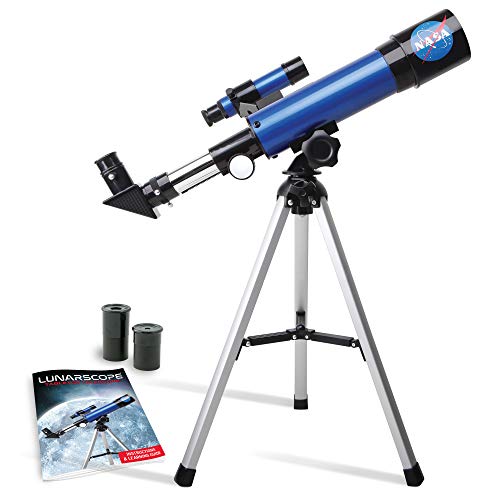
The NASA Lunar Telescope for Kids offers a gentle introduction to astronomy with a focus on lunar observation. It features high-quality optical glass and a finder scope to help children locate the Moon before zooming in for details. A tabletop tripod provides a stable viewing base, enabling smooth panning across the lunar surface. Its design is straightforward for younger users, encouraging repeat exploration while minimizing frustration. The combination of low- and high-power eyepieces helps young learners experiment with magnification in a safe, kid-friendly package.
LeapFrog Magic Adventures Telescope

The LeapFrog Magic Adventures Telescope combines real viewing capabilities with interactive learning. A built-in 2.4-inch video screen enables kids to view celestial scenes, while an adventure game pathway on a spacecraft reinforces engagement. With up to 110x zoom, children can admire lunar features or nearby landscape scenes during daylight. The accompanying NASA videos and images extend learning beyond just viewing, offering dynamic content that can sustain curiosity over time without requiring additional devices. This option blends play and education for a 5-year-old audience.
Gskyer 70mm Refractor Telescope

The Gskyer 70mm Refractor Telescope is positioned as a kid-friendly starter instrument with a larger aperture and a straightforward setup. Its 70mm objective and 400mm focal length yield brighter images, suitable for mounting on a simple tripod. The kit includes two eyepieces and a 3x Barlow lens to explore different magnification levels. A 5×24 finder scope with crosshair lines aids in locating objects, while a wireless remote and smartphone adapter expand opportunities for capturing sceneries through the eyepiece. This model supports hands-on learning and photography-inspired exploration for young observers.
Little Experimenter Projector Telescope
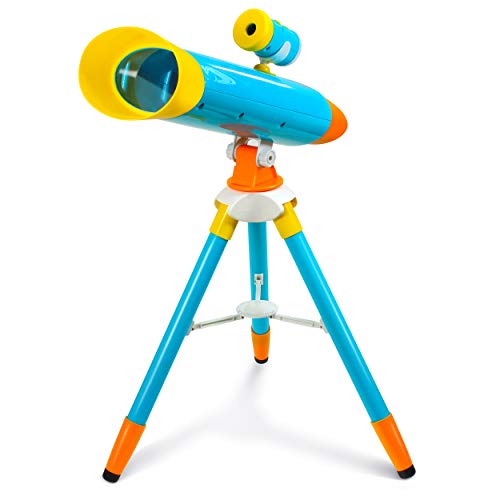
The Little Experimenter Projector Telescope merges a child-friendly telescope with space-themed projections. It projects 24 different space images onto a wall or ceiling, providing an engaging visual anchor for bedtime or quiet-time space exploration. With 2x magnification and a foldable tripod, this tool supports flexible viewing angles while keeping the experience playful. It is designed for durability and simple operation, making it suitable for early elementary ages who are just beginning to explore celestial concepts. The included educational content helps extend the experience beyond mere peering through an eyepiece.
Telescope For Kids 50mm 100x Magnification

The Luzsco 50mm Telescope provides adjustable magnification from 20x to 100x, a practical range for young stargazers learning to focus and refine their target. It includes a sturdy tripod, two eyepieces, and a Barlow lens option which introduces kids to the idea of magnification adjustment in a hands-on way. The multi-coated optics are designed to deliver clearer visuals, reducing distortion and making craters and stars easier to discern. This setup emphasizes portability and an approachable learning curve for children who are just starting to explore astronomy.
Buying Guide
When choosing a telescope for a five-year-old, several factors influence long-term enjoyment and safety:
- Age appropriateness: Look for designs labeled for younger children with simple assemblies and intuitive controls.
- Durability and safety: Durable plastic housings, shatter-resistant optics, and rounded edges support safe handling during active play.
- Ease of use: Quick-setups with clear guidance, a stable tripod or table-top base, and minimal configuration reduce frustration.
- Optics quality vs. simplicity: While advanced optics are not necessary, a few intentionally designed eyepieces or a finder aid can boost early success.
- Learning content: Some models pair viewing with educational content (NASA videos, space images), which can deepen engagement without extra devices.
- Portability and storage: Lightweight units with compact packaging are ideal for travel or classroom use.
- Future-proofing: A telescope that allows adding accessories (additional eyepieces, adapters) can grow with the child as their interest expands.
- Safety and supervision: Parents or guardians should supervise use, especially with small parts or while aiming at bright objects.
For families deciding among options, consider whether the child benefits more from guided content (as with the LeapFrog and projection-based models) or from traditional observing practice (as with the standard refractors and beginner kits). Durability and age-appropriate features are often more impactful than premium optics at this stage. If possible, select a model that emphasizes exploration, colorful visuals, and interactive learning to sustain curiosity over time.