Best Space Toys for 7 Year Olds: Fun, STEM, and Imagination
Discover top space-themed toys perfect for seven-year-olds, combining creative building, science exploration, and interactive play. This guide highlights five engaging options designed to spark curiosity about planets, rockets, and the universe while supporting early STEM skills. Each pick offers different styles of learning—construction, observation, and hands-on experiments—so kids can explore space in ways that match their interests.
| Product | Brand | Key Concept | Format |
|---|---|---|---|
| LEGO Creator 3 in 1 Space Robot Toy (31164) | LEGO | Multiple play models: robot, spaceship, or dog | Building Kit |
| LEGO Creator 3 in 1 Space Shuttle Toys (31134) | LEGO | Shuttle and astronaut variations | Building Kit |
| NASA Lunar Telescope | Blue Marble | Astronomy observation for beginners | Telescope |
| Solar System Felt Board (BONNYCO) | BONNYCO | Solar system exploration with felt pieces | Educational Felt Set |
| Skillmatics Guess In 10 NASA Space | Skillmatics | Space-themed card guessing game | Card Game |
LEGO Creator 3 in 1 Space Robot Toy

The LEGO Creator 3 in 1 Space Robot Toy (31164) offers three build options from the same bricks: a space robot, a space dog figure, and a space rocket. Designed for kids 8 and up, it emphasizes imaginative play as well as fine motor skills through adjustable limbs and joints. The model encourages kids to imagine storylines across space missions, with the robot featuring posable arms and a head that can spin, while the space dog has a rotating head and four movable legs. This versatility supports repeated play sessions and cognitive flexibility as children switch between configurations.
When building, children practice following complex instructions, planning steps, and logical reasoning. The 3-in-1 approach keeps play fresh and aligns with developmental needs for problem-solving and creativity. The kit accommodates solo play or collaborative sessions with siblings or friends, offering social and language development opportunities as children describe builds and adventures. The bricks are durable and compatible with other LEGO sets, enabling extended space-themed collections.
LEGO Creator 3 in 1 Space Shuttle Toys

The LEGO Creator 3 in 1 Space Shuttle Toys (31134) centers on a space shuttle build that can transform into an astronaut figure or a separate spaceship. This set emphasizes engineering concepts, such as modular design, moving wings, and an opening hatch with a removable satellite. For a seven-year-old, the dual-build pathway supports early engineering thinking and role-play scenarios of space exploration. Kids practice spatial reasoning as they rotate pieces, align wing joints, and extend satellite components, all while nurturing storytelling and pretend play around mission control and space travel.
With a focus on repeatable play, this kit helps children understand transformation between models and the idea that a single set can yield multiple outcomes. The included astronaut figure adds a tangible learning element about human spaceflight and exploration. As with other LEGO sets, it also reinforces patience, following instructions, and the satisfaction of completing a build before initiating a new configuration.
NASA Lunar Telescope
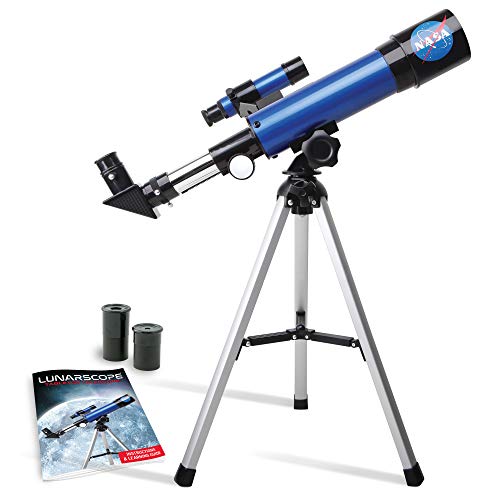
The NASA Lunar Telescope introduces young astronomers to the night sky with 90x magnification and a pair of eyepieces, plus a tabletop tripod and finder scope. This beginner-friendly telescope is designed for easy handling and stability, making it suitable for curious seven-year-olds eager to observe the Moon’s features and nearby celestial objects. The inclusion of a finder scope helps young observers learn how to locate targets, while the high- and low-power eyepieces encourage exploration at different scales.
Educational value comes from guided observation and hypothesis testing. Parents and educators can use observation prompts to discuss lunar phases, craters, and light pollution, tying telescope use to basic physics concepts in an age-appropriate way. The compact, table-top design makes it suitable for desks, shelves, or kids’ study nooks, turning science time into a routine activity rather than a one-off gift.
BONNYCO Solar System Felt Board

The BONNYCO Solar System felt board offers a tactile learning experience with 13 planets, the Sun, and the Moon, along with 46 additional solar system elements. This educational toy includes 5 dwarf planets and adhesive hangers for wall mounting, making it suitable as a classroom tool or a home learning activity. English-labeled pieces help children associate planet names with their positions and features, supporting vocabulary development and memory recall in an engaging, hands-on format.
As a Montessori-inspired resource, the felt board fosters independent play and storytelling while promoting spatial awareness and sequence understanding—essential skills for early science literacy. The soft, portable components are safe for younger hands and easy to rearrange during guided or free-play sessions. This option complements more construction-focused toys by offering a different sensory experience and a visual map of the solar system.
Skillmatics Guess In 10 NASA Space

Skillmatics Guess in 10 NASA Space is a quick, engaging card game that encourages deductive reasoning and space knowledge. Players ask up to ten yes-or-no questions to identify a NASA-themed card, challenging memory, strategic thinking, and communication skills. The game is well-suited for family play or classroom intervals, offering educational content in a fast-paced format that keeps children engaged. The NASA imagery reinforces curiosity about space while providing a collaborative, low-pressure environment for learning through play.
The game emphasizes strategy, teamwork, and competitive excitement, with clue cards and bonus questions adding depth to gameplay. Its portability makes it ideal for travel or to present as a supplemental activity alongside larger space-themed kits. While primarily a card game, it supports broader educational goals by reinforcing science vocabulary, spatial reasoning, and logical questioning.
Buying Guide: Key Purchase Considerations
When selecting space-themed toys for seven-year-olds, consider how each option aligns with developmental goals, interests, and the learning style of the child. The following factors help compare items across building sets, observation tools, and hands-on activities:
- Learning style: Building sets (like LEGO) promote construction skills and storytelling; telescopes build observation and science inquiry; felt boards support tactile, independent play; card games cultivate reasoning and communication.
- STEM focus: Evaluate whether the toy supports science concepts such as planetary science, propulsion, gravity, or observational skills. Look for age-appropriate explanations and guided activity ideas.
- Durability and safety: Check for sturdy parts suitable for 7-year-olds, with safe materials and no small, easily swallowable pieces. Durable toys encourage longer use and more extended learning.
- Longevity and replay value: Multi-build kits and open-ended tools offer more long-term engagement, whereas single-use kits may appeal for shorter-term projects.
- Portability and storage: Consider if the toy travels well, stores neatly, and fits into a child’s play area or classroom setting.
- Educational value vs. entertainment: Balance factual space content with imaginative play to support both knowledge acquisition and creative storytelling.
- Parental involvement: Some options are designed for independent exploration, while others invite collaborative activities that support bonding and guided discovery.
- Budget and accessory compatibility: While not including prices, ensure the toy works with existing collections or offers future expansion possibilities to maximize value.
For space enthusiasts, combining a building kit with a telescope or an interactive game can provide a well-rounded learning experience. A multi-model LEGO set encourages engineering thinking, while a telescope introduces observational astronomy. A felt board adds a visual, hands-on astronomy map, and a card game offers quick, repeatable space-themed challenges to reinforce memory and reasoning. Selecting a mix of these formats can help cater to different moods—whether a quiet, focused build session or an active group activity.