Best Sensory Mat for Autism: Top Therapy Mats for Home Use
If you’re seeking effective tools to support sensory exploration and calming activities, sensory mats can be a practical option. This guide highlights five highly relevant mats designed for autistic children and other kids who benefit from tactile, visual, and auditory stimulation. Each selection emphasizes safety, durability, and multi-sensory play, helping caregivers choose mats that fit therapeutic goals and everyday use at home, in classrooms, or therapy settings.
The following table provides a quick snapshot of the featured products, including what makes them stand out and where to find them on Amazon. It’s intended to help you compare core features at a glance before diving into detailed sections.
| Product | Main Benefit | Key Texture/Feature | Size / Setup |
|---|---|---|---|
| Maitys 7 Pcs Sensory Mats | Colorful, modular puzzle mats for exploration | Textured surfaces, safe PVC | ≈9.8″ x 9.8″ each; 7 pieces |
| KIGLY Large Sensory Mats | Big, varied textures with a learning guide | Crinkly, mirror, multiple textures | 9″ x 9″ each; 9 mats |
| Edusense Sensory Mat for Autism | Orientation-friendly puzzle mats for play and growth | Six raised textures; bright colors | Textured puzzle mats (size varies) |
| MOTGOM 12 Set Sensory Floor Tiles | Comprehensive multi-sensory exploration kit | Interlocking EVA with varied textures | 12 tiles; interlocking design |
| SMALL FISH Liquid Sensory Tiles | Dynamic lava-flow visuals for movement and play | Liquid-filled, non-toxic; colorful | 12″ x 12″ tiles; 4- or 9-piece sets |
Below, five products are explored in depth to help you compare abilities, safety, and play value. Each section includes a clickable link to the product on Amazon for quick reference.
Maitys 7 Pcs Sensory Mats for Autistic Children

Maitys offers a set of seven massage game mats designed for autistic children, with a mix of colors and puzzle-like assembly options. The mats are described as PVC-based, soft, and durable, with no strong odor. The product emphasizes safe stimulation and ease of storage, making it suitable for home use, therapy sessions, and classroom activities. Each tile measures about 25 cm square, offering a compact yet engaging surface for stepping, grasping, or sitting. The set’s versatility lies in their ability to be rearranged into various puzzle configurations to promote spatial awareness and fine motor skills while providing tactile variety.
Features highlight: 7-piece set, color-rich textures, interlocking design, 25 cm tiles, PVC construction, safety-focused and fade-resistant. This option is well-suited for families seeking modular, affordable sensory play that can be adapted to different activities and therapy goals. Consider it for spaces where quick setup and easy storage are priorities.
KIGLY Large Sensory Mats (9 Mats) Rainbow Colors
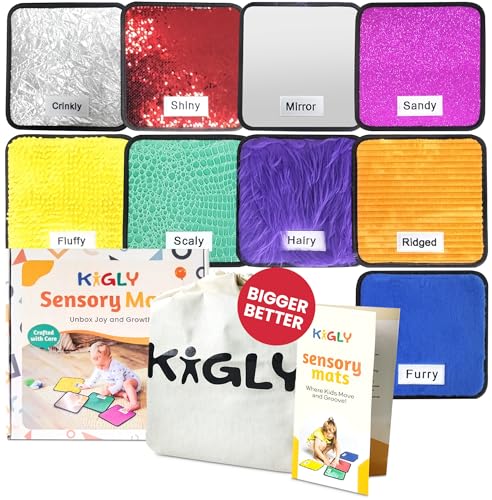
KIGLY presents a larger-than-average sensory mat collection with nine 9″ x 9″ tiles, designed for expanded play and learning. The packaging notes a guide manual with game ideas to maximize learning. The mats provide multi-sensory stimulation through varied textures, including crinkly and mirror-like surfaces, plus bright colors intended to stimulate visual processing while encouraging calm and focused play. The non-slip back aids stability during activities, whether at home, in a classroom, or in a therapy setting. The varied textures support tactile discrimination and exploration.
Key points: 9 mats, larger play area, multi-sensory textures, guide manual with ideas, non-slip backing, vibrant visuals. This option is ideal for families or classrooms seeking a structured yet flexible sensory setup that can support guided activities alongside free play.
Edusense Sensory Mat for Autism Children

Edusense offers a textured puzzle play mat designed for autistic children, focusing on six raised patterns to promote sensory development and coordination. The mats feature bright colors to engage visual recognition skills and are positioned as beneficial for both children and adults seeking sensory relief through movement or vibration. Beyond therapy, these mats can transform living spaces, classrooms, or offices into inclusive sensory zones. The product emphasizes safety, non-toxicity, and broad applicability for learning and daily routines, including adaptability for outdoor or indoor use.
Highlights include six distinct textures, durable construction, and color-affirming design. The mats are presented as tools for growth and relaxation, suitable for therapy sessions, home use, and transitional spaces where steady, non-invasive sensory input is desirable.
MOTGOM 12 Set Sensory Floor Tiles

MOTGOM provides a comprehensive 12-tile set designed for multi-sensory exploration. Each tile measures about 12.2 inches square and features a non-slip bottom to reduce shifting during use. The EVA foam base and soft surface materials are described as kid-friendly, with varied textures that encourage relaxation, focus, and tactile exploration. The interlocking design supports easy assembly and rearrangement to suit different spatial layouts and activity types, from obstacle courses to calm-down zones. This set aims to balance durability with portability for classrooms, homes, and therapy rooms.
Purchasing considerations include interlocking stability, texture variety, and overall footprint. The tiles are intended to accommodate active play while maintaining safety and ease of cleaning, making them suitable for ongoing use in routines that emphasize sensory regulation and gross motor engagement.
SMALL FISH Liquid Sensory Floor Tiles (9-Piece)

These 9-piece liquid-filled tiles create a dynamic lava-flow effect when stepped on. The visual movement supports attention, exploration, and gross motor activities like hopping and climbing, while colorful tones aid color recognition. The tiles use a non-toxic liquid sealed within PVC surfaces and offer an anti-slip back for safety on various floor types. They’re positioned as versatile for homes, daycare centers, and schools, enabling interactive learning and sensory play without long setup times.
Key attributes include varied color palettes, non-toxic liquid, leak-resistant design, and a focus on engaging movement as a core component of the sensory experience. When selecting these tiles, consider space, traffic level, and how frequently you plan to rearrange them for different games or therapy activities.
Buying Guide for Sensory Mats
- Texture variety: Look for mats with a mix of textures (soft, crinkly, mirror-like, ridged) to support tactile discrimination and sensory processing.
- Size and layout: Assess available space and whether you prefer individual tiles or larger interlocking mats to create a defined sensory zone.
- Material safety: Prioritize non-toxic materials, durable surfaces, and non-slip backing for safer use by young children.
- Maintenance: Choose mats that are easy to clean, with surfaces that resist odors and fading after frequent use.
- Portability: If you need to move mats between rooms or locations, consider lightweight, foldable, or modular designs with simple assembly.
- Classroom versus home use: For classrooms, look for larger sets with a guided activity guide; for home use, modular sets offer flexibility for different rooms and routines.
- Therapeutic alignment: Some mats include game ideas or lesson plans to support structured sessions, which can be valuable for consistent progress monitoring.
- Safety and durability: Check for seams, edge finishes, and the overall construction to ensure long-term use with active play.
- Accessibility: Consider color contrast and texture cues that aid navigation and inclusive play for children with diverse needs.