Best Science Kits for 3 Year Olds: Fun, Safe, and Educational STEM Toys
Exploring science with toddlers can build curiosity, observation skills, and early problem-solving. The following hand-picked science kits are designed for 3-year-olds or younger preschoolers, offering age-appropriate activities that encourage hands-on learning without overwhelming scales. Each option focuses on exploration, safe materials, and guided experiments.
Summary of Selected Products
| Product | Age Range | Focus | Key Benefit |
|---|---|---|---|
| Learning Resources Primary Science Deluxe Lab Set | 3+ | Hands-on experiments | Develops fine motor skills and observation |
| Learning Resources Splashology! Water Lab | 3+ | Water science | Explores volume and buoyancy in a playful way |
| Learning Resources Fizzy Volcano | 4+ | Chemical reactions | Engages early inquiry with fizzy experiments |
| National Geographic Kids Junior Chemistry Set | 4-6 | Basic chemistry | 50 experiments to spark curiosity |
| Doctor Jupiter My First Science Kit | 4-8 | Multiple experiments | Broad STEM foundation with kid-friendly tasks |
Learning Resources Primary Science Deluxe Lab Set
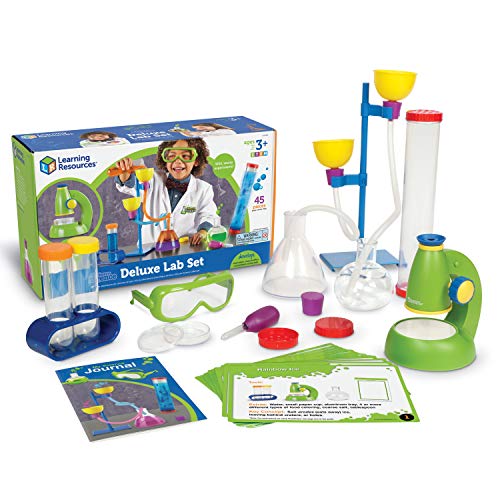
The Primary Science Deluxe Lab Set introduces preschoolers to basic scientific methods through guided activities and kid-friendly lab gear. With 45 pieces, the kit supports problem solving, fine motor development, and sequential thinking as children follow simple directions and observe results. Activity cards help caregivers and kids document findings in a write-and-wipe journal, reinforcing early literacy and observation skills. The kit emphasizes preschool science through hands-on exploration, making it a practical gateway to STEM at home or in a classroom.
Learning Resources Splashology! Water Lab

Water-based experiments in Splashology! invite toddlers to explore volume, buoyancy, and flow in a safe wet environment. With seven hands-on activities, kids interact with waterproof cards that describe each experiment, turning bath time or a water table session into a science mini-class. The kit’s design supports observation skills, predict-and-test thinking, and fine motor development through manipulating cups, funnels, and other water tools. It’s an approachable entry into scientific inquiry for rainy days or calm playtime.
Learning Resources Fizzy Volcano

This 13-piece kit introduces the science of fizzing and foaming reactions in a kid-friendly format. Guided by a full-color activity guide, children perform 10 experiments that build observation and basic trial-and-error skills. Kid-sized lab tools like a beaker, dropper, and funnel promote fine motor practice while encouraging careful measurement and sequence following. The Fizzy Volcano fosters curiosity about chemical reactions without overwhelming younger learners with complex steps.
National Geographic Kids Junior Chemistry Set

Designed for early learners, this chemistry set offers 50 experiments and more than 20 lab tools to explore chemistry with common household items. Step-by-step illustrated instructions make it accessible for young scientists to follow along and complete experiments independently or with minimal adult support. The kit emphasizes safe, age-appropriate exploration while introducing core chemistry concepts such as reactions, mixtures, and observation.
National Geographic Light Up Terrarium Kit for Kids

While oriented toward slightly older children, the terrarium kit provides an engaging, immersive science experience for curious toddlers with supervision. Kids can build a miniature ecosystem complete with plants, gemstones, and a light-up lid. The wide-mouth terrarium simplifies assembly and observation for little hands, and the included USB-powered light provides a gentle night-light function. This kit blends botany, earth science, and design, helping children observe plant growth and habitat dynamics over time.
Doctor Jupiter My First Science Kit

Doctor Jupiter presents a broad array of early STEM activities with more than 100 experiments designed to spark curiosity and critical thinking. The kit emphasizes inquiry—kids are encouraged to observe, ask questions, and test ideas through guided challenges. It’s a solid option for families seeking a diverse set of experiments that scale in complexity, helping young learners build a solid foundation in problem-solving and scientific thinking.
UNGLINGA 70 Lab Experiments Science Kit

UNGLINGA offers a large set of 70 experiments in one kit, featuring volcanoes, fruit circuits, and other classic science projects. The extensive collection supports diverse interests and longer play sessions, encouraging experimentation and iterative thinking. While some activities may require more adult guidance for younger children, the manual provides clear instructions and visuals to help caregivers facilitate learning and safety.
Buying Guide: Key Considerations For 3 Year Olds
- Age-appropriate complexity: Select kits with simple steps, large parts, and visual instructions to match a 3-year-old’s developmental stage.
- Safety and materials: Look for non-toxic components, rounded edges, and washable materials to simplify cleanup and reduce risk.
- Guided vs. open-ended play: Some kits offer structure through cards and guides, while others encourage free exploration; a blend often works best for preschoolers.
- Skill development focus: Prioritize activities that build fine motor skills, observation, cause-and-effect reasoning, and basic measurement concepts.
- Caregiver involvement: Consider how much adult participation is needed; opt for kits with easy-to-understand instructions and minimal setup time.
- Washable and reusable components: Reusability adds value as children revisit experiments and refine their observations over time.
- Expansion potential: Look for kits that scale with growing curiosity, offering more advanced experiments or complementary activities.
All featured products emphasize safe, age-appropriate science play for early learners. When selecting a kit, balance the child’s interest with the complexity of tasks, ensuring caregiver support is readily available to guide exploration and reinforce early scientific thinking.