Best RC Planes for Beginners: Safe, Easy-to-Learn Options to Start Flying
Discover top beginner-friendly RC planes that balance stability, ease of use, and instructional features. This guide highlights five entry-level models with beginner-friendly controls, gyro stabilization, and SAFE or similar assistive technology to reduce crashes and accelerate learning. Each option includes key specs and what makes it suitable for new pilots, so you can choose the right trainer for steady progress from first flight to controlled aerobatics.
| Product | Brand | Key Benefit |
|---|---|---|
| HobbyZone AeroScout S | HobbyZone | SAFE technology for crash reduction |
| P-51D Mustang RC Plane | VOLANTEXRC | Three flight modes and gyro stability |
| RCSHOBBY Sport Cub 500 S2 | RCSHOBBY | Three-level flight control with gyro stabilization |
| HobbyZone Carbon Cub S2 | HobbyZone | Versatile trainer with SAFE technology |
| Volantexrc Spitfire | VOLANTEXRC | 6-axis gyro stabilization for stability |
Note: This article uses five select models that are well-suited for beginners, offering stability, assist modes, and straightforward assembly or operation. Each section provides a quick overview, an image, and the top features to help you compare at a glance.
HobbyZone AeroScout S Trainer

The HobbyZone AeroScout S 2 1.1m RTF Basic is designed as a durable trainer for first-time pilots and instructors. It features exclusive SAFE technology to help prevent crashes and simplify learning. Flight modes include Beginner, Intermediate, and Experienced, which can be switched with a single flip. This makes it suitable for progressing skill development under supervision or solo practice.
VOLANTEXRC P-51D Mustang RTF

This 4-channel RC plane offers three flight control levels and a 6-axis gyro stabilizer for stable flights, even in light wind. Beginners can utilize full assist and gradually move to manual control as confidence grows. The plane is ideal for learners who want a capable model with aerobatic capability once they gain experience.
VOLANTEXRC Ranger600 4-Channel RC Plane

The Ranger600 provides 4-channel control with durable foam construction and three flight modes. It includes a propeller protection system and features that support a wide range of pilots—from beginners to advanced. The three-level flight mode system helps learners advance step by step, building confidence and technique.
RCSHOBBY Sport Cub 500 S2

Designed for beginners and adults alike, the Sport Cub 500 S2 uses lightweight EPP foam and a gyro stabilization system for stable handling. It features a three-level flight control setup—beginner with full assist, intermediate with partial assist, and expert with manual control—helping new pilots learn step by step. The model emphasizes approachable flight times and reliable performance during early flights.
MATHSLICE RC 2-Channel Plane

This light, 2-channel RC plane uses 2.4 GHz control with an emphasis on ease of use and longer fly times. Weighing around 35–38 g, it is a basic starter option suitable for very gentle flights and indoor/outdoor practice. It provides a straightforward introduction to RC piloting and flight timing considerations for new pilots.
HobbyZone Carbon Cub S2 Trainer

The Carbon Cub S2 stands out as a capable, versatile trainer inspired by the CubCrafters design. It includes SAFE technology to minimize crashes and offers Beginner, Intermediate, and Experienced flight modes that can be changed quickly. This model is well-suited for pilots who want a realistic trainer with room to grow into more advanced flights and scales of control.
LEAMBE Brushless F4U Corsair 500mm
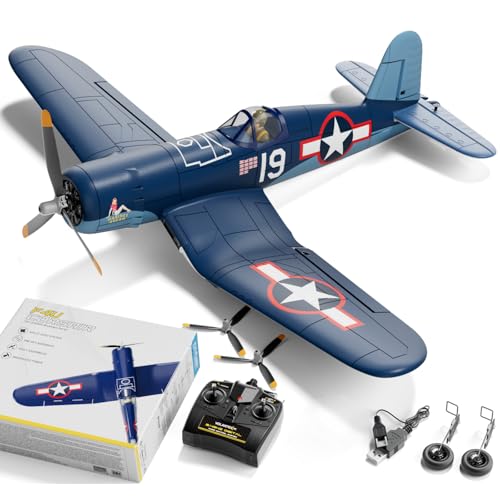
The LEAMBE Corsair combines a powerful brushless motor with a 4-bladed propeller and a comprehensive setup designed for broad skill levels. It includes three flight modes, a stable gyro, and user-friendly takeoff/return controls. Aimed at beginners who want a realistic, high-performance trainer, it provides accessible entry into more advanced RC flying while maintaining safety features and reliable stability.
Buying Guide for Beginner RC Planes
- Stability systems: Look for planes with gyro stabilization, SAFE-like flight aids, or three-level flight modes to help new pilots progress safely.
- Ease of assembly and operation: RTF (Ready-To-Fly) kits with included batteries and chargers reduce setup friction. Consider planes with simple control layouts for faster learning curves.
- Durability: Foam construction and propeller protection reduce damage risk during early crashes or rough landings. Durable builds help you practice longer without replacements.
- Flight time and power: Beginners benefit from moderate flight times; models with efficient motors deliver more practice per charge and reduce downtime.
- Size and environment: Larger trainers are better for outdoor wide-open spaces; smaller indoor-friendly flyers work well in gyms or backyards with careful control.
- Upgrade path: Choose models with modes that let you graduate to manual control, aerobatics, and scale flights. A gradual control transition supports confidence building.
- Customer support and community: Access to manuals, spare parts, and online communities can help resolve setup questions and share tips for safer flying.
- Safety considerations: Ensure proper range, binding procedures, and strict adherence to local regulations, especially for beginners in public airspace.