Best Programmable Robot Kits for 12 Year Olds: Top STEM Bots for Coding & Creativity
Choosing the right programmable robot for a 12-year-old can spark lasting interest in science, technology, engineering, and math. The following selections emphasize hands-on building, clear coding pathways, and features that align with pre-teen curiosity. Each option supports different learning styles—from visual Scratch coding to text-based Python—while offering expandable play and robust safety for curious minds.
Summary Table Of Selected Products
| Product | Key Focus | Age Range | Approximate Complexity |
|---|---|---|---|
| Henoda Robot Toys | Remote/app control, 4 modes | 8-16 | Moderate |
| Makeblock mBot | Scratch & Arduino integration, STEM basics | 8-12 | Beginner–Intermediate |
| ELEGOO UNO R3 Smart Robot Car Kit | Arduino-based programming, hardware basics | 8-16 | Beginner–Intermediate |
| Makeblock mBot2 | AI learning, Scratch & Python | 8-12+ | Intermediate |
| SGILE RC Robot | Gesture sensing, programmable actions | 6-12+ | Beginner |
Henoda Robot Toys For Ages 8-16 – App or Remote Controlled STEM Kit
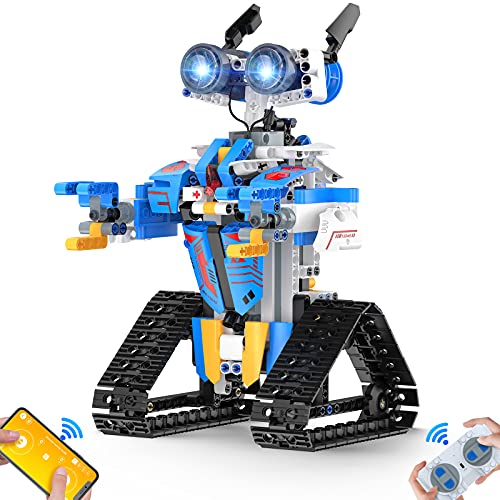
Henoda combines a large construction set with multiple control modes, making it adaptable for 12-year-olds who are exploring movement, steering, and transformation. The kit includes 468+ pieces and glow features that add visual appeal during demonstrations. Students can practice hand-eye coordination and build confidence in mechanical assembly, then switch to remote or app control to program routes and actions. Four control modes – app Bluetooth, remote control, path mode, and voice or STEM programming – provide a varied learning path, enabling learners to advance from guided experiments to independent projects. The 20-meter remote range supports outdoor exploration and team challenges.
From a cognitive perspective, Henoda’s block-based construction helps learners visualize kinematics and spatial reasoning. It also introduces programming logic as children map actions to commands, a foundation for future robotics topics. While the kit is designed for broad age ranges, 12-year-olds can maximize its potential by documenting build steps, comparing different control modes, and documenting how changes affect robot behavior. The product suits a classroom rotation or family STEM evenings, especially when paired with writing prompts or project-based challenges.
Makeblock mBot: Scratch & Arduino Compatible Robotics Kit

The mBot kit from Makeblock emphasizes beginner-friendly coding with Scratch and an introduction to Arduino. It’s well suited for 12-year-olds who are starting to translate on-screen instructions into physical movements. The kit arrives with clear building instructions (typically ready in about 15 minutes) and offers multiple modes—line-following, obstacle avoidance, and remote control—so learners can observe cause-and-effect as they refine their programming. Rich tutorials and available apps facilitate progressive learning, while the open ecosystem invites DIY experiments and expansions with other Makeblock modules. Note that some components require separate battery purchases, so plan accordingly.
Educational outcomes include improved logical thinking and problem-solving as students organize workflows, debug code, and optimize sensor responses. The mBot also supports a shared learning experience: students can pair projects with classmates to compare strategies and document results, aligning with collaborative skills essential in STEM fields. For 12-year-olds, it’s a reliable stepping-stone toward more advanced robotics and coding concepts without overwhelming complexity.
ELEGOO UNO R3 Smart Robot Car Kit For Arduino

ELEGOO’s UNO R3 kit is ideal for students who want a hands-on Arduino experience and the flexibility to customize. The kit ships with 24 modules, including obstacle avoidance and infrared remote control, and supports smartphone or tablet control across Android and iOS. It’s well suited for a 12-year-old who has some comfort with basic electronics and is ready to build a project that integrates sensors, motors, and simple code. The included documentation simplifies the learning curve, and the open-ended nature of Arduino projects encourages experimentation. While assembly requires some patience, this kit rewards persistence with tangible results and a solid foundation in electronics and programming concepts.
Educators and parents may use this kit to structure lessons around sensors (distance, color), motor control, and basic feedback loops. It helps reinforce the link between software commands and hardware actions, a central tenet of modern robotics. For a 12-year-old, this kit can evolve from guided labs to independent projects, such as building line-following robots or simple autonomous vehicles, fostering curiosity and practical problem-solving.
Makeblock mBot2 Coding Robot: Scratch & Python

mBot2 advances the coding experience by blending Scratch and Python, with a clear pathway into AI-style thinking through play. For a 12-year-old, the kit expands from basic block-based coding to text-based programming in Python, while still offering visual tools for quick wins. The project catalog includes multiple modes—Drive, Draw and Run, Musician, and more—allowing learners to switch between creative exploration and systematic problem-solving. Battery life supports extended sessions, and the kit’s modular design enables the addition of new sensors or accessories as interests grow. The combination of 8+ modes and ongoing curriculum updates makes mBot2 a strong long-term investment in STEM skill development.
With its emphasis on accessible coding and progressive challenges, mBot2 helps students build confidence in debugging and iteration. Parents and teachers can use the built-in tutorials to scaffold projects, then introduce independent challenges that align with school robotics or computer science curricula. The balance of approachable entry points and scalable complexity makes this a versatile choice for a 12-year-old interested in robotics and coding progression.
STEM 13-in-1 Solar Power Robots Kit By Bottleboom

The Bottleboom solar kit provides 13 different robot designs powered by solar energy, offering a unique angle for 12-year-olds who want to explore energy science alongside robotics. Building and rebuilding multiple configurations teaches adaptability, engineering thinking, and real-world energy concepts. As the sun powers the robot, children can observe how photovoltaic energy converts to mechanical action, reinforcing scientific reasoning. The solar approach is particularly engaging for outdoor learning and science fairs, and it reduces battery dependence, which is appealing for those seeking eco-friendly experiments. While solar kits may have more dependencies on weather, they can spark curiosity about renewable energy and engineering design.
13-in-1 construction promotes problem solving, planning, and iterative design. This kit is well-suited for group projects or family challenges, where students discuss optimization strategies and compare different robot configurations. It can also complement other robotics kits by illustrating how alternative energy sources impact performance and endurance in dynamic environments.
Makeblock mBot Kit With Scratch Coding Box

The Makeblock mBot with Scratch coding box emphasizes a seamless transition from block-based to more advanced coding. The kit includes four projects—line-following, obstacle avoidance, remote control, and other standard tasks—plus a rich set of tutorials that guide learners through building and coding progressively. The step-by-step manuals help ensure a smooth build process, and the coding cards provide a structured way to practice problem-solving and debugging. For 12-year-olds, this kit supports both quick wins and deeper explorations into robotics and programming, offering a solid platform for developing computational thinking and project-based learning.
Buying Guide: Key Purchase Considerations And Comparisons
- Learning Path: Decide whether you want block-based coding for quick wins (Scratch-like) or Python/Arduino for deeper programming. Many kits offer both or a clear upgrade path.
- Age and Skill Fit: While many products target broad age ranges, match the complexity to the child’s current abilities and readiness for more detailed coding tasks.
- Hardware versus Software Focus: Some kits emphasize mechanical assembly and sensor integration (hardware-heavy), while others focus more on software control (coding-heavy). A balanced mix supports well-rounded STEM growth.
- Expandability: Look for kits with modular components or compatible add-ons. This helps extend learning over time as the child’s interests evolve.
- Power and Maintenance: Consider battery needs, reusability of parts, and the availability of replacement components. A kit that’s easy to recharge and repair reduces downtime in learning.
- Safety and Comfort: Choose robust, age-appropriate materials with smooth edges. Ensure supervision guidelines align with the child’s independence level during building and programming.
- Project Diversity: A kit offering multiple projects or modes promotes sustained engagement and helps prevent boredom from repetitive tasks.
- Educational Value: Look for kits with structured tutorials, lesson ideas, or teacher resources to maximize learning outcomes in both home and classroom settings.
Across these options, the best choice for a 12-year-old often balances ease of entry with opportunities for deeper exploration. Starter kits that provide Scratch or visual programming paired with expandable hardware typically yield the strongest long-term engagement, while Arduino- or Python-based kits tend to accelerate advanced skill development for older or highly motivated learners. Assess the child’s interests—whether they favor story-driven robots, controller-based experiments, or autonomous task challenges—and select a kit that aligns with that curiosity.