Best Preschool Toys for 4 Year Olds to Inspire Play and Learning
Finding engaging, educational toys for four-year-olds helps build early literacy, math basics, fine motor skills, and social cooperation. Below are five carefully chosen preschool toys that align with common 4-year-old development, featuring hands-on activities, colorful designs, and age-appropriate challenges. Each product highlights play-based learning benefits to support curious, active learners.
| Product | Brand | Key Benefit |
|---|---|---|
| School Zone Go Fish Alphabet Game Cards | School Zone | Letter recognition and word-picture matching |
| MOTREE Preschool Learning Toys Math Manipulatives | MOTREE | Hands-on counting, addition, and subtraction |
| IPOURUP Dinosaur Toys For Kids 3-5 | IPOURUP | Building blocks and stacking for fine motor skills |
| BEESTECH Alphabet ABC Learning Educational Toys | Beestech | Letter matching and word-building with wooden pieces |
| TOMY Pop Up Super Mario Board Game | TOMY | Color recognition, turn-taking, and strategic thinking |
| SEPHIX Montessori Math Toys 3-5 | SEPHIX | Hands-on number sense and tracing practice |
School Zone Go Fish Alphabet Game Cards

These alphabet-themed Go Fish cards blend play with literacy practice. The set features bold uppercase and lowercase letters and animal imagery to aid letter recognition and word-picture matching. An online access code to the Golden Scholar Club adds a digital learning layer, though the physical cards stand on their own as a quick, engaging game for small groups or family play. The bright, colorful animal illustrations support visual association and memory, while the bold letters help novices distinguish letter shapes during gameplay.
MOTREE Preschool Learning Toys Math Manipulatives

Designed for early math exploration, this set includes a wooden finger board, number blocks, flash cards, and a holder. It supports counting, addition, and subtraction within 10, helping children visualize numerical concepts. The Montessori-inspired approach encourages hands-on learning, enabling kids to physically manipulate pieces to build number sense while developing fine motor skills. This toy is well-suited for homeschool settings or classroom centers that emphasize concrete math experiences and problem-solving.
IPOURUP Dinosaur Toys For Kids 3-5
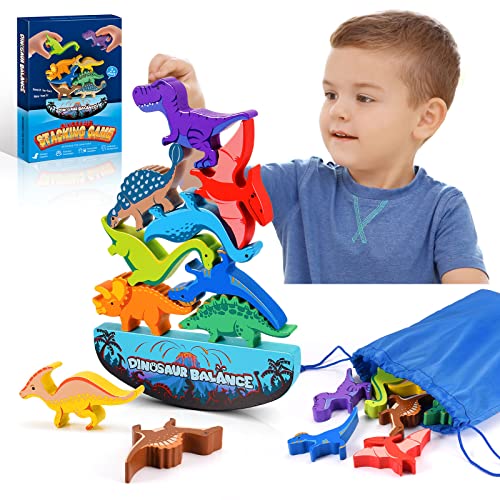
This wooden stacking set includes larger blocks that are easy for small hands to grip, with rounded edges for safety. The multilevel challenges foster concentration, patience, and spatial reasoning as children build stable towers. The toy also supports family-friendly balance games, inviting shared play with siblings or adults and reinforcing social interaction, turn-taking, and cooperative problem-solving during playtime.
BEESTECH Alphabet ABC Learning Educational Toys

Wooden letters pair with flash cards to form a sturdy, tactile learning system. Children place the letters on corresponding cards to spell words and recognize sounds. The wooden build ensures durability and safe use, while the simple storage bag helps keep pieces organized for quick cleanup. This set supports early literacy, letter-sound associations, and independent or guided practice with minimal adult intervention.
TOMY Pop Up Super Mario Board Game

Mario-themed pop-up action creates dynamic, fast-paced tabletop excitement suitable for family game nights. The game offers multiple play modes, including Classic Play, Coin Collection, and Team Play, which accommodates different skill levels. In addition to entertainment, players practice decision-making, color recognition, and cooperative interaction as they chase elements around the board. It’s a playful way to reinforce listening and turn-taking in a social setting.
SEPHIX Montessori Math Toys For 3-5 Year Olds

This math learning kit combines a double-sided wooden finger counting board, numbered blocks, challenge cards, a tracing stylus, and sturdy stands. It aligns with Montessori principles by encouraging self-directed exploration and hands-on problem solving. Children use the felt fingers and blocks to build equations, trace number tracks, and solve progressively challenging puzzles. The setup supports flexible play to suit individual paces and learning preferences, emphasizing visual and tactile math comprehension.
Buying Guide
- Age-appropriateness: Choose toys labeled for 3-5 years to match a 4-year-old’s developmental stage, ensuring safety features like rounded corners and non-toxic finishes.
- Learning focus: Consider whether the child benefits most from literacy (letters, reading), numeracy (counting, basic operations), or fine motor development (puzzles and stacking).
- Durability and materials: Wooden toys typically offer longer life and tactile satisfaction, while plastic options may be lighter and easier to clean.
- Social play: Games that support group participation build communication, sharing, and turn-taking skills, fostering social development.
- Storage and cleanup: Look for sets with organizers or bags to keep pieces accessible and reduce clutter in learning spaces.
- Versatility: Multi-functional toys (e.g., counting with cards or board games that teach colors) provide extended use as the child grows.
- Safety and supervision: Inspect small parts for choking hazards; supervise younger children during play, especially with loose components.
- Budget considerations: Balance durability with learning value; investing in a few well-made items can yield greater long-term engagement than many low-quality toys.