Best Piano Stickers for Keys: Colorful Labels to Accelerate Learning
Whether you are teaching a beginner, helping a child practice, or refreshing your own keyboard skills, piano stickers for keys can clarify note locations and speed up learning. This article highlights top-rated, removable key labels and outlines practical buying considerations. The selections below cover compatibility with 88-key, 61-key, and other common keyboard setups, durability, and user-friendliness. Explore practical options that blend clear labeling with clean removability for ongoing practice and retention.
| Product | Key Range | Material | Special Feature |
|---|---|---|---|
| COYAHO Piano Keyboard Stickers | 88/61/54/49/37 | Transparent vinyl with printed letters on backside | Removable with no residue; durable print |
| Lrokimg Piano Keyboard Stickers | 88/76/61/54/49 | Transparent, thin vinyl | Colorful, easy to remove and reapply |
| BEATBIT Piano Notes Guide (Black) | 88-key full size | Silicone note strips | No stickers; double staff for quick key finding |
| BEATBIT Piano Notes Guide (Rainbow) | 88-key full size | Silicone note strips | No stickers; rainbow colors for distinction |
| MUYOS Piano Keyboard Stickers | Full-size keys | Transparent vinyl with adhesive | Large white/black key labels; residue-free removal |
Note: This guide focuses on five products most relevant to piano key labeling, balancing readability, compatibility, and ease of use. Prices are not listed to keep focus on features and suitability for learners of all ages.
COYAHO Piano Keyboard Stickers
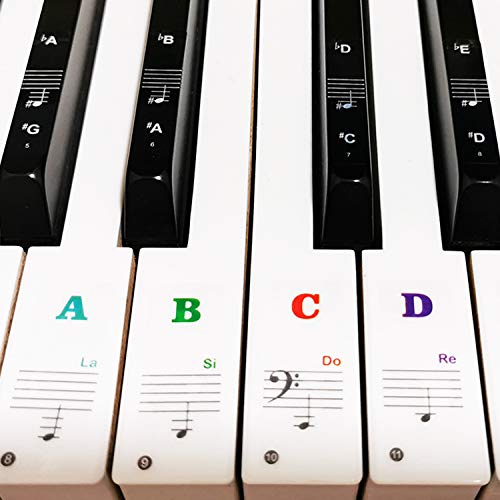
COYAHO’s sticker set is designed for broad keyboard compatibility, fitting 88-key, 61-key, 54-key, 49-key, and 37-key instruments. The white key stickers measure 4.0 cm by 1.55 cm, while black key stickers are 3.9 cm by 0.85 cm. The letters are printed on the backside, ensuring legibility during play. These labels are waterproof and can be wiped clean, making them durable under repeated use. The adhesive is formulated to remove cleanly, leaving no sticky residue and causing no harm to the keyboard surface. This makes COYAHO suitable for ongoing practice with multiple students or in classroom settings.
Lrokimg Colorful Keyboard Stickers

Lrokimg offers a versatile sticker set compatible with 88, 76, 61, 54, and 49-key keyboards. The stickers are transparent and thin, delivering a virtually invisible labeling solution that does not interfere with play. They are easily pasted and removed without leaving residue. The vibrant colors help beginners quickly distinguish between keys, enhancing learning speed and engagement. This option is well-suited for classroom use or home practice where quick label changes may be needed as skills advance.
Runzoos Transparent Piano Key Stickers

Runzoos provides a transparent and removable sticker solution compatible with 88/76/61/54/49-key pianos. The stickers employ a clear printing approach to maintain key visibility while marking notes. They are designed for easy installation with clear cutting lines, enabling beginners to equip their keyboards quickly. The adhesive allows for repeated repositioning and removal without harming the surface, making it suitable for practice sessions that involve frequent changes to note layouts as players progress.
MUYOS Piano Keyboard Stickers
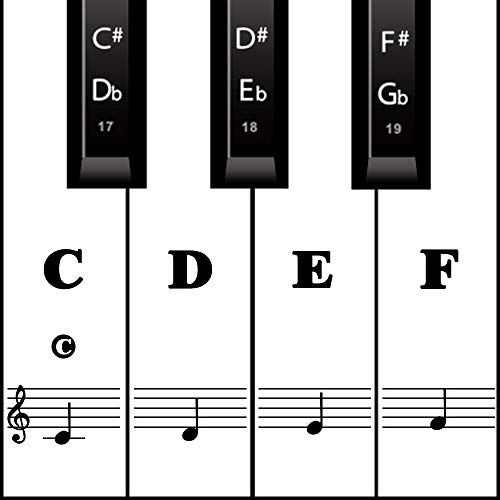
MUYOS focuses on large, easy-to-see labels for white and black keys, measuring 16×35 mm for white keys and 7×25 mm for black keys. The stickers come with user-friendly placement instructions and are designed to leave no sticky residue when removed. They are printed on transparent vinyl with a durable adhesive, ensuring longevity without damaging the keyboard surface. This option is ideal for beginners who benefit from high-contrast labeling that reduces visual clutter during practice.
Belfort Removable Piano Stickers

Belfort offers a silicone, glue-free solution that sits directly on the piano keys. Known for being easily removable, these note guides prevent damage to keyboards while providing a clear visual path for note recognition. The silicone strips can be repositioned as learners advance, and they help users locate notes quickly, supporting a rapid improvement in reading during practice sessions. This option blends tactile feedback with visible cues for beginners and educators alike.
ZUFECY Piano Keyboard Stickers

ZUFECY provides a universal sticker set designed to fit a broad range of keyboard configurations, including 88/76/61/54/49 key pianos. The labels use vivid colors to enhance key recognition and readability, making them especially helpful for beginners. Durability and clean removal are emphasized to ensure that learning sessions remain effective without long-term alterations to the instrument’s surface.
Buying Guide: Key Purchase Considerations
When choosing piano stickers for keys, consider the following factors to align with your goals and instrument type.
- Key compatibility: Confirm the sticker set supports your piano’s key count (88, 76, 61, 54, 49, or others). Some sets are universal, while others are tailored to specific ranges.
- Material and durability: Transparent vinyl and silicone options balance visibility with playability. Silicone strips avoid residue but require a surface-safe design to prevent slippage.
- Adhesive behavior: Removable, residue-free adhesives are crucial for renters, students, or classrooms. Reusable options reduce ongoing cost and waste.
- Label clarity: Large letters or high-contrast colors help beginners quickly locate notes. Double-staff guidance can speed up learning when using staff-based references.
- Install and removal ease: Look for easy alignment with minimal tools and straightforward removal without damage or sticky residue.
- Cleaning and maintenance: Waterproof and wipe-clean surfaces simplify upkeep, especially in shared learning spaces or kids’ practice areas.
- Visual design: Colorful labels or color-coding schemes can foster engagement, but avoid excessive clutter that distracts from reading the music staff.
- Price and reuse: Reusable silicone or reusable label methods may reduce long-term costs, especially for multiple learners or ongoing practice.
In choosing between sticker labels and silicone-note guides, weigh stability during playing vs. ease of removal. Stickers provide traditional labels with clear, scalable color coding, while silicone note guides offer a non-adhesive, residue-free approach suitable for frequent reconfigurations or for learners who prefer a more tactile learning aid. Consider your teaching setting, the learner’s age, and how often you expect to adjust the labeling as skills develop.