Best Piano Pieces for Children: Fun, Easy Classics for Young Pianists
Finding engaging, approachable piano pieces for young beginners can help nurture a lifelong love of music. This guide highlights five kid-friendly piano collections that blend well-loved melodies with beginner-friendly arrangements. Each entry features classic and contemporary pieces arranged for piano, emphasizing standard notation and accessible fingerings. Whether a child is just starting or looking for short, rewarding pieces, these selections offer variety, educational value, and playability that parents and teachers can rely on.
| Product | Brand | Format | Highlights |
|---|---|---|---|
| Piano Pieces for Children (Everybody’s Favorite Series, No. 3) | Music Sales | Piano Solo | Includes works by masters and folk tunes; standard notation; 100 compositions |
| Piano Pieces for Children 2 (EFS No. 250) | Music Sales | Piano Solo | 192 pages; comprehensive beginner-to-intermediate repertoire |
| Piano Pieces for Young Children (EFS No.252) | Music Sales | Piano Solo | 144 pages; approachable repertoire for early learners |
| Easy Piano Pieces for Children – Beginner Piano Songbook with Mozart and Debussy | Music Sales America | Piano | Over 100 simple pieces; fingering guidance; classical selections |
| Piano Pieces for the Adult Beginner, No. 251 | Music Sales | Piano Solo | 192 pages; friendly for older beginners exploring repertoire |
Piano Pieces for Children (Everybody’s Favorite Series, No. 3)
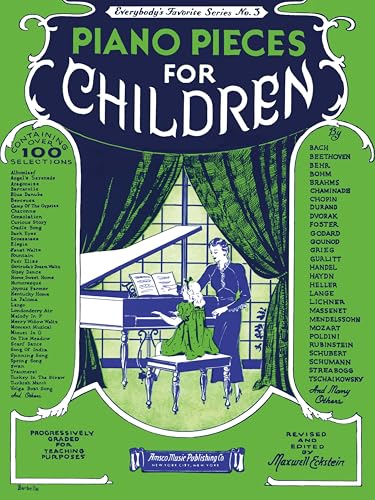
This collection presents a broad spectrum of pieces suitable for early to mid-level pianists. With 100 compositions spanning from works by classical masters to folk tunes and dances from various countries, the selections emphasize standard notation and clear fingerings. The repertoire supports developing reading skills and a sense of musical style, helping young players experience both tradition and world music in a single volume. Teachers can assign short pieces for practice or longer explorations for recital preparation.
Piano Pieces for Children 2 (EFS No. 250)

Designed as the next step in the children’s series, this edition expands the beginner-to-intermediate repertoire with 192 pages of material arranged for piano. The content accommodates continued skill development, offering a mix of simpler pieces alongside slightly more challenging passages to stretch technique and musicality. The format supports independent practice and classroom-sharing sessions, making it a reliable bridge between early beginner books and more advanced collections.
Piano Pieces for Young Children (EFS No.252)

Optimal for early learners, this 144-page collection focuses on approachable, age-appropriate pieces that reinforce reading and rhythm. The selections are chosen to build confidence through repeating patterns and familiar melodic shapes, while introducing a small but meaningful variety of styles. It serves well for daily practice routines or group classes, providing steady progression as technique and musical expression deepen.
Easy Piano Pieces for Children – Mozart and Debussy

This beginner-friendly songbook compiles over 100 pieces with simple arrangements suitable for young pianists. It blends selections from Mozart and Debussy with easy fingerings to encourage musicality and tonal awareness early in the learning journey. The book’s layout supports guided practice, with clear notation and approachable tempos, making it a practical option for home study or classroom warm-ups.
Piano Pieces for the Adult Beginner, No. 251

Although designed with adult beginners in mind, this collection offers pieces that mature students often appreciate for ongoing practice. The 192 pages of repertoire provide a balanced mix of approachable melodic lines and simplified textures that reinforce reading, rhythm, and finger independence. It serves as a practical next step for learners who have completed early beginner books and want sustainable, non-intimidating material.
Library of Piano Classics

This collection curates famous classical piano pieces for intermediate to advanced players, expanding the options beyond beginner territory. While not specifically child-focused, it offers valuable exposure to timeless repertoire, encouraging older or more advanced learners to explore stylistic nuances and performance practices. The selection can complement younger students’ studies when they’re ready to tackle more technically demanding material or to prepare for recitals with more varied programming.
Buying Guide for Piano Pieces for Children
Key considerations when selecting piano pieces for children include reading level, repertoire variety, and pedagogical support. Start with clearly notated pieces and predictable patterns to build confidence, then gradually introduce pieces with increasing technical demands. Look for books that provide fingering suggestions, musical style notes, and a logical progression in difficulty. Consider the child’s interests—folk tunes, classical excerpts, and international melodies all help sustain engagement. Finally, balance quantity with quality: a few well-chosen pieces that inspire consistent daily practice often outperform a large pile of less cohesive material.
Repertoire diversity
Choose collections that mix folk tunes, classical miniatures, and culturally diverse pieces. This breadth fosters a broader musical palate and helps children relate to different characters and stories through music. It also supports cognitive development by exposing learners to varied rhythms, textures, and melodic contours.
Progressive difficulty
Look for graded selections that allow a stepwise progression. Introductory pieces should reinforce reading, rhythm, and hand coordination, while later selections offer longer phrases and more nuanced dynamics. A gradual challenge reduces frustration and sustains motivation.
Pedagogical support
Fingering guides, performance tips, and clear notations are valuable. Books with minimal editorial ambiguity help teachers and parents provide constructive feedback during practice. If possible, pair pieces with a supplementary method book or online resources that reinforce technique and theory.
Practical considerations
Consider page count, binding durability, and layout. A well-organized book with legible print and ample spacing reduces eye strain. For classroom use, consider multi-copy sets to facilitate group activities and peer learning. For home practice, a compact, informative edition can be a reliable daily companion.
Instrumental compatibility
Ensure the selected titles are arranged specifically for piano or keyboard. Some collections label instrumentation clearly, which helps avoid mismatches when students have access to different keyboard formats. Pieces labeled “piano solo” are typically best suited for standard upright or digital pianos used in most homes and schools.