Best Math Toys for 5 Year Olds That Build Skills
Finding the right math-focused toys for five-year-olds can boost early numeracy, problem-solving, and fine motor skills while keeping learning fun. Below is a curated guide to five engaging options that combine hands-on play with age-appropriate challenges. Each product encourages critical thinking, number sense, and spatial reasoning through colorful, tactile activities.
| Product | Brand | What It Aims To Build | Age Range |
|---|---|---|---|
| STEM Explorers Brainometry | Learning Resources | Pattern recognition, logic, fine motor skills | 5+ |
| Math Island Addition & Subtraction Game | Learning Resources | Addition, subtraction, mental math confidence | 5+ |
| STEM Explorers Pixel Art Challenge | Learning Resources | Critical thinking, pattern construction, spatial skills | 5+ |
| alilo Math Games | alilo | Addition, subtraction, multiplication, division, quick calculations | 5+ |
| TOP BRIGHT Preschool Math Blocks | TOP BRIGHT | Number recognition, counting, basic operations | 2-4 to early 5 |
Note: The products above are selected for relevance to math learning at early elementary levels, combining engaging play with foundational math skills. Each item supports different learning styles—from strategic thinking and pattern design to fast mental math and hands-on counting.
STEM Explorers Brainometry — Brain Teasers And Pattern Blocks

The Brainometry set from Learning Resources is designed to develop logical thinking and spatial reasoning through hands-on pattern matching. The kit includes tactile blocks with diverse shapes and patterns that invite children to build and compare, reinforcing early geometry concepts while improving fine motor control. Ten double-sided activity cards offer progressive challenges, keeping kids engaged as they grow more confident with each puzzle. This resource supports guided exploration and independent practice, making it suitable for home use or classroom centers.
Math Island Addition & Subtraction Game — Volcano Adventure
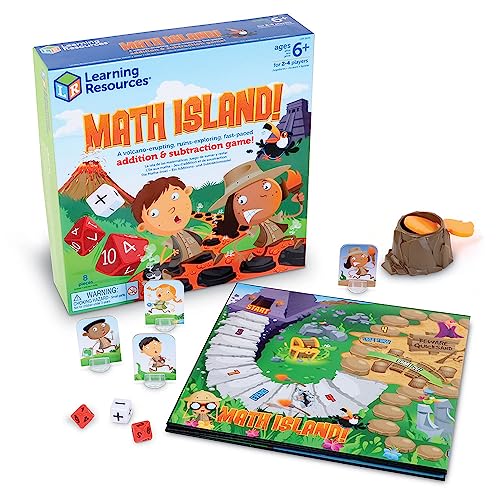
This math-focused game transforms practice into an adventure by guiding players across a volcano island. Children solve addition and subtraction problems to progress, building fluency with essential math facts. The set includes two 10-sided number dice and an operation die to create varied equations, encouraging quick mental math and number sense. A volcano popper mechanism adds a playful feedback loop, rewarding successful strategy and boosting engagement while avoiding heavy drill-style repetition.
STEM Explorers Pixel Art Challenge — Pattern Building

Pixel Art Challenge blends math and art, guiding kids through 10 double-sided challenge cards with increasing difficulty. The activity emphasizes problem-solving, pattern construction, and spatial reasoning as children assemble pixel pieces to form designs. It is a screen-free learning option that supports early coding concepts and mathematical thinking by organizing shapes and colors into coherent patterns. Fine motor skills are sharpened by precise piece placement, making it a well-rounded STEM activity.
alilo Math Games — 19 Interactive Challenges

alilo’s math games provide a robust range of number-based challenges, from addition to division across 19 interactive activities. The device uses instant voice feedback and star rewards to reinforce correct answers and motivate continued practice. An automatic error-check feature lets children review mistakes, offering immediate correction and guided retry, which is useful for building confidence and reducing frustration as new math concepts are introduced.
TOP BRIGHT Preschool Math Blocks — Early Numeracy

TOP BRIGHT’s Montessori-inspired math manipulatives combine counting blocks with a wooden finger board to support number recognition and basic operations. Designed for younger learners, this kit focuses on easy counting, simple addition and subtraction within 10, and hands-on exploration. The tactile blocks help children visualize math concepts, building a foundation for more complex arithmetic as they transition into kindergarten and early elementary math.
Buying Guide: Key Purchase Considerations
- Learning goals: Choose sets that balance number sense, operations, and spatial reasoning to cover diverse math skills rather than a single focus.
- Age appropriateness: Ensure activities match the child’s developmental level to prevent frustration and encourage sustained engagement.
- Engagement style: Consider whether the child benefits from hands-on manipulation, story-driven exploration, or game-based challenges, and select accordingly.
- Reward and feedback mechanisms: Toys with immediate feedback (audio cues, rewards) can boost motivation, but consider balance with open-ended tasks that foster independent thinking.
- Durability and safety: For younger children, choose sturdy materials and pieces that are easy to handle and clean.
- Digital vs. screen-free: Screen-free options support focus and fine motor skills, while some devices introduce timed challenges or quick feedback that some kids enjoy.
- Progression: Look for products with varied levels or expandability (multi-card challenges, additional sets) to grow with the child’s abilities.
- Storage and portability: Portable games and compact blocks are helpful for travel or classroom centers with limited space.
When selecting math toys for five-year-olds, aim for a mix of activities that promote reasoning, memory, and calculation fluency. The items above provide varied approaches—from pattern-building and puzzle-solving to timed practice and adventure-based games. A well-rounded collection supports a broader math foundation and keeps young learners motivated to explore numbers and patterns.