Best Learning Toys for a 5 Year Old Boy That Spark Creativity and Skills
Finding engaging, educational toys for a five-year-old boy can boost early literacy, math readiness, and scientific curiosity. This guide highlights five acclaimed options that blend hands-on exploration with fun. Each pick targets key skills like letter recognition, problem solving, and STEM thinking, helping kids build confidence while they play. Below you’ll find a quick overview, detailed product sections, and a buying guide to compare features, durability, and age appropriateness.
| Product | Brand | Key Focus | Typical Use |
|---|---|---|---|
| LeapFrog Mr Pencil’s Scribble Write and Read | LeapFrog | Letter writing, tracing, early literacy | Interactive writing practice with animated feedback |
| 10 in 1 STEM Toys for 4-8 Year Olds | Tsomtto | Building, engineering, hands-on STEM | Modular models and step-by-step building guides |
| Doctor Jupiter My First Science Kit | Doctor Jupiter | Science exploration, experiments | 100+ experiments for hands-on discovery |
| Learning Resources Brainometry | Learning Resources | Pattern blocks, logic, fine motor skills | Brainteasers and building tasks for critical thinking |
| TOP BRIGHT Preschool Learning Toys | TOP BRIGHT | Early math concepts, counting and sorting | Montessori-inspired number blocks and manipulatives |
These selections emphasize durability, age-appropriate challenge, and clear learning outcomes. Read on for a closer look at each product, including how it can fit into a playtime routine, what skills it reinforces, and what families should consider when choosing. All sections include practical use cases and are suitable for a 5-year-old boy who enjoys active, hands-on play.
LeapFrog Mr Pencil’s Scribble Write And Read

LeapFrog’s Mr Pencil provides a playful way to learn uppercase and lowercase letters through guided tracing. After tracing, the letters come alive as animated animals and objects, reinforcing letter shapes and sounds. The product also guides children through number tracing with dotted lines, transforming into countable objects to support early math skills. A notable feature is personalization: you can customize by entering a child’s full name for practice writing it. This personal touch can increase engagement and retention. The hands-on approach helps kids build fine motor skills while reinforcing literacy and early numeracy.
LIWIN LET’S GO! Learning Games for Kids
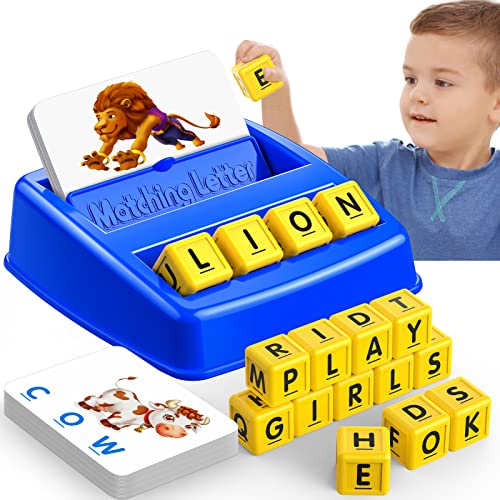
This set focuses on matching letters with a family-friendly, interactive approach. Designed for ages 3-8, it helps develop memory, spelling, word recognition, and strategic thinking. The included activities encourage parent-child interaction, offering a natural platform for turn-taking, sharing, and cooperative problem solving. While the primary emphasis is on letter learning, the game format supports cognitive flexibility and social skills, making it a balanced choice for a 5-year-old who enjoys group play and collaborative challenges.
10 in 1 STEM Toys for 4-8 Year Olds

This 167-piece building set supports a broad range of models across ten different configurations, including towers, rails, vehicles, planes, and robots. The included step-by-step guide helps kids follow instructions and learn to read diagrams, a valuable skill for engineering tasks. The emphasis on teamwork and collaborative building can strengthen communication and cooperative play, while the varied models keep a 5-year-old engaged as they explore different mechanisms and motion concepts. It’s especially suitable for a curious child who enjoys constructing complex structures.
Doctor Jupiter My First Science Kit

Doctor Jupiter’s science kit invites young scientists to explore with 100+ experiments that cover a spectrum of topics, from water-based activities to electricity-inspired demos. The kit emphasizes inquiry and critical thinking by encouraging questions, observations, and experimentation. It serves as a practical introduction to the scientific method, offering screen-free exploration that aligns with a child’s natural curiosity. The included materials are designed for safe, at-home use, making it a robust option for independent play or guided learning sessions with a caregiver.
Learning Resources Brainometry

Brainometry combines pattern blocks, logic puzzles, and building tasks to boost critical thinking and problem-solving. The kit includes 10 double-sided activity cards with progressive difficulty, making it adaptable for a 5-year-old’s development and a growing household of budding mathematicians. The tactile blocks and patterns encourage hands-on exploration, helping children understand geometry, symmetry, and spatial relationships while reinforcing fine motor skills. It’s a compact, durable choice for busy playrooms and classroom settings alike.
School Zone Go Fish Alphabet Game Cards

Go Fish Alphabet Game Cards blends card play with literacy learning. With bold, colorful animal illustrations and uppercase-lowercase letter pairings, kids practice letter recognition, sounds, and early vocabulary. The game format supports cooperative play and social interaction, enabling children to learn through fun, low-pressure competition. For a five-year-old boy beginning to read or needing extra practice with letters, this game offers a relaxed, repeatable way to reinforce foundational literacy skills during family or classroom activities.
Learning Resources STEM Explorers Magnet Movers

Magnet Movers introduces basic physics concepts through a 39-piece magnet set, including a magnetic wand and various magnetic components with an activity guide. The magnets encourage experimentation with attraction, repulsion, and spatial reasoning, while the hands-on nature keeps a 5-year-old engaged. This set supports early science literacy, STEM curiosity, and fine motor control as children manipulate pieces to create structures and observe magnetic behavior. It is well-suited for classroom activities or at-home STEM centers.
TOP BRIGHT Preschool Learning Toys

TOP BRIGHT’s preschool set presents Montessori-inspired math manipulatives, including counting blocks and a wooden finger board. It’s designed to support early numeracy, number recognition, and basic arithmetic within 10. The tactile, open-ended nature of this toy allows kids to explore counting, sorting, and simple addition through hands-on play. The wooden components are typically durable, making this a practical choice for daily use in homes or early learning environments. It suits a child who enjoys constructing and investigating numbers through play.
Buying Guide: Key Purchase Considerations
- Age appropriateness: Ensure the toy’s complexity matches a 5-year-old’s cognitive and motor development. Look for adjustable difficulty or activities that scale with growth.
- Skill focus: Choose products aligned with your child’s needs—letter recognition, early math, STEM exploration, or scientific inquiry—to complement school curricula.
- Durability and safety: Toys should withstand frequent handling and be built from non-toxic materials. Check for small parts that could pose choking risks.
- Engagement and replay value: Seek toys with multiple activities or modes to sustain interest beyond initial fascination.
- Learning style compatibility: Some children prefer hands-on building, others respond to storytelling or guided exploration. A mix can cover diverse learning preferences.
- Parental involvement: Toys that enable parent-child interaction can reinforce learning, social skills, and cooperative problem solving.
- Storage and cleanup: Consider compact sets or organized components to minimize clutter and simplify setup.
When selecting learning toys for a five-year-old boy, balance educational goals with play value. The items above offer a mix of literacy, math, engineering, and science activities designed to engage curiosity, support school readiness, and encourage hands-on exploration. Incorporating a few of these into a weekly routine can foster a well-rounded foundation for future learning, while maintaining the joy of play.
Buying Guide Summary: Choose a blend of literacy-focused, STEM-focused, and open-ended manipulatives to provide a well-rounded early learning experience. Prioritize durability and age-appropriate challenges, and consider how each toy can be integrated into guided play sessions to maximize learning outcomes.