Best Emotion Cards for Toddlers to Build Emotional Skills
Emotion cards for toddlers offer a simple, engaging way to help young children recognize, label, and manage their feelings. This guide highlights five highly rated sets, each designed to support emotional intelligence, empathy, and communication. From cartoon faces to realistic expressions and coping strategies, these tools cater to diverse learning styles and needs, including autism, ADHD, and speech delays. Explore practical features, suitability for therapy or home use, and thoughtful buying considerations to find the best fit for your child.
| Product | Brand |
|---|---|
| Emotions Flashcards, 50 Different Feelings with Coping Skills | SpriteGru |
| Lachilly Emotions Learning Flashcards | Lachilly |
| Feelings in a Flash – Emotional Intelligence Flashcard Game | Brybelly |
| MEROCO Feelings Emotions Cards | MEROCO |
| Humyoun Emotions Flash Cards (40 cards + mirror) | Humyoun |
Best Emotions Flashcards With Coping Skills

The SpriteGru Emotions Flashcards set features 50 different moods represented by expressive cartoon faces. This design helps children identify and articulate feelings while also offering practical coping skills printed on the flip side. The dual-sided format supports both emotion recognition and self-regulation strategies, making it a versatile option for therapy sessions and home learning. Suitable for children with autism and ADHD, these cards foster empathy and self-awareness through interactive play.
Lachilly Emotions Learning Flashcards

These Lachilly Emotions Flashcards combine high-frequency English words with engaging cartoon images to promote vocabulary growth alongside emotional literacy. The 15 double-sided cards offer a cost-effective, compact option for classrooms or homeschooling. Designed for kindergarten to first grade, the set supports early reading, expressive language, and social communication. It’s a practical choice for building foundational emotional vocabulary in Toddlers and young learners.
Feelings In A Flash – Emotional Intelligence Flashcard Game
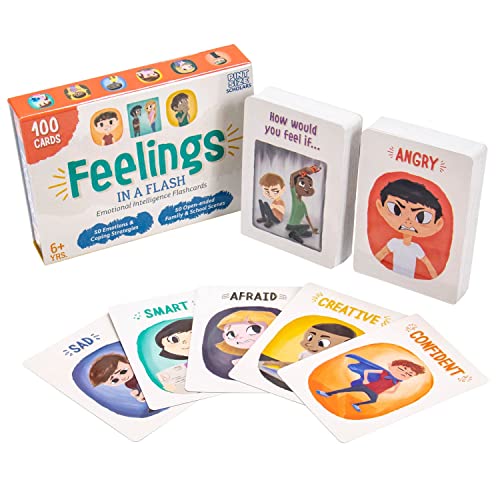
Feelings In A Flash provides 50 scenario cards paired with 50 emotion faces to teach empathy and coping strategies. By exploring real-life contexts, children can connect emotions to situations, improving social understanding. The open-ended nature supports discussion, making this set suitable for family learning, classrooms, and therapy settings. It emphasizes practical coping suggestions on each emotion card to guide positive behavior and decision-making.
MEROCO Feelings Emotions Cards

Realistic facial expressions help children imitate and understand a broad range of emotions. The included mirror enhances self-observation, supporting better recognition of one’s own emotions. The set is designed for use in speech therapy, autism support, and social-emotional learning efforts. Durable materials ensure long-term use, with multiple cards within each emotion category to reinforce learning and repeated practice in various contexts.
Humyoun Emotions Flash Cards Plus Mirror

This 41-piece set includes 40 double-sided cards and a mirror, aiding children in recognizing and mimicking realistic facial expressions. It’s specifically marketed for therapy, with a focus on ADHD and autism support. The cards cover a wide range of emotions, enabling educators and parents to expand a child’s emotional vocabulary while providing practical opportunities for practice in everyday interactions and structured activities.
See My Feelings Mirror By Hand2mind

Hand2mind’s See My Feelings Mirror introduces six core emotion slides and easy-to-recognize emojis. The interactive format encourages toddlers to label emotions, practice naming strategies, and engage in social skills activities. The real-photo imagery supports connection to actual people and expressions, helping children relate feelings to everyday experiences. It’s a practical addition to calm-down corners and small-group activities in classrooms or therapy spaces.
Buying Guide: Key Purchase Considerations
- Age and developmental fit: Choose sets labeled for toddlers or early preschool to ensure age-appropriate content and card complexity.
- Delivery method: Double-sided cards with coping skills versus purely descriptive faces; consider whether you want practical strategies included on each card.
- Therapy compatibility: For children with autism, ADHD, or language delays, sets with mirrors, real-life photos, or open-ended questions can enhance engagement and learning.
- Durability and materials: Look for sturdy cards, safe finishes, and water-resistant components for frequent handling by small children.
- Vocabulary level: Higher-frequency words support early reading, while pictorial cues help pre-readers. Some sets balance both for broader use.
- Portability and storage: Compact, lightweight sets are ideal for travel therapy sessions or classroom centers; consider storage solutions.
- How to use: Check whether the set includes suggested activities, prompts, or caregiver tips to maximize learning outcomes.
- Inclusivity: Some cards feature diverse expressions and contexts to reflect a broad range of experiences and backgrounds.
Usage Tips for Parents and Educators
- Start by naming emotions aloud, linking facial expressions to feelings to build recognition and labeling skills.
- Pair cards with guided conversations: “What would you do if you felt this way?” to practice coping strategies.
- Use rotation: introduce a small subset daily to prevent overwhelm and maintain interest.
- Incorporate into routines: Calm-down corners, snack-time discussions, or role-playing scenarios reinforce learning.
- Adapt for individual needs: For children with speech delays, pair cards with gesture cues or AAC supports as needed.
Emotion cards for toddlers provide a structured, engaging way to grow emotional intelligence. By combining expressive faces with practical coping tools, these sets support self-awareness, communication, and social skills in early learners. Use this guide to compare features, assess fit, and select a collection that aligns with your child’s development and learning setting.