Best Educational Toys for Kids: Learning Games That Spark Curiosity
Parents and caregivers seeking engaging, age-appropriate ways to support early learning will find a curated set of educational toys designed to develop reading readiness, STEM thinking, and imaginative play. The following selections emphasize hands-on exploration, fine motor skills, and problem-solving, making them suitable for preschool through early elementary ages. Each option blends durable materials with development-focused activities to keep kids motivated and curious as they learn.
| Product | Brand | Age Range | Key Benefit |
|---|---|---|---|
| Learning Educational Toys for 2-6 Years Old | KIZZYEA | 3-6 | Alphabet and word-building through picture-to-letter matching, fine motor practice |
| Magnetic Tiles – Road Set | Goodtiles | 3-8 | Open-ended city-play and spatial reasoning with magnetic tiles |
| 70 Lab Experiments Science Kit | UNGLINGA | 6-12 | Hands-on experiments to explore chemistry and physics concepts |
| GeoSafari Jr. Talking Kids Microscope | Educational Insights | 3-6 | Intro to science observation with guided narration |
| Additional STEM sets | Various | 3-8 | Broad exploration of science, technology, engineering, and math |
Note: All products are evaluated for educational value and durability, with emphasis on age-appropriate challenges, safety, and learning outcomes. Images and product descriptions reflect current listings. Availability and packaging may vary by retailer.
Learning Letters And Blocks Set For Curious Minds
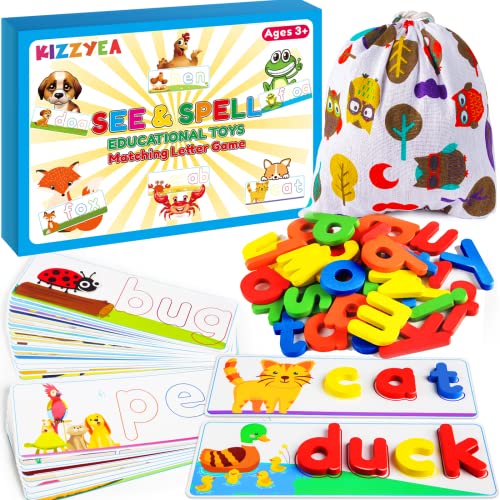
The KIZZYEA set introduces early literacy through a hands-on letter-building system. With 28 double-sided flash cards and 52 wooden blocks, children engage with 56 CVC sight words and numerous scenes that reinforce memory and word-building connections. As kids stack bricks and match letters to cards, fine motor skills strengthen and alphabet familiarity grows, enabling basic spelling like FUN. The educational design targets foundational reading readiness while supporting color and shape recognition. The wooden blocks are larger to reduce choking risk and are finished with water-based non-toxic paint to emphasize safety in preschool environments.
Key learning angles include: alphabet recognition, early word construction, memory development, and spatial awareness. The kit aligns with Montessori-inspired play and supports collaborative learning when used with peers or adults. Its multi-sensory approach—visual cards, tactile blocks, and verbal engagement—helps children connect letters to sounds in a playful context.
City Road Magnetic Tiles For Creative Play

The Goodtiles magnetic tiles road set emphasizes engineering-focused play and spatial reasoning through a city-building theme. The 38-piece collection includes road tiles, traffic signs, and colorful magnetic blocks to help children visualize traffic flow and urban planning scenarios. While there are no toy cars included, kids can imagine vehicles and infrastructure, which nurtures storytelling and executive-function skills such as planning and sequencing. The tiles are designed for compatibility with existing magnetic tile systems, allowing caregivers to expand a child’s play environment over time. This kit supports STEM learning by enabling experimentation with balance, symmetry, and cause-and-effect relationships during construction.
Educational angles to consider include: creative problem-solving, early geometry concepts, and standalone or combined play with other brands. The emphasis on open-ended play aligns with Montessori-inspired approaches, encouraging children to test hypotheses, adapt designs, and communicate reasons for chosen layouts.
UNGLINGA 70 Lab Experiments Kit

This chemistry-and-science education kit offers a broad set of experiments—volcano eruption, crystal growth, fruit circuits, and more—designed to cultivate curiosity and analytical thinking. With 70 different activities, children can explore foundational scientific principles, learn to follow step-by-step instructions, and practice hypothesis testing. An illustrated manual provides clear guidance, supporting independent exploration while also offering opportunities for guided learning with an adult. The range of experiments supports cross-disciplinary learning, blending chemistry, physics, math, and safe lab practices in a kid-friendly format.
Key considerations include safety, age-appropriateness, and the balance between guided activities and open-ended inquiry. Parents should supervise experiments that involve heat or chemical reactions and ensure proper handling of materials. The set’s breadth helps accommodate learners with varying interests, from physical reactions to circuit-building concepts, fostering a lasting interest in STEM disciplines.
GeoSafari Jr. Talking Microscope

The GeoSafari Jr. Talking Kids Microscope introduces preschoolers to the wonders of nature with guided narration from a familiar voice. This talking microscope helps children observe details up close, fostering curiosity about animals and plants while developing vocabularies through descriptive prompts. The device is designed to be user-friendly for young learners, with simple controls and child-safe optics. The accompanying content invites kids to look, listen, and learn, reinforcing observational skills and science literacy at an early age. The inclusion of a recognized host character offers added engagement that supports sustained attention during explorative sessions.
Educational value focuses on observational skills, early biology concepts, language development, and confidence in handling scientific tools. Caregivers can extend learning by asking questions about what the child sees and connecting observations to real-world ecosystems and habitats.
Buying Guide: Key Purchase Considerations For Educational Toys
- Age appropriateness: Match complexity to the child’s developmental stage to avoid frustration while ensuring a challenge that promotes growth.
- Learning goals: Identify which areas you want to support (reading readiness, STEM basics, fine motor skills, or imaginative play) and select toys that align with those aims.
- Safety and materials: Opt for non-toxic paints, sturdy wood or BPA-free plastics, and appropriately sized parts to minimize choking hazards for younger children.
- Durability and value: Look for durable construction that withstands frequent handling and potential drops, plus expandable play options to grow with the child.
- Open-ended vs structured play: A mix works best—open-ended toys foster creativity, while structured activities promote specific skill practice.
- Brand familiarity and instructions: Clear manuals and intuitive design help caregivers facilitate learning and maintain engagement.
- Maintenance: Consider ease of cleaning and storage to encourage regular use in day-to-day routines.
- Inclusion and diversity: Choose toys that depict diverse scenarios and roles to support broad perspectives and inclusion in play.
- Cost-to-benefit balance: Weigh the breadth of activities against price and the likelihood of continued interest over time.
- Safety supervision: Some activities require supervision, especially experiments and tools that involve small parts or liquids.