Best Developmentally Appropriate Toys for 3-5 Year Olds: Hands-on Learning and Fun
Finding age-appropriate toys for preschoolers involves balancing skill development with engaging play. The selected products below emphasize early literacy, math, fine motor skills, and imaginative exploration, all tuned for ages 3 to 5. Each item supports hands-on learning, safe design, and opportunities for independent or guided play.
| Product | Focus Area | Key Benefit |
|---|---|---|
| Walenty Preschool Workbook | Writing & Fine Motor | Erase-ready pages for repeated practice |
| Gagule Number Counting Blocks | Early Math & Spatial Skills | Hands-on counting and basic operations |
| LIWIN LET’S GO! Letter Matching | Phonics & Memory | Word recognition and letter discrimination |
| NASHRIO Busy Book | Screen-Free Learning | 12 themes; portable for travel |
| MOTREE Math Manipulatives | Numeracy & Problem Solving | Concrete counting and arithmetic |
Walenty Preschool Learning Activities Workbook

The Walenty workbook targets children aged 3-5 with a broad mix of tracing, handwriting, color and shape recognition, and matching activities. Pages emphasize correct stroke movement and handwriting basics while promoting hand-eye coordination and fine motor skills. This tool supports independent practice and can complement homeschooling or classroom activities. The design is water-resistant and durable, with easy-erase surfaces suitable for repeated practice using included markers and eraser. Ideal for building concentration and persistence through engaging tasks.
Montessori Number Counting Blocks Toy

This Montessori-inspired set introduces basic numeracy through tangible items: a wooden finger counting board, counting blocks, flash cards, and storage. Designed for little hands, the kit supports addition and subtraction within 10 via visual, tactile play. It fosters early math concepts while encouraging fine motor development and independent exploration, making it suitable for homeschool environments and preschool classrooms alike.
LIWIN LET’S GO! Matching Letter Game
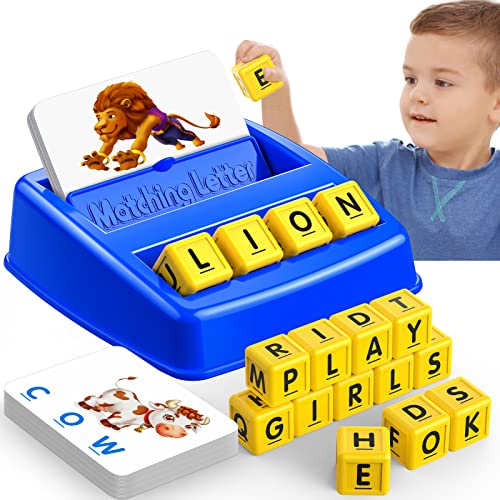
LIWIN LET’S GO! offers an engaging matching letters game designed for ages 3-8. For 3- to 5-year-olds, it supports memory, simple spelling, and early vocabulary recognition. The game also encourages parent-child interaction, helping children learn turn-taking, sharing, and cooperative play. The activity fosters strategic thinking and enhances word recognition by locating corresponding letters on cards, making it a versatile tool for pre-reading development.
NASHRIO Busy Book For Toddlers

The NASHRIO Busy Book brings screen-free learning with 12 themes and 12 drawing/writing pages. It centers on alphabet, numbers, colors, shapes, and recognition activities, designed to boost focus, concentration, and problem-solving. Its portable, travel-friendly format makes it a practical option for car rides and waiting rooms, supporting quiet, independent exploration while promoting fine motor skills and cognitive development.
MOTREE Educational Math Manipulatives

This kit provides a concrete approach to early math through wooden counting blocks, finger boards, and flash cards. It supports counting, basic arithmetic, and visualizing numerical relationships. The hands-on nature strengthens fine motor skills and fosters an intuitive grasp of quantity, making it suitable for classroom centers, homeschooling setups, and individual practice sessions for 3- to 5-year-olds.
Buying Guide: Key Purchase Considerations
- Developmental fit: Choose toys aligned with typical milestones for ages 3-5, such as letter recognition, number sense, fine motor control, and basic problem-solving.
- Learning style compatibility: Include a mix of tactile, visual, and auditory options to accommodate different learning preferences and keep engagement high.
- Safety and durability: Look for non-toxic materials, rounded edges, and sturdy construction suitable for rough handling by young children.
- Screen-free options: Balance digital or screen-based activities with hands-on toys to promote attention span, imaginative play, and family interaction.
- Portability and storage: For busy families, compact sets or busy books with organized storage help maintain order and accessibility.
- Skill progression: Select toys that introduce or reinforce foundational concepts—letter recognition, counting, basic addition/subtraction, and pattern recognition—then gradually increase complexity.
- Parental involvement: Some games encourage shared play, which can support language development, social skills, and early literacy through guided participation.
| Aspect | What It Means For Your Child |
|---|---|
| Hands-on learning | Engages multiple senses to build memory and understanding. |
| Fine motor focus | Supports pencil grip, buttoning, cutting, and crafts later on. |
| Early numeracy | Develops counting, simple addition/subtraction, and quantity comprehension. |
| Pre-reading skills | Enhances letter recognition, phonics, and word identification. |