Best Counting Cubes for Kids: Top MathLink Sets for Early Math Mastery
Counting cubes open a world of hands-on math learning for young children. The following picks highlight versatile sets that support counting to 100, basic arithmetic, patterning, and early STEM skills. Each product combines colorful, connectable cubes with activities or guides to promote fine motor skills, spatial reasoning, and school readiness. Read on to compare features and find the best fit for home, classroom, or homeschool use.
| Product | Brand | Best For |
|---|---|---|
| Learning Resources MathLink Cubes – Set of 100 | Learning Resources | Counting to 100, classroom fundaments |
| Learning Resources MathLink Cubes Big Builders – Set of 200 | Learning Resources | Imaginative play, early engineering |
| SpriteGru Math Linking Cubes – 100 | SpriteGru | Colorful counting and early STEM |
| KUTOI Math Manipulatives Counting Cubes – 100 | KUTOI | Hands-on operations, patterns and math basics |
| Learning Resources STEM Explorers MathLink Builders – 100 | Learning Resources | Critical thinking, fine motor with building |
Learning Resources MathLink Cubes — 100 Cubes
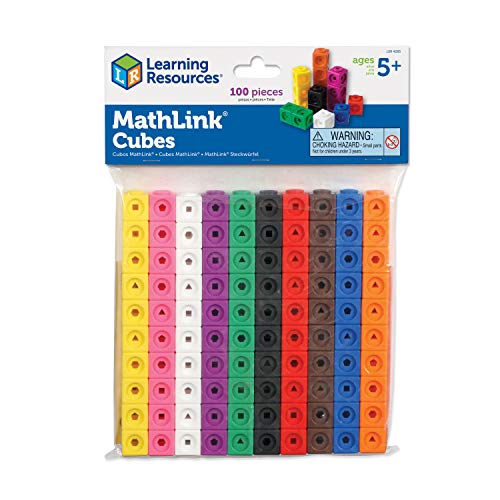
The 100-cube set provides a compact foundation for essential math skills. Children can practice one-to-one correspondence, counting to 100, skip counting, and basic addition and subtraction. The cubes snap together on all sides, enabling more complex patterning and geometric explorations. The set supports color and shape identification, patterning, matching, and fine motor development. It is suitable for homeschool, classroom activities, and early math centers, with a focus on school readiness and practical math concepts.
Learning Resources MathLink Cubes Big Builders — 200 Cubes

The 200-piece Big Builders set invites expansive play and early engineering. Beyond counting and basic operations, children imagine and construct vehicles, animals, and structures, strengthening critical thinking and design planning. The larger quantity supports collaborative activities and extended projects, while activity guides help teachers and parents introduce math concepts through engaging builds and games. This set emphasizes creativity alongside foundational math literacy, making it strong for classrooms and homeschooling environments.
SpriteGru Math Linking Cubes — 100

SpriteGru’s 100-piece set features ten vibrant colors, making it easy to explore color relationships, counting, place value, and basic operations. The cubes link together to form various configurations, supporting imaginative play like names, robots, windmills, and more. This kit is well-suited for preschool and kindergarten activities, homeschool sessions, and small-group math centers, offering engaging, color-coded practice for early math fluency and creative thinking.
KUTOI Math Manipulatives Counting Cubes — 100

Designed for ages 4-8 and up to 6th grade, KUTOI’s counting cubes emphasize a hands-on approach to addition, subtraction, multiplication, and division. The ten-color palette enhances pattern recognition and visual learning, making it easier for kids to grasp numeric relationships and quick mental math. The durable, stackable design supports continuous practice, small-group activities, and classroom use, with a focus on building confidence through visual math representations.
Learning Resources STEM Explorers MathLink Builders — 100

STEM Explorers Builders combine math manipulatives with building challenges to promote critical thinking and fine motor skills. Children construct animals, objects, and more while exploring STEM concepts. The 100-piece set supports guided activities and independent exploration, helping young learners apply math in design tasks. It’s a practical choice for centers, after-school programs, and homeroom math activities that blend arithmetic with engineering thinking.
Buying Guide: Key Considerations For Choosing Between Counting Cubes
- Learning goals: Align cubes with counting accuracy, patterning, basic operations, and early engineering concepts. If you want deeper engineering and design play, consider the larger 200-piece sets.
- Age and skill range: For younger children, 100-piece sets with bright colors are typically sufficient. For mixed-age groups, 200-piece sets offer more challenge and collaboration opportunities.
- Durability and storage: Look for sturdy construction and a clear storage solution or box to keep pieces organized between activities.
- Color and pattern options: Sets with 10 colors or multi-pattern options help teach color recognition, place value, and patterning more effectively.
- Educational scope: Some sets emphasize foundational counting, while others include activity cards or guides that structure lessons and centers.
- Classroom suitability: For teachers, sets with larger piece counts and accompanying activities can support multiple students and stations.
Across these options, counting cubes serve as versatile tools for developing numerical fluency, spatial reasoning, and problem-solving. The right set depends on your learner’s age, group size, and preferred learning style. Whether used for individual practice, small-group instruction, or guided activities, these cubes provide tangible, colorful ways to explore math concepts in practical, engaging ways.