Best Construction Kits for 12 Year Olds: Engaging STEM Projects for Growing Builders
Finding hands-on, screen-free learning activities for curious pre-teens can be a challenge. The following construction kits for 12 year olds blend engineering concepts with creative play, helping kids build confidence, problem-solve, and explore how things work. Each pick below offers clear instructions, durable components, and real-world STEM value, making them suitable for gift-giving, classroom use, or family projects.
| Product | Brand | Key Benefit | Age Range |
|---|---|---|---|
| Smartivity DIY Robotic Mechanical Hand | Smartivity | 100% screen-free, hands-on engineering | 8–14 years |
| Snap Circuits Flight Deck | Snap Circuits | Electrical circuits with flight-based experiments | 8+ years |
| Thames & Kosmos Structural Engineering: Bridges | Thames & Kosmos | Force, load, and structural principles | 8+ years |
| Engino STEM: Structures & Bridges | Engino | 9 modeled systems demonstrating building forces | 9+ years |
| Yutin Wood Building Kits | Yutin | Wood construction projects with multiple models | 8–12 years |
Smartivity Diy Robotic Hand: A Hands-On Engineering Kit

The Smartivity DIY Robotic Mechanical Hand combines mechanical engineering with creativity. Step-by-step instructions guide kids as they assemble a working hand-like device, reinforcing concepts such as gears, levers, and motion transfer. The kit emphasizes a screen-free, educational experience designed to boost problem-solving, spatial reasoning, and persistence. It is suitable for a broad age range, including 12-year-olds, and offers a lifetime supply of replacement parts to minimize interruptions during play.
The kit’s action-packed design helps young builders see cause-and-effect in real time. Assembling the device fosters patience and attention to detail while reinforcing foundational science knowledge. The included manual provides clear explanations along with checklists and troubleshooting tips, helping learners stay engaged even if a step becomes challenging. This product is well-suited to independent play or guided activities in classrooms or after-school programs.
In addition to the immediate hands-on appeal, Smartivity emphasizes long-term learning. Building the robotic hand introduces kids to the basics of biomechanics and mechanical advantage, laying groundwork for more advanced robotics projects later. The absence of screens makes it a compelling alternative for families seeking productive screen-free entertainment that still feels modern and exciting.
Snap Circuits Flight Deck: Flight-Themed STEM Studio

Snap Circuits Flight Deck blends simple circuit-building with flight- and air-themed experiments. With five unique projects, kids learn how electricity, airflow, and motion interact to produce lift, propulsion, and control. Projects include launching paper airplanes, operating a spinning wheel, and levitating balls with air pressure. The clear, step-by-step directions foster independence and confidence, while the hands-on activities encourage experimentation and curiosity about physics and engineering.
The kit is designed for flexible use, letting learners explore different configurations as they gain confidence. By answering questions about why certain designs work, children build a practical understanding of energy transfer, circuitry, and the basics of aerodynamics. It also provides an accessible way for caregivers and educators to facilitate inquiry-based learning without specialized equipment.
As a gift or classroom resource, Flight Deck stands out for its approachable complexity. It introduces essential STEM concepts without overwhelming beginners, while still offering room to grow through additional Snap Circuits sets. The emphasis on independent exploration makes it suitable for self-directed projects or guided activities within a group setting.
Thames & Kosmos Bridges & Skyscrapers Kit

This Thames & Kosmos kit invites learners to build 20 different models while exploring foundational physics concepts such as force, load, compression, and tension. With more than 285 interchangeable building pieces, the set includes a 36-page illustrated manual and an assembly guide. Students compare different structural designs, testing hypotheses about stability and resilience under various loads. The project-based approach supports iterative learning as kids adjust models to improve performance.
Educational value arises from translating theoretical ideas into tangible structures. The activity emphasizes scientific reasoning, measurement, and planning, while also developing fine motor skills through precise assembly. The kit’s versatility makes it useful for family projects, STEM clubs, or classroom demonstrations where students can compare bridge designs and skyline formations side by side.
For teachers and parents, the Bridges & Skyscrapers kit offers a clear path from concept to hands-on creation. The included manual provides guided experiments, questions, and room for independent inquiry, making it suitable for both structured lessons and open-ended exploration.
Engino Structural Engineering: Bridges And Buildings
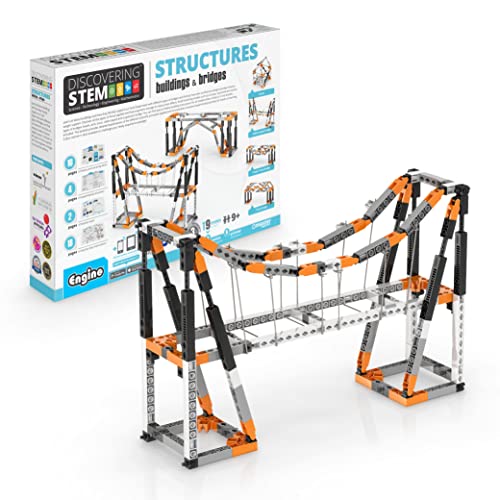
Engino’s STEM Toys focus on structures, buildings, and bridges, offering nine different working models. Learners explore how forces act on different designs and how weight distribution affects stability. Each model demonstrates a particular engineering principle, translating complex ideas into tactile experiences. The kit includes 10 pages of theory and facts, plus practical experiments and a short quiz section to reinforce learning. It has earned recognition as a top STEM toy selection, underscoring its instructional value.
The instruction set is clear and approachable, with a combination of guided steps and room for experimentation. Students can compare models, discuss alternate configurations, and experiment with material properties. The variety of models—ranging from simple structures to more complex builds—supports differentiated learning, making it suitable for mixed-age groups or individual study.
Educators and parents appreciate its emphasis on foundational engineering concepts, including loads, tension, and stability. The engaging format makes engineering accessible to curious 12-year-olds while remaining rigorous enough for classroom use or science fair prep.
Yutin Wood Building Kits: 4-in-1 STEM Craft Kit

This 4-in-1 wood construction kit includes a Tower Crane, Hydraulic Loader, Solar-Powered Truck, and Road Roller. The wooden pieces provide a tactile, satisfying building experience while minimizing plastic use. The set is designed to spark curiosity about construction, mechanics, and energy concepts, with projects that are suitable for 8–12-year-olds. The included instructions and multiple model options encourage creativity and flexible thinking as children plan, build, and test their creations.
Wood craftsmanship adds a tangible sense of durability and quality. Kids gain practical skills in planning, measurement, and hand-eye coordination as they follow step-by-step build guides. The kit also supports collaborative play, enabling family or class projects that explore different designs and outcomes, from simple towers to more elaborate machines. It is a strong option for young builders who prefer traditional materials with modern STEM applications.
Buying Guide: Key Purchase Considerations For 12-Year-Old Builders
When selecting construction kits for 12 year olds, consider the following factors to ensure the best fit for skill level, interests, and learning goals.
- Curriculum and age-appropriateness: Choose kits that align with foundational STEM topics—mechanics, electricity, structures—and match the child’s current abilities while challenging them just enough.
- Hands-on complexity: Look for kits with clear instructions, scalable difficulty, and opportunities to modify designs or run experiments to reinforce concepts.
- Materials and durability: Durable components, safe materials, and reliable parts reduce frustration and extend playtime learning.
- Educational value: Favor kits that explain the science behind the projects and include activities that promote critical thinking, hypothesis testing, and problem-solving.
- Independent vs guided use: Some kits are excellent for solo exploration, while others benefit from cooperative play or teacher-led activities.
- Expansion potential: Kits that integrate with other sets or offer additional projects provide long-term value and growth paths.
- Rebuildability and spare parts: Replacement parts or modular designs help maintain interest and accommodate trial-and-error learning.
For a balanced learning experience, parents and educators can mix projects that emphasize different disciplines—mechanics, electronics, and civil engineering—so kids experience a broad range of STEM concepts. Consider pairing a circuit-focused kit with a structural or wooden-building kit to reinforce cross-domain understanding. Finally, gauge interest by observing which projects captivate the child most and then supplement with related activities or challenges to deepen understanding.