Best Coding Kits for Kids: Fun, Safe, and Educational STEAM Toys
Discover top-rated coding kits designed to spark curiosity, teach fundamentals, and build confidence in young learners. The selections below cover hands-on electronics, robot building, unplugged coding, and kid-friendly programming tools suitable for ages 5 and up. Each kit combines practical activities with clear learning goals, offering a screen-free or partially screen-enabled approach to help kids understand logic, problem solving, and basic engineering principles.
The following summary table highlights the five chosen products, including key strengths and what makes them a good fit for different ages and interests. Use this quick guide to compare styles—from snap-circuit experiments to color-sensing robots and kid-friendly programming platforms.
| Product | Brand | Core Focus | Learning Angle |
|---|---|---|---|
| Snap Circuits Jr. SC-100 | Snap Circuits | Electrical circuits | Hands-on circuit concepts for ages 8+ |
| Thames & Kosmos My Robotic Pet: Coding Chameleon | Thames & Kosmos | Color-sensing coding robot | Unplugged coding with color cards and sensors |
| Teach Tech Mech 5 | Snap Circuits | Mechanical coding robot | Mechanics and basic coding concepts |
| ELEGOO UNO R3 Smart Robot Car Kit V4 | ELEGOO | Arduino-based robotics | Programming, sensors, and remote control |
| Osmo Coding Starter Kit | Osmo | Hands-on coding with physical blocks | Interactive, screen-based and hands-on collaboration |
All five kits provide structured activities, clear instructions, and opportunities to build real-world skills. Whether a child prefers assembling circuits, coding through play, or exploring robotics with color and sensors, these kits offer engaging paths to grow confidence in STEM subjects.
Snap Circuits Jr. SC-100 Electronics Exploration Kit

The Snap Circuits Jr. SC-100 kit offers an approachable way to explore electrical engineering concepts. With more than 100 possible projects and a full-color project manual, kids 8 and older can build a wide range of devices—from alarms to flying gadgets. The 29 included parts snap together safely, helping children understand circuits, conductivity, and the basics of electronics. The modular design makes it easy to reconfigure for new experiments, encouraging repeated exploration and curiosity.
Key strengths include a strong introductory narrative, clear visuals, and age-appropriate challenges that scale up as understanding grows. For families, this kit can be a shared learning activity that gradually introduces more complex ideas, while keeping safety and engagement at the forefront.
To maximize learning, consider pairing projects with simple explanations about circuits, voltage, and switches. Additional kits from Snap Circuits can extend the learning path as interest deepens, creating a modular, long-term STEM activity plan.
Thames & Kosmos My Robotic Pet: Coding Chameleon

This color-sensing coding robot combines hands-on building with unplugged coding challenges. The 15-inch robotic chameleon features articulated joints and color sensors, allowing kids to program a range of movements and reactions using physical action cards. The color sensor, infrared sensor, and RGB LEDs enable interactive play without screens, making it ideal for classroom demonstrations or at-home exploration. Kids learn about sensors, feedback, and basic programming logic through tangible actions and color-based commands.
The kit supports exploration across three modes—play, code, and learn—so instruction can adapt to a child’s pace. It emphasizes solving problems with physical tools, which can reinforce computational thinking without relying on digital interfaces. This approach suits families seeking screen-free coding experiences that still feel modern and engaging.
Teach Tech Mech 5 Mechanical Coding Robot
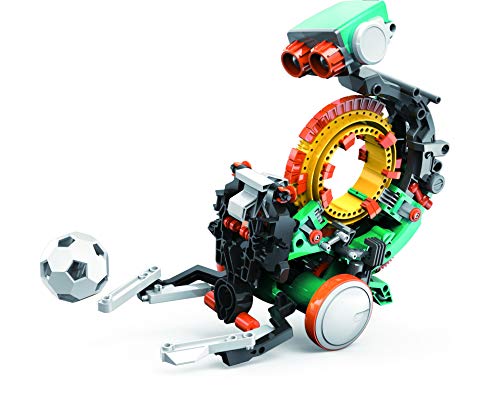
Mech-5 offers a unique blend of mechanics and coding in a single, mission-based robot. Kids snap coding buttons onto a coding wheel to control the robot’s actions—throwing, lifting, kicking, and drawing are all achievable through modular design. This hands-on approach helps young engineers connect mechanical systems with basic programming concepts. The kit emphasizes problem-solving, sequencing, and cause-and-effect reasoning as children build and test their creations.
With a focus on tangible outcomes, Mech-5 suits learners who enjoy building and seeing immediate results from their coding decisions. It can be used to illustrate how computational thinking translates into mechanical motion, making it a strong bridge between software ideas and physical machines.
ELEGOO UNO R3 Smart Robot Car Kit V4

The ELEGOO UNO R3 Smart Robot Car Kit V4 centers on Arduino-based robotics, offering a complete package for learners who want to delve into programming, electronics, and autonomous systems. The kit includes 24 components, such as obstacle avoidance and line-tracing modules, with compatibility for Android and iOS control through apps. It’s a robust option for older kids and pre-teens who are ready to tackle more advanced electronics projects and software integration. The assembly process emphasizes careful wiring and system integration, building practical knowledge about sensors, actuators, and control logic.
Educational value lies in translating code into behavior—designing circuits, writing simple programs, and testing outcomes in real-world scenarios. This kit supports a progression from block-based or simple text programming to more complex coding concepts, making it a solid long-term STEM investment.
Osmo Coding Starter Kit

Osmo’s Coding Starter Kit blends physical game pieces with a digital interface, delivering a hands-on coding experience for ages 5 and up. The included Osmo Base (not shown in images) pairs with compatible iPhone or iPad devices to bring coding puzzles to life, including modules such as Coding Awbie and Coding Jam. This approach emphasizes logic, sequencing, and pattern recognition through interactive play, making it accessible for younger children while remaining scalable for older kids as skills grow. Osmo’s design encourages collaboration and family involvement in learning activities.
Strengths of Osmo include its blend of tangible blocks and app-based feedback, which supports multi-modal learning. It is particularly well-suited for early learners who benefit from visual cues and guided instruction, while still offering challenges that extend beyond beginner concepts.
Buying Guide: Key Purchase Considerations And Comparisons
- Age appropriateness: Check recommended age ranges and project complexity. Some kits start very young with unplugged or simple electronics, while others target older kids with more programming depth.
- Learning style: Decide between screen-free experiences (color sensors, physical blocks), mixed-media kits (some app integration), or fully digital platforms. A multi-modal approach can reinforce concepts from different angles.
- Safety and durability: Look for sturdy components, snap-tieces, and non-toxic materials. Reusable kits with switches and connectors tend to provide lasting value.
- Expansion potential: Consider whether the brand offers additional accessories or kits that extend learning with more projects and modules.
- Curriculum alignment: Some kits align with STEM education standards or offer structured lesson ideas, which can help caregivers introduce topics confidently.
- Technical complexity: For beginners, start with simpler kits and progressively move to ones that require coding or robotics concepts, to avoid frustration and promote persistence.
- Platform preferences: If a child enjoys tablets and apps, choose kits like Osmo or Arduino-based kits that support app-based programming. For screen-free learners, color-sensor robots or mechanical coding kits may be preferable.
- Budget and long-term value: Compare the number of projects, parts, and potential for expansion when assessing long-term educational value.
Across these options, parents and educators can select kits that balance immediate engagement with opportunities for deeper learning. The best choice often combines a primary kit that matches a child’s current interests with one or two supplementary kits to broaden exposure to different STEM domains, such as electronics, robotics, and algorithmic thinking.