Best Wood Models for Kids: Engaging STEM Kits and Building Projects
Wooden building kits and 3D puzzles offer hands-on learning, problem solving, and creative play for kids. This guide reviews five top wood-based model kits that support STEM education, motor skills, and imaginative exploration. Each option emphasizes safe, age-appropriate building, clear instructions, and lasting family activity value.
| Product | Brand |
|---|---|
| Yutin STEM Kits for Kids Age 8-12 (6 Pack) | Yutin |
| NATIONAL GEOGRAPHIC Da Vinci Model Kit – Catapult Kit | Blue Marble |
| STEM Kits for Kids Ages 8-12 (4-in-1) | Yutin |
| Dinosaur STEM Kits for Kids Ages 8-12 | Yutin |
| Poraxy 5 in 1 STEM Kits for Kids | Poraxy |
Introduction continues: This selection emphasizes diverse models, from multi-vehicle sets to historic mechanisms and dinosaur-themed builds. Each item fosters hands-on learning, motor skills development, and curiosity about how things work, with age-appropriate components and clear instructions for safe, screen-free play.
Yutin 6-Pack STEM Kits for Kids
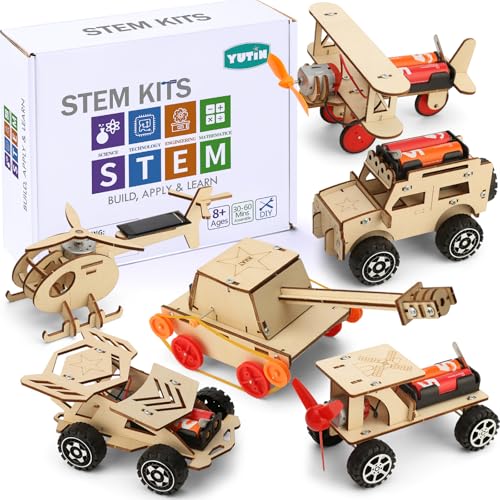
The Yutin 6-pack kit includes six wooden car-themed builds: four-wheel drive, tank, wind-powered vehicle, off-road vehicle, solar helicopter, and biplane. The set also includes a screwdriver. Battery power is not included. This collection supports hands-on exploration of motor operation, energy conversion, and vehicle mechanics. It encourages kids to learn by assembling real-world models, while fostering fine motor skills and spatial reasoning.
NATIONAL GEOGRAPHIC Da Vinci Catapult Kit

This National Geographic kit builds three ancient machines: a ballista, a bombards-style cannon, and a catapult. Fully functional models come with 15 projectiles and six paper targets. The kit includes laser-cut wooden components, rubber bands, sandpaper, and simple instructions. It provides a practical introduction to early engineering and physics concepts without requiring specialized tools. The projects typically take 1-3 hours to complete, offering a concise yet rewarding building experience.
STEM Kits for Kids Ages 8-12 (4-in-1)

This kit combines four distinct wood-building projects: a Tower Crane, a Hydraulic Loader, a Solar-powered Truck, and a Road Roller. It’s designed to spark curiosity in science and engineering while improving hand-eye coordination and creativity. The components emphasize safe, sturdy wooden construction with clear instructions. It’s pitched as an ideal gift to nurture engineering interests and reduce screen time, suitable for a wide age range within the 8-12 bracket.
Dinosaur STEM Kits (4-in-1)

This set contains four dinosaur-themed wooden puzzles: Tyrannosaurus, Triceratops, Pterosaur, and Brachiosaurus. Children assemble the pieces to reveal each dinosaur, while learning about animal shapes and joints. The kit emphasizes easy popup-piece assembly with labeled parts and screws, supporting early engineering and problem-solving, with clear instructions suitable for home or classroom use. It aims to engage kids in hands-on discovery and imaginative play while building fine motor skills.
Poraxy 5 in 1 STEM Kits for Kids
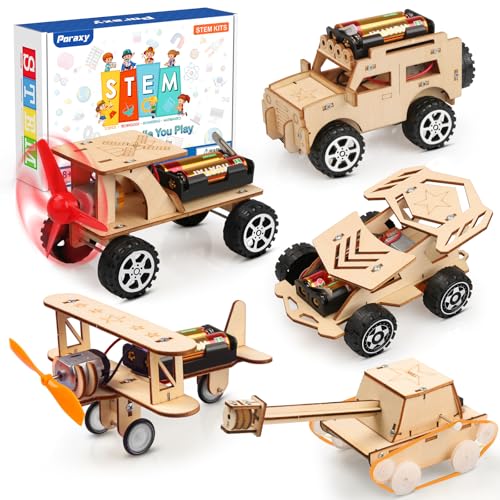
The Poraxy 5-in-1 kit offers five distinct model cars within a single package. It supports building engineering toys that strengthen scientific understanding and practical construction skills. The kit emphasizes hands-on activities designed to reinforce STEM concepts, with an emphasis on curiosity, problem-solving, and collaborative play. Materials are packaged to encourage independent or guided assembly, making it suitable for a range of ages toward the upper end of the 8-12 bracket.
Yutin Remote Control Wood Model Kit
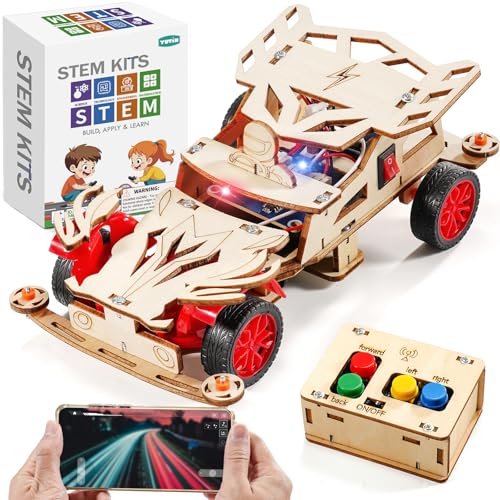
Note: This listing features a remote-control wood car project with a detailed build process. The kit emphasizes building a functional RC vehicle from wood, including a screwdriver and detailed instructions. It supports learning about electronics, propulsion, and control systems through practical, hands-on activity. It’s designed for ages around 8-12, with adult supervision recommended for younger children.
Buying Guide: Key Purchase Considerations
- Age appropriateness: Check recommended ages and the level of supervision needed. Some kits suit younger kids with adult help, while others are designed for independent building by older children.
- Skill development goals: Consider whether the kit emphasizes mechanical engineering, problem solving, creative design, or STEM concepts like energy, motion, and hydraulics.
- Materials and safety: Look for pre-sanded wood, child-safe screws, and non-toxic finishes. Ensure there are no small parts that pose choking hazards for younger children.
- Number of projects and complexity: Multi-pack sets provide variety but may require more time and space. A 4-in-1 or 5-in-1 kit offers broader learning in one purchase.
- Instructions and support: Clear step-by-step guidance and diagrams help kids stay engaged. Some kits include extra tools (like screwdrivers) to facilitate independent assembly.
- Reusability and upcycling: Some kits allow reuse of materials, enabling ongoing projects or expansion with additional sets.
- Educational value vs. entertainment: Balance does not need to be exclusive; select kits that teach concepts while remaining enjoyable to sustain interest.
- Gift suitability: Consider the recipient’s interests (cars, dinosaurs, architecture) and whether the kit can be a standalone project or a shared family activity.
Comparative Perspectives
- Hands-on STEM emphasis: Kits like the 4-in-1 and 5-in-1 sets emphasize practical building and foundational science concepts, while the National Geographic catapult focuses on historical engineering with functional models.
- Variety vs. focus: Multi-project kits provide broad exposure, whereas single-theme kits (dinosaur puzzles or remote-control builds) offer deeper exploration of a specific interest.
- Independence vs. guided play: Some kits are truly kid-driven with minimal adult help, while others are better suited for guided sessions, especially with younger children.
- Durability and reuse: High-quality wood and metal fasteners support repeated builds and long-term use, enhancing value beyond a single project.
- Physical vs. cognitive demands: Complex assemblies improve fine motor skills and spatial reasoning, while simpler builds still support sequence following and problem solving.