Best Traffic Signal Toys for Kids: Safe, Educational Lights for Play
For parents and educators, traffic signal toys can teach road safety, color recognition, and sequencing through engaging play. This guide highlights five top picks that combine durability, interactive features, and safe design to support early learning. Each product below includes hands-on modes, light sequences, and kid-friendly construction to help children understand how intersections work while having fun.
| Product | Brand | Key Feature |
|---|---|---|
| Hiboom 1 Piece Traffic Light Toy | Hiboom | Manual/Automatic modes; 28.3″ height; durable plastic |
| ArtCreativity Traffic Light for Kids | ArtCreativity | 8 operating modes; rechargeable with remote |
| VOSAREA Realistic Traffic Light Toy | VOSAREA | LED signals with authentic sounds; compact mini size |
| Kiddie Play Traffic Signs Set | Kiddie Play | Includes signs and crosswalk; beeping LED lamp |
| Theo Klein Traffic Lights Premium | Klein | Real working lights; durable construction |
Hiboom 1 Piece Traffic Light Toy

The Hiboom 1 Piece Traffic Light Toy provides a single, tall traffic light with two operating modes: manual and automatic. In manual mode, children press a round button to illuminate a chosen light. Automatic mode cycles red for 35 seconds, yellow briefly, then green for 35 seconds, with short yellow re-entry, repeating the sequence. Durability comes from sturdy plastic designed to withstand hours of play. The toy uses three AAA batteries (not included) and measures about 8.5 x 28.3 inches overall, with light modules around 8.1 x 3.2 inches. This setup supports solo or shared play, encouraging social interaction and cooperative learning.
Why it fits early learning: The predictable light cycle helps kids anticipate transitions and understand traffic flow. The option to switch modes allows educators and parents to tailor sessions—demonstrating cause and effect in a safe, controlled environment. The tall design mirrors real-world signals, aiding spatial reasoning and perspective-taking during pretend play.
Key considerations: Battery availability is essential for immediate play. The height is ideal for group activities yet may be tall for smaller play spaces. Its single light head emphasizes color recognition and timing rather than a full multi-signal system.
ArtCreativity Traffic Light for Kids

The ArtCreativity Traffic Light is a 13-inch educational lamp with eight distinct modes. It can display red, yellow, green on all sides or selectively on some sides, rotate signals, and simulate real traffic light choreography. A notable advantage is the rechargeable battery and wireless remote, eliminating the need for constantly buying batteries. Modes include full color displays, partial color combinations, rotation sequences, and real-traffic-like rotation. The product is designed to engage classroom or homeschool settings and elevate behavior and participation through gamified learning.
Why it fits learning goals: Teachers and parents can use the varied modes to reinforce color recognition, sequencing, and memory. The remote and rechargeability support flexible lesson planning and reduce maintenance time between sessions. The multi-sided display encourages students to compare perspectives and understand how intersections can be controlled from different angles.
Key considerations: Rechargeable power adds convenience but requires charging access. Some modes emphasize rotation more than continuous single-signal practice, which is useful for broader classroom activities but might be less focused on one-light practice for younger children.
VOSAREA Realistic Traffic Light Toy

The VOSAREA traffic light toy focuses on realism and tactile feedback. It features working red, yellow, and green LEDs with authentic signal sounds, bringing pretend-play crossings to life. The compact mini-size (roughly 17 x 11.5 x 5.5 cm) fits well on desks or shelves, with a sleek black base and bright colors to complement a child’s space. Lights change automatically, offering a hands-off experience that helps kids learn timing and road patterns as signals shift. This supports independent exploration as well as collaborative games with peers.
Why it works for foundational skills: Realistic cues reinforce understanding of safe crossing behaviors, while automatic sequencing builds a sense of cause and effect. The compact footprint makes it easy to integrate into playrooms or classrooms without dominating the space.
Key considerations: Some children may benefit from advanced modes occasionally; this model emphasizes automatic sequences and visual cues, which is excellent for younger learners but may be supplemented with more interactive modes later on.
Kiddie Play Traffic Signs Set
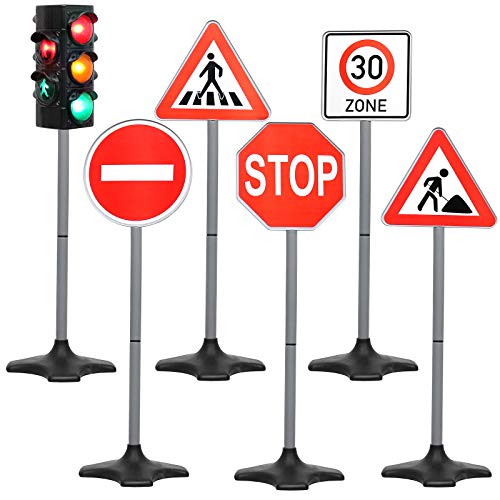
The Kiddie Play Traffic Signs set expands pretend play with a working four-way traffic light and crosswalk, plus 11 mini traffic signs. The package includes 5 warning signs (STOP, Pedestrian Crossing, No Entry, Road Works, 30 mph Zone), 5 foot plates, 10 bars, and 5 connection plugs. A beeping LED traffic light adds auditory feedback to reinforce learning. This set is ideal for small-group activities and classroom stations, enabling children to practice traffic safety rules in a structured, interactive way.
Educational value: The diverse signs and crosswalk elements support early literacy and symbol recognition, while turning signals encourage sequencing and turn-taking during collaborative games. The physical components foster fine motor skills through assembly and playtime manipulation.
Key considerations: This is a multi-piece kit; ensuring all parts are accounted for is important for safe use. The reliance on LEDs for beeping signals can help with sensory engagement but may require supervision to manage noise levels in quiet environments.
Theo Klein Traffic Lights Premium
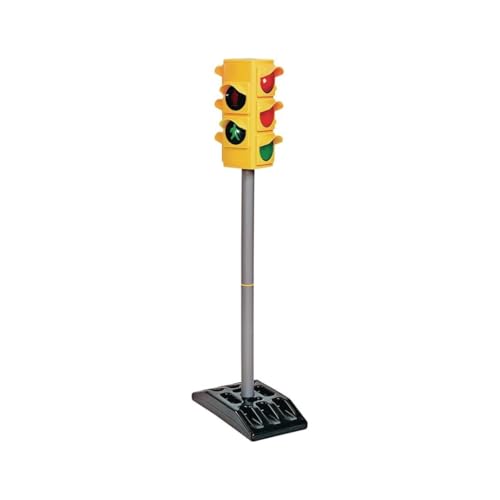
The Theo Klein Traffic Lights Premium offers real-looking lights arranged on a four-sided traffic signal, designed for kids ages 3 and up. The set emphasizes realism and durability, using sturdy plastic to withstand hours of imaginative play. It includes four-color signaling to teach color recognition and sequencing, with batteries not included (recommended 4xAA). The design supports group role-play and classroom demonstrations, making it a reliable option for teaching traffic safety concepts in a hands-on way.
Educational value: Realistic lighting patterns help learners understand timing, safe crossing practices, and how traffic signals manage intersections. The sturdy construction ensures longevity in busy play areas and shared spaces.
Key considerations: Battery requirements and the size of the unit should fit the intended play area. The focus on a single intersection can be complemented with additional signs or crosswalk props for broader scenarios.
Buying Guide: Key Purchase Considerations for Traffic Signal Toys
- Age suitability: Look for age-appropriate features, such as simplified modes for younger children and more complex sequences for older kids.
- Durability and materials: Choose sturdy plastics and safe, non-toxic finishes designed to withstand repeated handling and drops.
- Power options: Some models use batteries; others offer rechargeable batteries or remote control. Consider ease of recharging and availability of replacements.
- Modes and interactivity: A mix of manual and automatic modes fosters independent learning and social play. Multi-mode units can support different lesson plans.
- Size and footprint: Ensure the unit fits your play area or classroom setup, especially for shared spaces.
- Educational value: Prioritize features that reinforce color recognition, sequencing, rule-based play, and traffic safety concepts.
- Group play suitability: Sets with multiple lights or signs encourage collaboration, turn-taking, and cooperative problem-solving.
- Storage and maintenance: Easy assembly, disassembly, and cleaning help sustain long-term use in classrooms and homes.
- Safety standards: Check for BPA-free plastics and smooth edges to reduce choking hazards for younger children.
- Compare realism vs. simplicity: Realistic signals aid understanding of traffic flow, while simpler, colorful lights can be better for younger learners.
- Single vs. multi-signal sets: More signals support multi-child play and broader scenario practice, but require more space and organization.
- Audio features: Beeping sounds can engage sensory learners but consider environments where noise should be minimized.
- Battery management: If batteries are required, plan for replacement costs and safe storage when not in use.