Best Toy Clocks for Teaching Time
Explaining how to tell time is a core early learning objective, and kid-friendly clocks make the process engaging and hands-on. The following selections emphasize clear, moveable hands, age-appropriate design, and interactive features that reinforce time-telling skills in both classroom and home settings. Each option below aligns with common teaching goals—matching hour and minute hands, understanding analog and digital reading, and building confidence through guided play.
| Product | Brand | Key Feature |
|---|---|---|
| Learning Resources Big Time Mini Clock | Learning Resources | Hidden gears maintain correct time as you spin the hands |
| BEST LEARNING Learning Clock | BEST LEARNING | Talking clock with quiz mode and Sleep Mode night light |
| Melissa & Doug Turn & Tell Wooden Clock | Melissa & Doug | 12+ reversible time cards and hands that turn |
| Learning Resources Time Activity Set | Learning Resources | Multi-sensory system with clock, cards, puzzles, and dice |
| Coogam Wooden Clock Teaching Time Toy | Coogam | Analog and digital learning with a board game |
Learning Resources Big Time Mini Clock

The Learning Resources Big Time Mini Clock is designed to teach early time skills with a hands-on approach. Its hidden gears prevent the hands from misaligning while students twist the hour and minute pointers, creating a sense of cause-and-effect as time progresses. Color-coded hands align with hour and minute markings to reinforce reading accuracy. This classroom-friendly clock supports guided instruction and independent exploration, making it suitable for small groups or one-on-one tutoring sessions.
Key benefits include tactile engagement, durable construction, and a layout that emphasizes real-world clock reading. The clock’s mechanics help students visually connect the movement of the hands with the passage of time, supporting both analog time-telling and foundational math concepts such as sequencing and counting.
BEST LEARNING Learning Clock

The BEST LEARNING Learning Clock is a multi-award-winning educational toy that speaks the time and offers interactive quiz modes. It guides children to align the hour hand with the corresponding numeral and adjust the minute hand to the desired minute. The device reads the time aloud, reinforcing auditory and verbal associations with the visual clock face. In Quiz Mode, learners answer questions about time concepts, which helps with engagement and retention. Sleep Mode adds a soothing night-light and plays classical music, which can support a calming bedtime routine.
This clock supports diverse learning needs through its combined visual, auditory, and interactive features. The step-by-step manipulation of clock hands encourages independence while providing immediate feedback. It is particularly useful for classrooms implementing structured time-telling activities as well as parents seeking a versatile at-home learning aid.
Melissa & Doug Turn & Tell Wooden Clock

The Melissa & Doug Turn & Tell Wooden Clock emphasizes hands-on, kid-powered learning. It features sturdy time cards that slot into the clock’s top for time-matching activities and a hideaway digital clock that automatically changes to reflect the analog time shown. This combination of analog and digital practice helps children recognize time concepts across formats. The clock is designed for durable classroom use and robust home-school activities, making it a reliable choice for long-term learning.
Educators and parents benefit from its tactile card system, which adds a portable, classroom-ready element to lessons. As students manipulate the hands and check the corresponding cards, they build confidence in telling time and in following time-based routines.
Learning Resources Time Activity Set
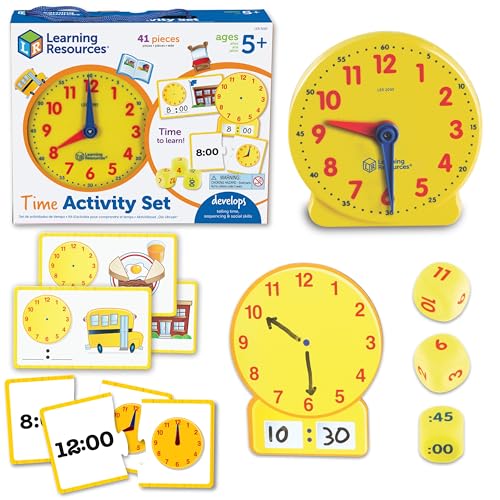
The Learning Resources Time Activity Set provides a comprehensive, multi-sensory approach to learning time. It includes a realistic clock with synchronized hands that move together, plus double-sided activity cards, a dry-erase board, and matching puzzles. Foam dice and additional manipulatives offer varied activities to suit different learning styles and paces. The system is designed to accommodate whole-class instruction or independent practice, enabling teachers to differentiate lessons for diverse learners.
With color-coded hands and a variety of activities, students can practice sequencing, elapsed time, and time-telling in incremental steps. The durable materials are suitable for busy classrooms, making it a dependable core resource for early math and time concepts.
Coogam Wooden Clock Teaching Time Toy

The Coogam Wooden Clock pairs analog and digital time learning with a fly-telling time board game. The hands rotate for easy adjustment, and the kit includes four double-sided flashcards for practice plus a board game set for 2-4 players. This interactive package turns time-telling into an engaging, collaborative activity—ideal for classrooms and homeschool groups. The mix of direct clock play and game-based learning supports memory retention while encouraging critical thinking about time concepts.
Its Montessori-inspired design emphasizes hands-on discovery, making it suitable for early years and mixed-ability groups. The combination of clock work, flashcards, and a board game helps learners translate time-reading skills into practical routines and scheduling awareness.
Buying Guide: Key Purchase Considerations And Comparisons
- Age and developmental stage: Choose clocks with clear, large numerals for younger children and denser, more challenging activities for older kids. Look for hands that are easy to grip and turn with smooth movement.
- Analog vs digital emphasis: If the goal is telling time on analog clocks, prioritize models that emphasize hour and minute alignment, with color-coded hands or guided feedback. For mixed literacy, consider sets that include both analog and digital practice.
- Hands-on manipulation: Hands-on clocks with moveable hands and hidden gears tend to reinforce correct time progression and reduce frustration during learning.
- Engagement features: Interactive quizzes, songs, or night-light options can boost sustained attention, especially in group settings. Sleep or quiz modes may be beneficial for transition times or nighttime learning routines.
- Durability and classroom suitability: Look for sturdy materials, secure hands, and components designed to withstand frequent handling in classrooms or busy homes.
- Comprehensive sets vs single clocks: Kits with activity cards, puzzles, and games offer broader practice, while single clocks provide focused, incremental practice for focused lessons.
- Storage and portability: Consider compact, stackable sets or organizers that help keep small pieces together when used in classrooms or travel.
- Teacher-friendly features: Clear labeling, color-coding, and alignment with common math standards can simplify lesson planning and ensure consistent results across different students.
- Budget and longevity: Durable wooden clocks typically offer longer life and higher resilience in classroom settings, while plastic models may be lighter and more affordable for at-home use.