Best Deep Space Telescopes for Astronomy Enthusiasts
The night sky reveals countless deep-space wonders, from distant galaxies to glowing nebulae. This guide highlights five top-performing telescopes that balance beginner-friendliness with the power needed for serious deep-space observing. Each selection offers solid optics, stable mounts, and practical features to explore the cosmos from your backyard or a dark-sky site. Use the buying guide at the end to compare options and choose based on aperture, mount type, portability, and upgrade potential.
| Product | Aperture | Focal Length | Mount Type | |
|---|---|---|---|---|
| Celestron NexStar 8SE | 8 in | 2032 mm | Computerized Alt-Az | Advanced deep-space observing |
| Celestron StarSense Explorer DX 130AZ | 130 mm | 650 mm | Alt-Az with smartphone guidance | Beginner-friendly sky tour |
| MEEZAA 150EQ Newtonian Reflector | 150 mm | 650 mm | German Equatorial | Bright deep-sky views |
| Dianfan 90mm Refractor | 90 mm | 800 mm | AZ mount (alt-az) | Balanced portability and power |
| Hawkko 90mm Refractor | 90 mm | 900 mm | AZ mount | Clear lunar and planetary views |
Note: The following product sections present the five selections most relevant to deep-space observing. Each section includes a brief overview, key features, and practical considerations for choosing the right instrument for your skies and goals.
Celestron NexStar 8SE Computerized Telescope

The NexStar 8SE combines a large 8-inch Schmidt-Cassegrain optical tube with a fully automated GoTo mount. Its 2032 mm focal length provides bright, detailed views of the Moon, planets, and bright deep-sky objects such as galaxies and nebulae. The NexStar+ hand control accesses a database of 40,000+ objects and automatically slews to targets, simplifying alignment and tracking. This setup suits observers who want ambitious performance with straightforward operation and future expandability.
Key considerations include portability versus weight, the need for a sturdy observing site, and the value of automated targeting for busy schedules or urban environments with limited star visibility. A solid option for intermediate to advanced amateur astronomers seeking a capable, long-term instrument.
Celestron StarSense Explorer DX 130AZ
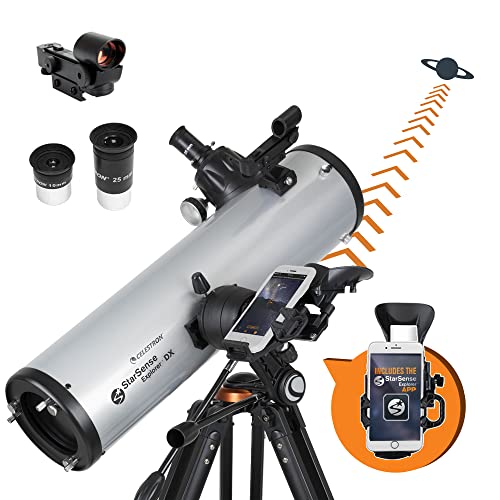
This 130mm Newtonian reflector excels for beginners and casual observers. It includes smartphone-guided StarSense technology, which analyzes the sky to determine your telescope’s position and suggests objects to view. The 650 mm focal length and 26–130X magnification range, aided by two eyepieces and a 2X Barlow lens, offer a flexible balance of wide-sky scanning and detailed lunar and planetary views. A red dot finder helps with quick targeting, while the Moon filter reduces glare for comfortable lunar detail.
Considerations center on the ease of setup, the quality of the smartphone integration, and how the app-driven guidance compares with more traditional star-hopping methods. Ideal for families and newcomers who want an approachable path into deep-space observing with modern tech assistance.
MEEZAA 150EQ Newtonian Reflector
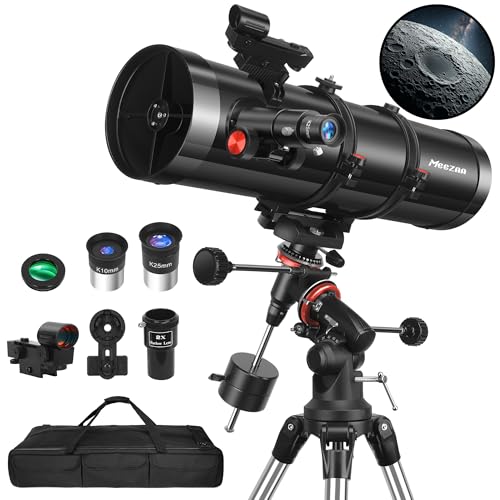
The MEEZAA 150EQ offers a 150 mm aperture and a 650 mm focal length, delivering strong light-gathering power for bright deep-sky views. The red dot finder aids in initial targeting, while the upgraded equatorial mount enables smoother manual tracking of celestial objects as they move across the sky. This setup is well-suited for amateur astronomers who want more light grasp than smaller refractors and a stable platform for extended observing sessions.
Practical considerations include the weight of the mount, ease of alignment, and the potential for future upgrades such as a motor drive or computerized accessory. It strikes a balance between performance, cost, and portability for frequent observers.
Dianfan 90mm Refractor with 800mm Focal

The Dianfan 90mm refractor delivers a practical 800 mm focal length with a fully coated 90 mm objective. The telescope includes two eyepieces and a 3× Barlow lens for a 32×–240× magnification range, enabling detailed lunar and planetary observations. The 45° zenith mirror provides upright images for terrestrial viewing, broadening its appeal to both stargazers and educational use. The quick-setup design is beginner-friendly, with smooth focusing for fast target acquisition.
Key considerations are whether the user prioritizes portability and quick assembly versus ultimate deep-sky light throughput. It’s a solid option for families and new astronomers seeking an affordable, capable entry into deeper space views.
Hawkko 90mm Refractor with 900mm Focal

The Hawkko 90mm refractor provides a 900 mm focal length with a fully multi-coated 90 mm lens to improve brightness and contrast. Its AZ mount offers straightforward operation and easy setup, making it a practical option for backyard astronomy. The 36×–270× magnification range supports a broad spectrum of targets, from lunar features to brighter deep-space objects when atmospheric conditions permit. Its portability makes it suitable for outdoor trips or quick sessions between duties.
Important considerations include mount stability on uneven ground, ease of aiming at distant objects, and whether the observer intends to upgrade to a tracking system or motor drive later on.
Buying Guide: Key Purchase Considerations
- Aperture size and light gathering: Larger apertures reveal fainter deep-space targets but add weight and cost. For serious deep-space work, consider 130 mm and above; for portability, smaller apertures still offer rewarding sky views with the right conditions.
- Mount type and tracking: Equatorial mounts excel for long-exposure and tracking accuracy, while Alt-Az mounts are easier for beginners and casual observing. Computerized GoTo or StarSense systems reduce sky-search time but add complexity and cost.
- Optical design: Refractors provide crisp views with minimal maintenance but can cost more per millimeter of aperture. Reflectors (like Newtonians) generally offer more aperture for the price and are favored for deep-sky work, but collimation requirements should be considered.
- Portability and setup time: If you travel to dark skies or have limited observing time, a lighter setup with faster setup is advantageous. Consider tripod stability and assembly steps in your decision.
- Accessories and future upgrades: Look for included eyepieces, a finder, a Moon filter, and compatibility with additional accessories (motor drives, field rotators, or camera adapters) to expand capabilities over time.
- Image quality and coatings: Fully multi-coated optics improve light transmission and contrast. Quality coatings and optical alignment influence the clearness of deep-space objects and planetary details.
- Target suitability: For deep-space exploration, prioritize larger apertures and stable mounts. For planets and the Moon, high magnification and steady optics are key, with good atmospheric conditions required for the best results.