Best Solar System Toys for 10 Year Olds: Hands-on Space Fun
The solar system is a perennial favorite for curious kids, especially around space-themed learning and imaginative play. This guide highlights five top solar system toys that blend hands-on building, interactive learning, and room décor appeal for 10-year-olds. Each pick encourages exploration, STEM thinking, and creativity, with clear educational benefits and engaging play experiences. Below is a quick summary of the chosen products to help you compare at a glance.
| Product | Brand | Key Feature |
|---|---|---|
| LEGO Technic Planet Earth and Moon in Orbit | LEGO | Crank-powered orbit model with months and moon phases |
| National Geographic Glow-in-The-Dark Solar System Model Kit | Blue Marble | Glows in the dark; movable arms; all-in-one kit |
| MOCBURIKU Solar System Building Set | MOCBURIKU | Rotatable, motor-assisted 8-planet model |
| Nine Planets DIY Solar System Model | Little Jupiter | Wood model with puzzle and fact cards |
| Science Can Interactive Solar System Model | Science Can | Talking projector with 8 planets and bilingual content |
Note: Each product is designed to support STEM learning, hands-on construction, and space-themed imagination suitable for 10-year-olds. Availability and exact features may vary by retailer.
LEGO Technic Planet Earth and Moon in Orbit
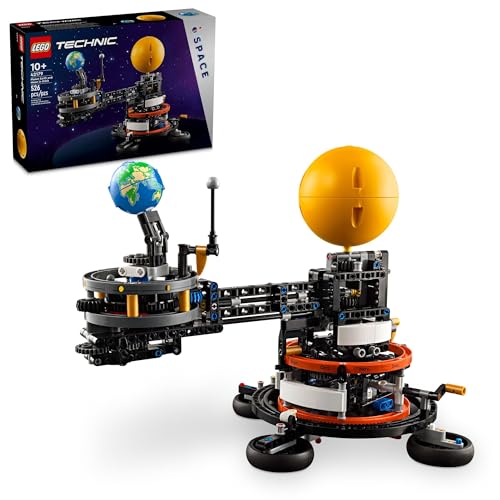
The LEGO Technic Planet Earth and Moon in Orbit (Set 42179) offers an interactive model where kids build a representation of the Earth, Sun, and Moon in orbit. By turning a crank, children can visualize the orbital dynamics and the influence of the Sun on seasons, with printed details showing months and moon phases. This kit supports imaginative play while reinforcing basic astronomy concepts, and doubles as space-themed room décor that appeals to both boys and girls. Suitable for independent play or collaborative building with friends or family.
Science Can Solar System for Kids – Talking Model

The Science Can Solar System for Kids combines a talking, 8-planet model with an engaging projector and bilingual content. Kids can press planet patterns to access educational facts and switch between English and Spanish, enhancing language-inclusive learning. Its immersive planetarium projector displays 24 full-color space images across the walls or ceilings, offering a visually rich way to explore planetary science. The interactive quiz mode adds an evaluative layer to independent learning, suitable for ages 6-12 and family science time.
National Geographic Glow-in-The-Dark Solar System Model Kit

The National Geographic Glow-in-The-Dark Solar System Model Kit for Kids enables builders to customize all eight planets and the Sun, creating a striking 3D model that glows in the dark. The kit is all-inclusive, including six paint colors, glow accents, brushes, decals, and a solar-system fact poster to assist study. Its movable arms allow adjusted planet positions, making it ideal for arranging a dynamic display in a bedroom or study space while reinforcing spatial reasoning and planetary alignment concepts.
MOCBURIKU Solar System Building Set

This MOCBURIKU Solar System Building Set blends STEM learning with mechanical engineering. The kit features a rotatable solar system with an L-motor and battery box, allowing children to simulate planetary revolution and rotation. It requires six AAA batteries (not included) and demonstrates a realistic planetary motion through a color-coded, eight-planet model. The mechanical transmission accurately mirrors orbital dynamics, supporting hands-on exploration of astronomy concepts and engineering principles in a visually engaging way.
Nine Planets DIY Solar System Model

The Nine Planets DIY Solar System Model by Little Jupiter presents a wood-based solar system kit with a puzzle and fact cards. This two-part project allows kids to build, paint, and learn about the major nine planets. It is especially suitable for science fairs, classroom displays, or bedroom décor. The included fact cards support quick reference to solar system information, making it a solid choice for learners who enjoy hands-on construction paired with informational content.
Buying Guide: Key Purchase Considerations
- Learning goals: Choose kits that blend hands-on building with astronomy concepts, such as orbital motion, phases, or planet facts. Some options emphasize projection and interactivity, while others focus on physical models and decor.
- Age and complexity: For 10-year-olds, look for kits that balance challenge with accessibility. Some sets include motors, disks, or bilingual content; others rely on manual assembly and painting.
- Durability and materials: Wood and high-quality plastics tend to withstand longer use and multiple play sessions. Glow-in-the-dark paints can be fun but may require careful handling by younger children.
- Additional learning tools: Posters, fact cards, and disks offer quick reference and enrichment beyond playtime. Bilingual features expand linguistic exposure in a bilingual household or classroom.
- Display and space: Some kits double as room décor with movable parts, glow features, or wall projections. Consider the child’s available space and whether the display will be a focal point in a bedroom or study area.
- Power and maintenance: Motorized kits require batteries; plan for replacements and safe handling of electronics in a child’s play environment.
- Educational value vs. entertainment: Balance scientifically accurate models with engaging activities to sustain interest and promote long-term curiosity about space.
These options provide varied approaches to exploring the solar system: building models, projecting space scenes, or combining both with interactive features. Each product supports critical thinking, spatial reasoning, and scientific literacy through hands-on exploration, aligning with common curiosity triggers for 10-year-olds who love space.