Best Small Stages for Kids: Portable Performance Platforms for Little Performers
Finding a safe, compact stage for children’s performances can boost confidence, encourage creativity, and make learning activities feel like a real show. This guide highlights five child-friendly, small-stage options that balance durability, portability, and kid-friendly design. Each pick is ideal for classrooms, playrooms, or home stages, offering features that reduce risk while expanding performance space for little stars.
Summary of chosen products
| Product | Key Benefit | Size (approx.) |
|---|---|---|
| Semi-Circular Portable Stage – Gray, 100x50cm | Sturdy, curved surface with high weight capacity | 100×50 cm |
| Semi-Circular Portable Stage – Red, 100x50cm | Same durable design with bold color for visibility | 100×50 cm |
| Semi-Circular Portable Stage – Red, 120x60cm | Larger area with same safety features | 120×60 cm |
| Alvantor Lemonade Stand Puppet Show Theater | Imaginative pretend-play theater and stage tent | 28″ x 20″ x 41″H |
| Little Pretender Karaoke Machine | Interactive singing with two microphones for group play | Mobile setup; portable |
Semi-Circular Portable Stage Gray 100x50cm

The gray semicircular stage provides a safe, curved surface designed to minimize sharp-edge risks while offering a clean, professional look for child performances. It uses a 15 mm thick composite surface supported by a robust iron frame, delivering a high weight capacity suitable for kids’ activities, public speaking, and light musical performances. The 15 cm frame height allows for easy use on carpets or small raised surfaces, and the modular design enables flexible layouts for classrooms or home stages.
Semi-Circular Portable Stage Red 100x50cm

Color variants help with visibility on stage and can boost engagement during performances. This red version mirrors the gray model’s sturdy construction, featuring a 15 mm thick composite surface and an iron frame that supports up to 500 kg (1100 lbs). Like its gray counterpart, it’s designed for single use or back-to-back setups—an ideal fit for flexible event spaces and educational settings where layouts may need quick adjustments.
Semi-Circular Portable Stage Red 120x60cm
This larger variant increases stage area while preserving the semicircular shape and safety features. With a 15 mm surface and a sturdy iron frame, it remains capable of supporting up to 500 kg (1100 lbs). The extra width and depth provide a more spacious performance zone for group activities, small skits, or presentations, making it well-suited for classrooms or community events where space allows.
Alvantor Lemonade Stand Puppet Show Theater
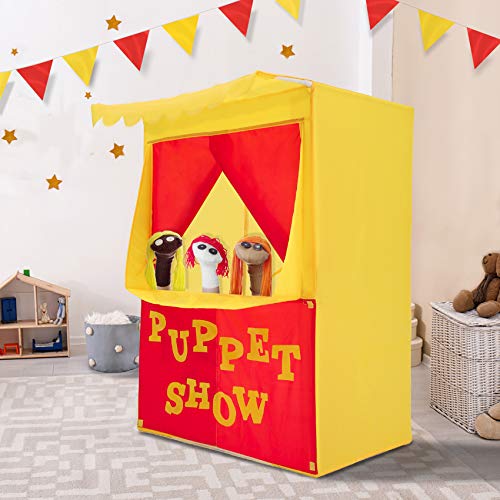
This pretend play theater blends a lemonade stand with a puppet show backdrop, offering a compact, imaginative stage for children. The design emphasizes easy setup, portable PVC poles, and fabric surfaces that can adapt to various play themes. It includes a padded front stage and a back door, enabling young performers to step in and out with ease. The setup encourages role-play, storytelling, and early-stage performance skills while keeping assembly straightforward for parents and teachers.
Little Pretender Karaoke Machine

For children who love singing and performance, this karaoke machine provides two microphones and an adjustable stand, along with a built-in speaker option and AUX connectivity. The system supports easy setup, a simple volume control, and a kid-friendly design that encourages group participation. It’s ideal for birthday parties, classrooms, or family gatherings where a musical highlight can spark enthusiasm and public-speaking confidence in young performers.
Buying Guide
Key considerations help identify the best small stage for a child’s needs:
- Safety and stability: Look for rounded edges, sturdy frames, and a non-slip surface. A high weight capacity helps accommodate growing children and simple props.
- Size versus space: Choose a stage size that fits your available room. Smaller 100×50 cm models are compact for indoor use, while 120×60 cm options offer more play area without becoming unwieldy.
- Portability: Lightweight construction, foldability, and included carrying cases simplify transport between home, school, and events.
- Versatility: Modular designs or multi-function sets (stage plus puppet theater, or stage plus karaoke) extend the range of activities beyond performances.
- Age appropriateness: For younger children, prioritize low heights and easy entry while older kids may benefit from larger stages and higher load capacities.
- Durability and materials: Composite surfaces with metal frames resist warping and provide long-lasting use in busy settings.
- Ease of setup: Quick assembly and disassembly save time for teachers and parents managing busy schedules.
Compare how each option aligns with your goals. If you want a dedicated stage feel with a simple setup, the semicircular stages excel, especially for small audiences and classroom use. For imaginative play and storytelling, the Alvantor theater adds thematic versatility. For musical or group activities, the Little Pretender karaoke setup offers immediate engagement with minimal equipment.
Durability versus portability is often the central trade-off. Heavier, more robust stages tend to last longer and support diverse activities, but lighter designs may be easier to maneuver in tight spaces. Consider how frequently you’ll move the stage, the age range of participants, and whether you need to scale from solo performances to group shows. A versatile, modular option can strike a balance between performance space and storage efficiency, while color choices can improve visibility on stage and in photos.
Accessibility, storage, and maintenance should also factor into your decision. Look for wipe-clean surfaces or fabrics that resist stains, easy-to-replace parts, and clear instructions for safe setup. If you’re coordinating classroom performances, a stage with quick-assembly features reduces disruption and helps students stay focused on their acts. For home use, a compact, portable unit that tucks away neatly after playtime can sustain motivation and keep spaces organized.
In summary, the best small stage for a child blends safety, practicality, and imaginative appeal. The five selections above cover a range of uses—from structured performances on semicircular stages to imaginative play theaters and interactive karaoke—providing options that suit different budgets, spaces, and activity types. Each product focuses on kid-friendly design, durability, and the ease of use that helps young performers shine.