Best Real Robots for Kids: Encouraging Learning With Hands-on Play
Realistic, programmable robots can spark curiosity in children, fostering skills from basic coding to creative problem solving. This guide highlights five engaging options that blend entertainment with STEM learning for kids aged 3–13. Each pick emphasizes interactive features, durability, and safe materials, helping parents choose a robot that fits their child’s interests and developmental stage.
Overview of selected products:
| Product | Brand | Key Features | Ideal For |
|---|---|---|---|
| Ruko 1088 Smart Robots for Kids | Ruko | 15.8-inch tall, voice control, APP control, 10 expressions, 9 joints, 10 songs | Creativity and basic programming for ages 4–9 |
| KingsDragon RC Robot Toys | KingsDragon | Gesture sensing, 50 actions, auto display, obstacle avoidance | Hands-on programming and interactive play for ages 3–8 |
| BAZOLOTA Robot Toys | BAZOLOTA | Gesture sensing, 164 ft control, 50 actions, singing and dancing | Engaging STEM play for ages 3–12 |
| HOLIBIBE Drawing Robot | HOLIBIBE | 150 drawing cards, 12 color markers, voice guidance | Creativity and early learning for ages 3–8 |
| Sillbird 12-in-1 Solar Robot Kit | Sillbird | Solar powered, 190 pieces, 5-in-1 builds | Hands-on engineering and renewable energy concepts for ages 8–13 |
Ruko 1088 Smart Robots for Kids

The Ruko 1088 stands out for its impressive height and expressive capabilities. At up to 15.8 inches tall, it presents a friendly, life-like presence that can engage kids during imaginative play or structured learning. The robot features ten facial expressions and ten songs, offering dynamic movement and feedback that keeps children engaged while exploring basic programming concepts. With nine flexible joints and app-based as well as voice control, kids can experiment with sequencing and cause-and-effect in a playful, intuitive way.
Educational value is central, as the Ruko 1088 provides a platform for early STEM exploration. Children can practice logical thinking while navigating gestures and actions, building fine motor skills and spatial awareness along the way. Beyond programming, the robot supports activities like storytelling, dance, and recording, broadening the scope of creative expression. Durability and safe materials are important considerations for younger users, and this model is designed to withstand energetic play while maintaining accessible control methods for beginners.
KingsDragon RC Robot Toys

KingsDragon offers a gesture-sensing robot that blends infrared control with intuitive hand-gesture commands. Children can guide the robot by simple movements—turning left or right, sliding forward or backward—providing an immediate sense of agency. The toy also includes an auto display mode and obstacle avoidance, which supports safer exploration and longer play sessions. A library of up to 50 programmable actions enables children to design sequences that demonstrate planning and memory, reinforcing learning in a hands-on, repeatable format. The robot’s design focuses on durable ABS plastic and articulated joints suitable for younger users who are developing fine motor skills.
For educators and parents, the KingsDragon model can serve as a bridge between touch-free control and basic coding concepts. Kids can experiment with input-driven actions and then observe how commands translate into movement, crafting simple patterns that lay the groundwork for more complex programming later. The visual cues—like LED eyes lighting up during movement—add an engaging, game-like element to the experience, making it appealing for both individual play and group demonstrations.
BAZOLOTA Robot Toys
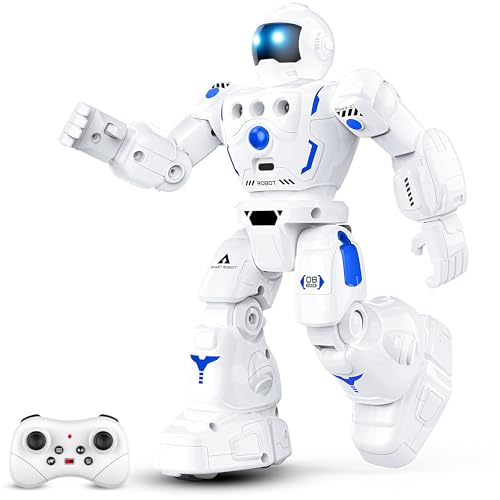
BAZOLOTA emphasizes a blend of gesture sensing, programming, and expressive performances. Kids can control the robot using gestures to make it slide, turn, or dance, with a substantial 164-foot operation range that supports room-to-room exploration. The robot supports a set of up to 50 programmable actions, which children can program by pressing the Programming button and guiding the robot through sequences. This feature fosters sequencing, memory, and logical planning, while singing and dancing add a performative dimension that can boost engagement during group activities. The build is designed with non-toxic ABS materials and sturdy wheels to handle varied play surfaces.
As a learning companion, the BAZOLOTA robot encourages independent experimentation. The 50-action library can be expanded by children as they gain confidence, providing a scalable path from simple motions to more complex choreographies. Teachers and parents can use this model to support early engineering skills, including cause-and-effect reasoning, timing, and precision in movement. The accompanying storytelling and music functions also help with auditory development and rhythm recognition during play.
HOLIBIBE Drawing Robot
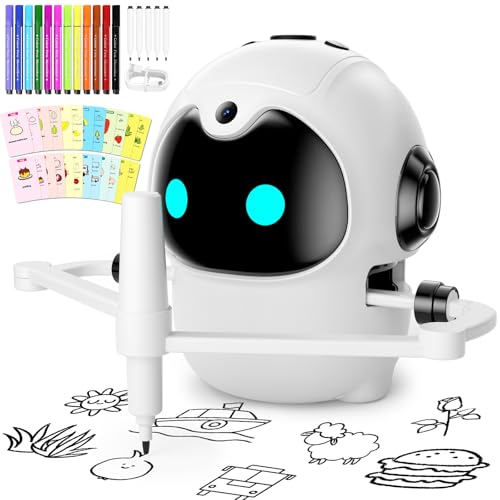
The HOLIBIBE drawing robot focuses on art-based learning. It combines guided drawing with Montessori-inspired principles to encourage independent thinking, observation, and logical reasoning. With 150 themed drawing cards and 12 color markers, children can engage in structured activities that translate into improved concentration and fine motor skills. A guiding voice and music create a supportive learning environment, helping kids follow steps and stay engaged as they complete each drawing. The toy’s approach blends creativity with cognitive development, offering a gentle but effective pathway into pre-writing skills and spatial awareness.
Parents seeking a calmer activity that still nurtures STEM-related growth may choose this model for quiet afternoons or classroom centers. The card-based system provides a predictable structure that reduces frustration while boosting confidence in drawing and planning. It’s well suited for kids who enjoy art and storytelling, providing a tactile counterpart to more action-oriented robots.
Sillbird 12-in-1 Solar Robot Kit
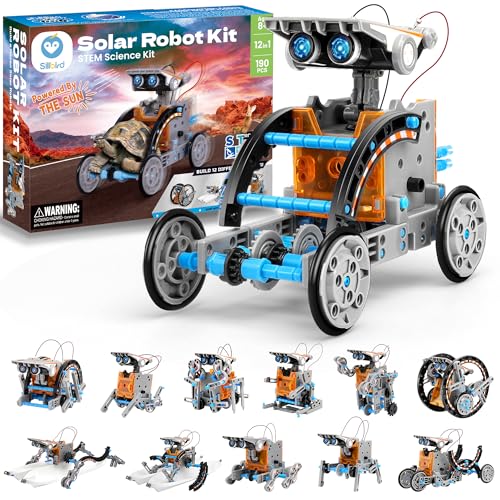
The Sillbird solar robot kit offers a hands-on introduction to engineering and renewable energy. With 190 pieces and five build modes, children can assemble diverse models that illustrate basic mechanical principles. The kit supports outdoor play powered by sunlight, with an indoor option using a bright artificial light source. This flexibility makes it ideal for developing problem-solving and spatial reasoning while keeping screens out of the equation. The dual control approach—manual assembly and app-enabled or remote operation—helps cater to different ages and learning preferences, providing a structured path from simple assembly to more complex programming skills.
Educators and parents can leverage this kit to discuss energy concepts, motion, and cause-and-effect. The modular nature of the 5-in-1 builds allows for progressive challenges, encouraging perseverance and hands-on experimentation. It’s a sturdy entry point for kids who prefer tangible construction activities over digital interactions, while still introducing coding concepts through iterative building and testing.
Buying Guide: Key Purchase Considerations
- Age appropriateness: Choose a model aligned with your child’s developmental stage. Younger kids often benefit from gesture sensing and story-based play, while older children can handle programming sequences and multi-step challenges.
- Learning goals: Decide whether the priority is creativity (drawing and storytelling), coding fundamentals (programming sequences), or engineering concepts (building and solar-powered models).
- Control method: Consider whether your child prefers remote control, gesture-based interactions, app control, or a mix. App-based models can extend learning, but require a compatible device.
- Durability and safety: Look for sturdy construction and non-toxic materials. Ensure age-appropriate small parts are limited for younger children.
- Expansion potential: Some kits offer upgradable programming features, additional actions, or multiple build modes, which can extend play value as skills grow.
- Power source: Solar-powered options teach renewable energy concepts, while battery-powered models may offer more consistent performance indoors.
- Learning style balance: If your child learns best through hands-on building, focus on construction kits. If they thrive with guided activities, opt for models with guided programs and voice prompts.
Choosing the right robot involves balancing educational value with entertainment. The options above provide pathways from simple, motion-based play to more complex programming and building projects. Parents can mix models to support a well-rounded approach to STEM learning, catering to curiosity, creativity, and critical thinking.