Best Radio Controllers for Drones: A Comprehensive Guide to Top Remote Transmitters
The right radio controller is essential for precise, reliable control of FPV drones, RC helicopters, boats, and multirotors. This guide reviews five standout options, highlighting compatibility, latency, range, and features to help you choose the best transmitter for your flying style. Each entry includes practical details drawn from the product specifications to support objective comparison for American readers.
Summary of chosen products:
| Product | Brand | Key Strength | Connectivity |
|---|---|---|---|
| Radiomaster Pocket ELRS Remote Controller | STARDRONE | Ultra-low latency with EdgeTX; compact portability | ExpressLRS |
| FLYSKY FS-i6X 10CH Transmitter | FLYSKY | Multi-channel capability and robust hopping | 2.4 GHz |
| C8 ELRS V3 Radio Transmitter | STARDRONE | ELRS 2.4G with 1000 m range | ELRS 2.4G |
| Radiomaster TX15 Radio Controller | STARDRONE | Long-range ELRS support with EdgeTX and a 3.5″ touchscreen | ELRS 2.4G/900MHz |
| Alaohu FS-i6X RC Transmitter | Alaohu | 10-channel PWM/ S.bus options for diverse setups | 2.4 GHz AFHDS2A |
Radiomaster Pocket ELRS Remote Controller
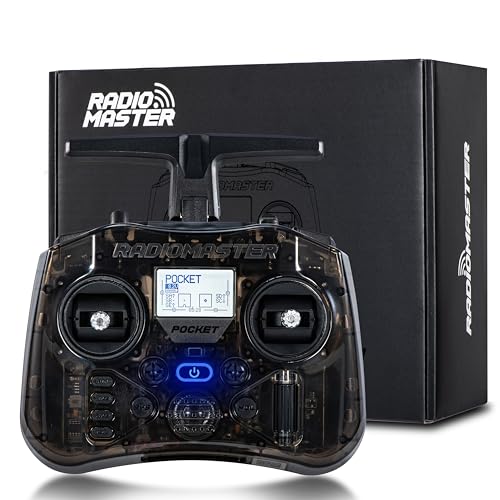
The Radiomaster Pocket is a compact, portable transmitter built around ExpressLRS for extended range and low latency. It supports FPV drones, RC multirotors, helicopters, boats, cars, and robots without requiring extra modules. Note that batteries are not included, so pilots should supply two 18650 cells for operation. The Pocket ships preloaded with EdgeTX firmware, enabling plug-and-play setup and extensive customization, including Lua scripting and Crossfire compatibility in some configurations. With 16-channel output and Hall-effect gimbals, it delivers precise, drift-minimized control for both racing and freestyle missions. This device suits pilots who value portability without sacrificing performance or firmware flexibility.
Key features include ExpressLRS compatibility for low-latency, tight control, and broad compatibility with modern RC ecosystems. The fixed-wing and multirotor applications are well-supported, with straightforward expansion through Lua scripts and user-defined screens. Suitable for enthusiasts seeking a high-quality, compact transmitter that remains versatile across a wide range of RC platforms.
FLYSKY FS-i6X 10CH Radio Transmitter
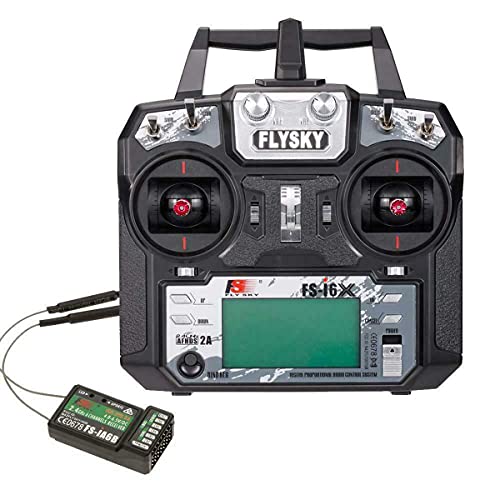
The FLYSKY FS-i6X is presented as a versatile 10-channel transmitter upgrade option, commonly paired with the FS-iA10B receiver for expanded channel capacity. It operates on 2.4 GHz with multi-channel hopping to reduce interference from nearby transmitters, supporting a range of devices—from RC boats to drones. The device emphasizes bidirectional communication, data sensing, and i-BUS support, making it a practical choice for pilots who require robust telemetry alongside straightforward programming. It’s particularly appealing to hobbyists seeking an affordable, multi-channel system with established compatibility in the consumer RC space.
Important considerations include compatibility with other receivers and how to activate up to 10 channels depending on the receiver model. Its hopping frequency spread across 2.408 GHz to 2.475 GHz helps mitigate interference in crowded airspaces. While it offers strong basic functionality, advanced users may compare it with ELRS-based options for longer-range and lower-latency needs.
C8 ELRS V3 Radio Transmitter
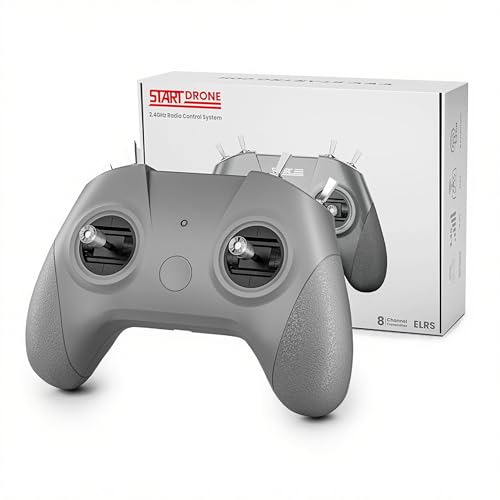
The C8 ELRS V3 is built around ExpressLRS 2.4G protocol, designed to work with ELRS receivers in FPV drones, RC helicopters, boats, and multirotors. This controller supports the firmware range 3.0–3.3 and claims a stand-out 1000-meter distance with end-to-end latency around 7 ms, which suits precision flying and competitive FPV. It also includes a USB-C connection for plug-and-play simulator integration, making it an attractive option for pilots who want to train with FPV simulators like Liftoff and Velocidrone. Designed for serious pilots seeking reliable, low-latency control, the C8 ELRS V3 pairs well with modern ELRS receivers and ecosystem tools.
The device supports an 8-channel output alongside a robust mechanical joystick design, with a focus on a high-performance MCU system and a 2.4Ghz ELRS module. It’s FCC compliant and aims to deliver professional-grade maneuverability, particularly in racing or freestyle contexts where range and response time matter most.
Radiomaster TX15 Radio Controller
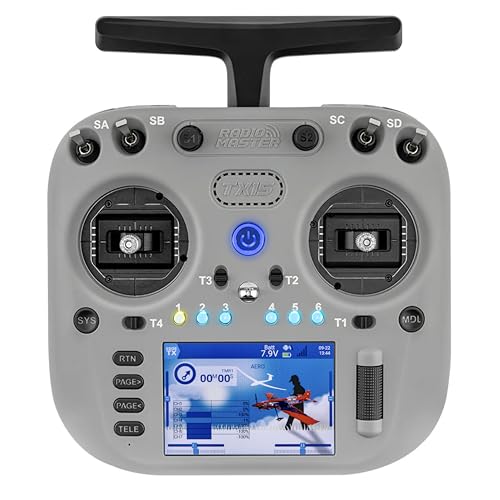
The TX15 from RadioMaster is designed for serious FPV pilots who demand long-range capability and fast processing. It supports both 2.4 GHz and 900 MHz ExpressLRS, delivering stable long-distance control with low latency courtesy of the internal Semtech LR1121 transceiver. Powered by a high-performance STM32 H7 chip, the TX15 runs EdgeTX firmware for smooth model switching and rapid scripting. Its standout feature is the 3.5-inch IPS touchscreen, offering vivid, sunlight-readable display of settings and model information with a brightness of about 600 nits. This combination of ELRS range, responsive hardware, and a bright touchscreen makes it a strong choice for pilots pursuing both long-range performance and a modern user interface.
Designed for versatility, the TX15 accommodates advanced configuration, custom scripts, and quick adjustments on the fly. The device can function optimally for FPV drones, multirotors, helicopters, cars, and boats, across various modes and setups, while maintaining a strong emphasis on low latency and user-friendly control aloud by EdgeTX flexibility.
Alaohu FS-i6X RC Transmitter

The Alaohu FS-i6X offers a practical 10-channel or 6-channel PWM setup with 2.4 GHz AFHDS2A compatibility. It emphasizes a flexible pairing with multiple receivers, with option to enable CH10 via the transmitter menu for expanded PWM use. The system supports S.bus and i.bus configurations, offering versatility across various RC aircraft, including quadcopters, fixed-wing planes, boats, and cars. Pilots can choose to use a separate 10-channel receiver for PWM mode, making it a strong candidate for hobbyists who require a broad compatibility range and straightforward configuration without excessive complexity.
Its core strengths lie in dependable long-range control and compatibility with broad receiver families, plus the ability to adapt to diverse setups—ideal for pilots who value flexibility and a familiar mode of operation in a tested, widely supported ecosystem.
Buying Guide: Key Purchase Considerations for Drone Radio Controllers
- Technology and protocol: ELRS (ExpressLRS) offers long range and low latency compared to traditional 2.4 GHz systems. Decide whether you need 2.4G only, or a dual-mode radio that can switch to 900 MHz or other protocols for extended range.
- Channel count and expansion: Look for a transmitter with sufficient channels for your gear and future upgrades. Some devices enable additional channels via compatible receivers or firmware updates.
- Firmware ecosystem: EdgeTX and Betaflight-configurable firmware provide extensive customization. Confirm compatibility with the flight stack and whether a specific firmware toolchain is required for optimal setup.
- Screen and ergonomics: A touchscreen can simplify on-field adjustments, while Hall-effect gimbals improve precision and reduce drift over time. Consider weight, balance, and grip comfort for extended sessions.
- Battery and power: Some transmitters require specific battery types; ensure you have the recommended cells or packs. Battery life influences how long you can fly between recharges.
- Simulator compatibility: If training with FPV simulators is important, verify USB-C or USB-A compatibility and the presence of plug-and-play support for popular simulators such as Liftoff, VelociDrone, and DRL.
- Compatibility with receivers: Match the transmitter to the correct receivers (ELRS, AFHDS2A, FrSky, etc.) and verify firmware compatibility to prevent binding issues.
- Support and ecosystem: A broader product ecosystem can simplify future upgrades. Look for brands offering regular firmware updates, documented guides, and active user communities.
- Price-to-performance: While premium models offer advanced features, there are affordable options with robust basics. Weigh your flying needs, such as long-range racing versus casual indoor flights, to determine value.
In selecting a drone radio controller, consider how you balance portability, range, latency, and customization. For FPV enthusiasts who race or perform complex maneuvers, ELRS-based transmitters with edge firmware and responsive gimbals tend to deliver the most reliable performance. For newcomers or hobbyists with eclectic hardware, a versatile controller with broad receiver compatibility and straightforward setup may be the best fit. Evaluating these factors against the five options above will help you identify the transmitter that aligns with your flying style and equipment ecosystem.