Best Programming Toys for 10-Year-Olds: Top STEM Robots and Kits
Searching for engaging, education-forward toys that blend coding with hands-on play? This guide highlights five top programming toys that suit curious 10-year-olds, helping them build fundamentals in robotics, problem solving, and system thinking. Each option combines practical projects with beginner-friendly coding and real-world STEAM skills, making learning enjoyable and screen-light when possible.
| Product | Brand | Key Benefit |
|---|---|---|
| ELEGOO UNO R3 Smart Robot Car Kit V4 | ELEGOO | Hands-on robotics for Arduino-based learning |
| Smartivity DIY Robotic Mechanical Hand | Smartivity | 100% screen-free STEM building and coding concepts |
| Henoda Robot Toys | Henoda | Remote/app-controlled multi-mode robot with 468+ pieces |
| 24-IN-1 STEM Circuit Science Kits | MEWOCHEE | Flexible circuit-based projects that teach fundamentals |
| Learning Resources Botley the Coding Robot | Learning Resources | Screen-free, age-appropriate coding practice |
ELEGOO UNO R3 Smart Robot Car Kit V4

The ELEGOO Smart Robot Car introduces Arduino-based robotics to young learners. It provides a complete educational framework that blends programming with electronics assembly, helping kids understand how sensors, actuators, and microcontrollers interact. With 24 kinds of modular parts, the kit supports obstacle avoidance, line tracing, infrared control, and mobile device control, enabling both guided projects and open-ended exploration. The design uses standardized 2.54 mm ports, simplifying assembly and reducing mistakes for beginners.
Smartivity DIY Robotic Mechanical Hand

This action-packed kit delivers screen-free, hands-on construction and engineering play. With a clear, step-by-step manual, kids assemble a mechanical hand and operate it to perform tasks, reinforcing core STEM concepts. The project is designed to engage ages 8–14 and aims to boost confidence, creativity, and curiosity. Replacement parts are included, helping extend playtime and learning beyond initial builds.
Henoda Robot Toys for 8-16 Year Olds
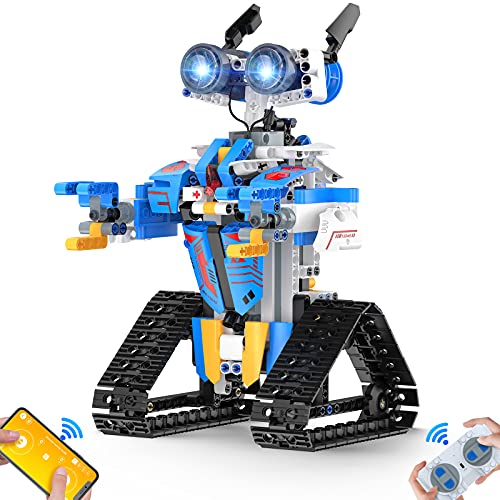
Henoda combines a large parts count with multiple control modes, including app Bluetooth control and a 2.4GHz remote. The robot moves in multiple directions and features glowing eyes and transforming limbs that spark imagination. This kit supports hands-on building, remote operation, and STEM exploration, making it suitable for family play as well as solo challenges. It encourages planning, problem solving, and critical thinking through engineering tasks.
24-IN-1 STEM Circuit Science Kits

The MEWOCHEE kit presents 24 different builds focused on circuits and robotics, including three robot heads and seven functional modules. Children connect circuits, install modules, and debug systems to create walking robots or bubble-blowing machines. The set emphasizes practical understanding of circuitry, sensors, and power management, supporting age-appropriate challenges for 8–13-year-olds and beyond. Clear instructions help beginners progress with confidence and minimal frustration.
Learning Resources Botley the Coding Robot

Botley offers screen-free coding introduction right out of the box. It targets younger coders with an 80-step program, loops, and obstacle detection that scales with skill development. While designed for children as young as five, Botley remains a strong fit for 10-year-olds seeking structured, family-friendly coding challenges. The set is ready-to-use with minimal setup, emphasizing practical programming concepts and immediate hands-on engagement.
Buying Guide: Key Considerations For Selecting Programming Toys
- Age- and skill-appropriateness: Choose kits that start with basic concepts and gradually introduce more complex ideas as competence grows. For 10-year-olds, look for modular projects, programmable components, and clear progression paths.
- Hands-on vs. screen time: A balance between building, wiring, and coding without screens supports diverse learning styles. Some kits offer both screen-free modes and app-based controls for flexible play.
- Build size and durability: Large piece counts can boost engagement but require space and storage. Consider sturdy plastics and snap-together parts to minimize frustration during assembly.
- Programming interface: Ensure the coding method is kid-friendly (block-based or visual, with optional text-based coding later). Compatibility with mobile devices or PCs may matter for extended use.
- Expandability: Kits that can be expanded with extra modules or compatible accessories maximize long-term value and freshness of challenges.
- Safety and supervision: Check small parts and age recommendations. Some kits include extensive manuals and safety guidance suitable for guided parental involvement.
- Replacement parts and support: Availability of spare parts can extend a kit’s life and ease repairs after wear or breakage.
- Educational alignment: Look for kits that emphasize core STEM competencies—logic, circuitry, robotics, and problem solving—rather than purely entertainment value.
Across these selections, the focus remains on approachable, engaging projects that teach programming, engineering, and analytical thinking. Each option provides a structured path from basic construction to more advanced tasks, helping 10-year-olds build confidence in practical STEM applications.