Best Physics Kits for Kids: Hands-on Ways to Explore Science
Discover engaging physics kits that foster curiosity, critical thinking, and practical understanding of electricity, magnetism, mechanics, and more. The following selections offer hands-on experiments, clear instructions, and kid-friendly materials to make learning physics exciting at home or in the classroom.
| Product | Brand | Key Focus | Approx. Complexity |
|---|---|---|---|
| Thames & Kosmos Mechanical Engineering: Machines & Vehicles | Thames & Kosmos | Mechanics, Motion, Gears | Intermediate |
| UNGLINGA 272 Experiments Science Kit | UNGLINGA | Chemistry, Physics, Volcanoes | Beginner–Intermediate |
| Mysterystone Science Experiment Kit | Mysterystone | Electricity & Magnetism | Beginner–Intermediate |
| EUDAX School Physics Labs Basic Electricity Discovery | EUDAX | Electric circuits & magnetism | Intermediate |
| 4M Kidzlabs Anti Gravity Magnetic Levitation | 4M | Magnetism & Magnetic Levitation | Beginner–Intermediate |
Thames & Kosmos Mechanical Engineering: Machines & Vehicles

The Mechanical Engineering kit offers 20 hands-on building projects and 22 supplemental experiments that introduce basic mechanical concepts. Students explore forces, motion, and simple machines through model construction and real-world demonstrations. The durable, reusable building system allows kids to reconfigure parts into new designs, promoting iterative problem-solving and engineering thinking. This kit is suitable for beginners who want a solid foundation in machine physics and design reasoning.
UNGLINGA 272 Experiments Science Kit

This comprehensive science kit embraces a wide range of topics, including volcanoes, crystal growth, holographic projections, rainbow water experiments, and chemistry magic reactions. With 272 effects and a kid-friendly kit design, it encourages critical thinking and collaborative exploration. The included tools and test tubes mimic a real lab environment, helping young scientists practice careful experimentation and data recording.
Mysterystone Electricity & Magnetism Kit

Designed to introduce electricity and magnetism with more than 50 do-it-yourself experiments, this kit includes a detailed manual that explains the physics behind each project. It covers circuits, magnets, and related phenomena, enabling students to design their own experiments beyond the included projects. The kit emphasizes hands-on learning and can support classroom-style demonstrations or at-home exploration.
EUDAX School Physics Labs Basic Electricity Discovery
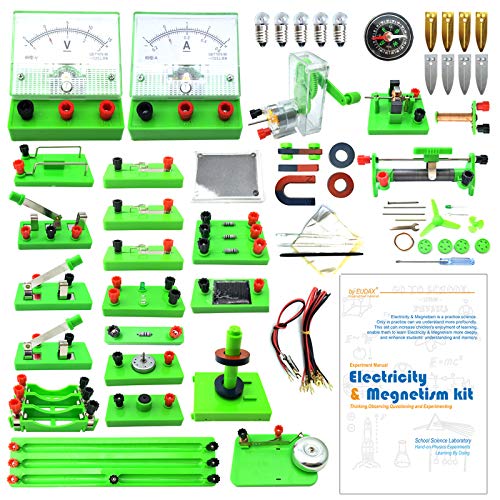
This kit guides high school–level learners through electricity and magnetism concepts with a full-color manual and 56 items for electricity plus 21 items for magnetism. It is designed to build foundational skills in circuit analysis and magnetic principles, offering a practical perspective on theory. Batteries are required, which aligns with typical classroom or home-use setups and promotes responsible power handling.
4M Kidzlabs Anti Gravity Magnetic Levitation

This kit focuses on magnetic force through hands-on experiments that demonstrate levitation and magnetic attraction. Activities include floating a pencil, levitating a screw, and building a maglev device. The set includes all necessary materials, making it an accessible introduction to magnetic concepts, force, and balance. Clear instructions support independent exploration and guided activities.
Buying Guide
Key purchase considerations for kids’ physics kits:
- <strongAge and skill level: Choose kits aligned with the child’s age and prior experience to prevent frustration and maximize learning gains.
- <strongConcept coverage: Match the kit to topics of interest, such as electricity, magnetism, mechanics, or a broad STEM approach.
- <strongMaterials and durability: Look for sturdy parts, non-toxic components, and reusable materials for extended hands-on use.
- <strongInstructions and safety: Clear, kid-friendly manuals with safety notes help independent experiments and parental oversight when needed.
- <strongScalability and expansion: Kits that allow new projects or integration with other sets enable continued learning and creativity.
- <strongEducational value: Prefer kits that explain the science behind experiments, not just steps to follow, to encourage scientific thinking.
- <strongStorage and organization: Consider kits with storage solutions to keep components organized for ongoing use.
- <strongBudget considerations: A mix of introductory sets and more advanced kits can cover early curiosity and deeper exploration over time.