Best Motor Kit for Kids: Top Hands-on STEM Sets for Young Builders
Exploring motors and circuits helps kids grow scientific curiosity while building practical skills. This guide highlights five engaging motor kit options that balance learning and fun, featuring working engines, solar-powered builds, and multi-model robotics. Each kit is designed to suit different ages and interests, from miniature engines to DIY STEM experiments. Read on to compare features, included components, and what makes each kit a strong choice for inspiring young makers.
| Product | Brand | Amazon Link |
|---|---|---|
| Playz V8 Combustion Engine Model Kit | Playz | Open |
| Sntieecr 276PCS DC Motor Kit | Sntieecr | Open |
| Sntieecr Electric Circuit Motor Kit with Solar Panel | Sntieecr | Open |
| EUDAX 465PCS DC Motor Kit | EUDAX | Open |
| Klever Kits 36-in-1 Motor Robotic Kits | Klever Kits | Open |
Playz V8 Combustion Engine Model Kit That Runs

The Playz V8 engine model kit delivers a realistic, working 8-cylinder engine experience. It engages learners by letting them assemble cranks, pistons, belts, and exhaust systems to create a mini V8 that actually runs. With interactive cables and engine sounds, the kit blends education with immersive play. It is suitable for ages 12 and up, appealing to both students and hobbyists who want a tangible engineering project that demonstrates internal combustion principles. Battery-powered action requires 3 AA batteries (not included).
Key features include a detailed, realistic V8 design, visible piston movement, and on-board mechanisms that mirror a real engine’s operation. This supports STEM learning by illustrating how components coordinate to convert chemical energy into mechanical motion. The kit is designed to stimulate curiosity, encouraging experimentation with timing, synchronization, and mechanical tolerances.
As a practical beginner-to-intermediate project, it offers a hands-on approach to motorized engineering. Parents and educators can use it to explain engine fundamentals, while older kids may tackle more advanced troubleshooting and tuning. It pairs well with classroom demonstrations, maker spaces, or weekend family STEM sessions. Batteries and some assembly time are required to unlock its full motorized experience.
Sntieecr Electric Circuit Motor Kit
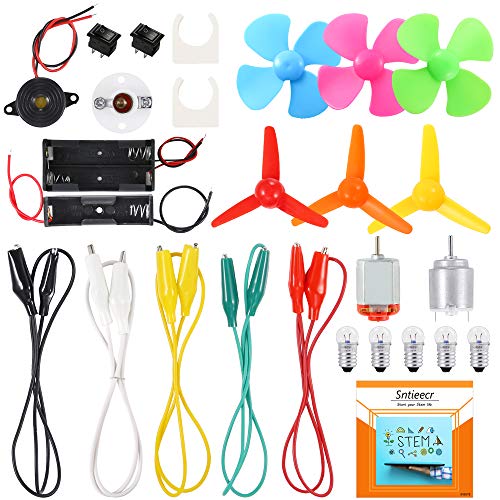
This kit provides a complete circuit-building experience with multiple motors, switches, bulbs, and wiring. It is designed to inspire kids to experiment with basic electrical circuits, turning ideas into tangible projects. The included components cover a wide range of circuit-building activities, supporting a strong foundation in electronics and engineering concepts. It’s well-suited for Montessori-inspired learning and classroom STEM projects, encouraging hands-on exploration and problem-solving.
The kit arrives with instructions and a robust assortment of accessories, including crocodile clips, various motors, and multiple propellers. This breadth of parts makes it ideal for open-ended experimentation—students can prototype simple circuits, test relationships between components, and observe how changes in wiring or component placement affect outcomes. It’s a versatile option for ongoing science exploration at home or in school.
Educational benefits include enhanced critical thinking, spatial reasoning, and practical understanding of electrical systems. While it emphasizes basic circuits, more advanced users can extend experiments by integrating sensors, extra power sources, or microcontrollers. This kit balances accessibility with room for deeper inquiry as kids grow more confident with electronics.
Sntieecr 276PCS DC Motor Kit

The Sntieecr 276PCS kit is a comprehensive set for DIY science projects, featuring 18 motors, a broad assortment of battery holders, gears, switches, LEDs, and a variety of propellers. It targets high versatility, enabling kids to design and build multiple motor-powered devices. The kit’s high-torque 130 motor can achieve exciting speeds, making it suitable for interactive demonstrations and hands-on experiments that illustrate motor dynamics and gear ratios.
Included components support a wide array of projects—from simple motion experiments to more complex machines. The variety of gears, propellers, and housings allows learners to explore mechanical design, torque versus speed, and the impact of component choice on performance. The kit is best for curious kids ready to tackle longer build sessions and more intricate constructions.
Educational outcomes emphasize engineering fundamentals such as mechanical advantage, motor control, and circuit integration. Children can experiment with different configurations, observe outcomes, and iterate designs. It serves as a strong foundation for budding engineers who enjoy tinkering and building functional models from parts.
EUDAX 465PCS DC Motor Kit

The EUDAX 465-piece kit is a broad, all-in-one set designed for extended DIY STEM exploration. It includes a combination of motors, gears, battery holders, plastic structures, and a helper guide. The expansive component list supports a variety of collaborative or solo projects, encouraging experimentation with different drive mechanisms and movement systems.
Users can build multiple projects from the included instructions and freely create new designs. The kit’s emphasis on hands-on construction promotes perseverance, spatial reasoning, and engineering thinking. It’s well-suited for school science projects, after-school clubs, and family STEM nights, offering ample room for expansion as kids gain confidence with motorized builds.
Educational value centers on practical mechanics, circuitry basics, and the connection between electrical energy and motion. It invites thoughtful experimentation—adjusting gear sizes, motor placement, and power sources to observe how performance shifts. This kit is a solid long-term investment for curious young engineers.
Klever Kits 36-in-1 Motor Robotic Kits
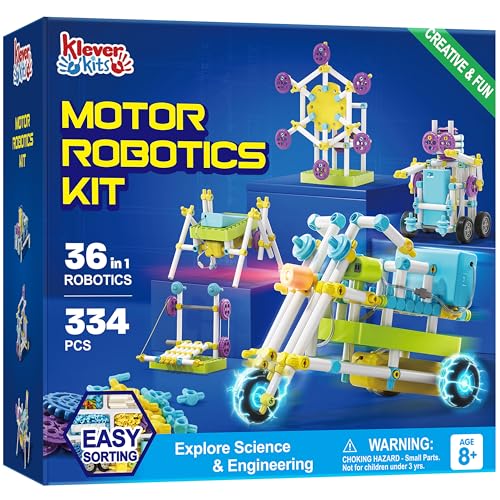
The Klever Kits offering covers 36 robot builds, including 14 motorized models such as walking machines and racing cars. This kit emphasizes creative exploration and hands-on problem solving, making it a compelling option for kids who enjoy iterative building and testing. A parts tray helps with organization, supporting efficient sorting and storage for ongoing projects.
Educational outcomes focus on mechanical design, robotics fundamentals, and systematic thinking. Children learn to plan, test, and refine their creations, gaining confidence in engineering concepts as they see machines come to life. The variety ensures compatibility with different interests, from simple vehicles to more complex autonomous models.
Buying Guide: Key Considerations For Choosing A Kid-Friendly Motor Kit
- Age appropriateness: Look for kits clearly labeled for the target age group, and prefer sets that scale with skill progression (beginner to advanced).
- Hands-on value: Prioritize kits that demonstrate real motion, not just static parts. A working engine, motor, or robot provides stronger learning feedback.
- Component range: A larger assortment of motors, gears, LEDs, and switches enables diverse projects and longer engagement.
- Guided vs. open-ended: Some kits come with step-by-step instructions; others encourage open-ended exploration. Mixed kits can provide structure with room for creativity.
- Durability and safety: Check plastic quality, clip connectors, and battery housing. Ensure parts are easy for young hands to manipulate without frequent breakages.
- Expandability: If kids outgrow a kit quickly, consider systems that support additional add-ons or compatible parts from the same brand.
- Educational value: Look for kits that explain fundamental concepts (torque, speed, gear ratios, circuits) either in the product guide or online resources.
- Storage and organization: Sorting trays and labeled compartments help kids keep parts tidy and accessible.
- Power options: Some kits rely on batteries; solar-powered or USB-powered options can diversify learning contexts and environmental considerations.
When choosing, align the kit with the child’s interests—engine replication, circuit experiments, or robotics projects—to maximize engagement and learning outcomes. Consider whether you want a kit for supervised, structured activities or for independent, exploratory builds. Finally, review the included instructions and available online resources to ensure you’ll have support as new concepts emerge.