Best Manipulatives for 2-Year-Olds: Montessori Toys for Early Learning
Discover engaging, development-friendly manipulatives designed for toddlers. This guide highlights five Montessori-inspired options that support fine motor skills, color and shape recognition, counting basics, and imaginative play. Each pick emphasizes safe materials, simple design, and hands-on learning that aligns with early childhood education principles. Use this overview to compare options and choose tools that fit your child’s interests and your parenting goals.
Summary of selected products:
| Product | Brand | Key Focus |
|---|---|---|
| Dailyfunn Montessori Toys Color&Shape Sorting Learning Box | Dailyfunn | Color & shape sorting; 25 wood pieces; advanced thinking cards |
| MOTREE Preschool Learning Toys For Toddlers | MOTREE | Math manipulatives; counting blocks; Montessori-inspired |
| TOP BRIGHT Preschool Learning Toys For Toddlers | TOP BRIGHT | Early math, counting, Montessori-inspired |
| Toys For 2 Year Old Boy — Wooden Tool Set | JOYSINTOY | Practical problem-solving; fine motor; imaginative play |
| Skoolzy Peg Board Set | Skoolzy | Color recognition; basic math & sorting |
Dailyfunn Montessori Toys Color&Shape Sorting Learning Box
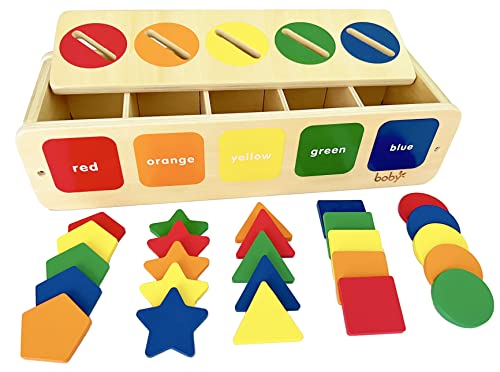
The Dailyfunn Color & Shape Sorting Learning Box is a versatile Montessori-inspired set designed for babies and toddlers aged 1-3 years. It features 25 solid wood pieces across five colors and five shapes, plus 13 answer cards for an advanced mode that exercises logical thinking. The kit emphasizes independent play, hand-eye coordination, and early problem-solving through color and shape matching. Parents can guide early learners in simple sorting activities, then gradually introduce the advanced cards to challenge cognitive development. The wooden pieces are smooth and easy for small hands to handle, aiding safe exploration.
Key aspects include a focus on independence, self-esteem, and foundational skills. The product aligns with Dr. Maria Montessori’s emphasis on hands-on learning and self-directed activity. The combination of tangible pieces and guided cards helps children see relationships between shapes, colors, and spatial arrangements. With repeated practice, youngsters can enhance fine motor control and pattern recognition while building confidence in their own abilities.
MOTREE Preschool Learning Toys For Toddlers

MOTREE’s preschool learning set focuses on early math concepts through counting blocks and related manipulatives. The package includes a wooden finger board, 13 colorful number blocks, 8 flash cards, and a holder to organize the pieces. Designed for homeschool use and preschool settings, this toy helps children visualize addition and subtraction within 10 by manipulating tangible blocks. The Montessori-inspired approach encourages hands-on exploration, enabling toddlers to connect concrete objects with numerical ideas. The set is crafted to support fine motor development as children handle, align, and count the blocks during play.
As children engage with the blocks, they encounter cause-and-effect relationships and begin to grasp basic arithmetic concepts. The open-ended nature of the manipulatives supports independent exploration, while the included cards offer guided practice as needed. The materials are child-friendly, non-toxic, and sized for small hands, reducing frustration and promoting sustained curiosity.
TOP BRIGHT Preschool Learning Toys For Toddlers

TOP BRIGHT offers an early math-focused set that combines colorful counting blocks with Montessori-inspired learning principles. Suited for 2- to 4-year-olds, the kit helps build foundational numeracy through counting, recognizing numbers, and simple arithmetic. The design emphasizes independent play, concentration, and problem-solving, encouraging children to explore patterns and order without constant adult instruction. The blocks are brightly colored to attract attention and support color recognition, while the structure fosters a sense of accomplishment as kids sort, stack, and count.
This set is particularly useful for families seeking a low-pressure way to introduce math concepts. The Montessori influence supports self-directed learning by allowing children to experiment with materials at their own pace. The tactile aspect can be especially engaging for kinesthetic learners who benefit from touching and rearranging physical pieces to understand abstract ideas.
Toys For 2 Year Old Boy — Wooden Tool Set

The JOYSINTOY wooden tool set is designed to mirror real-world practice while supporting Montessori-inspired play. Geared toward ages 2-4, the 42-piece toolkit includes an apron, hammer, wrench, screwdriver, and more, presented in a sturdy workbench. The emphasis is on hands-on construction, which fosters creativity, problem-solving, fine motor skills, hand-eye coordination, and spatial awareness. The durable wooden build ensures safety through smooth edges and solid construction, providing a reliable, long-lasting option for busy toddlers who enjoy pretend play and building activities.
By engaging in constructive play, children learn to sequence tasks, manage simple tool-based activities, and develop practical skills that translate to everyday activities. The design supports guided play with adult supervision, while the open-ended nature of the set invites children to imagine new projects, enhancing cognitive flexibility and imaginative capabilities.
Skoolzy Peg Board Set
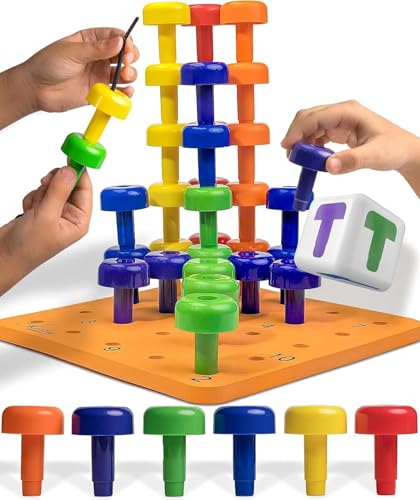
The Skoolzy Peg Board Set is a compact, Montessori-aligned activity designed for toddlers and preschoolers. This 33-piece set offers a peg board, 30 pegs in six vibrant colors, and a storage solution. The emphasis is on color recognition, early math skills, and sorting activities that promote organizational thinking and fine motor development. The large pegs are easy for small hands to grasp and place, supporting precision and control as children place pegs into the board. The included storage bag aids in tidying up after play, reinforcing routines and responsibility.
The peg board setup can be used for a range of activities—from color and shape matching to simple pattern creation. As a versatile tool, it supports progression from basic stacking to more complex tasks, aligning with a child’s growing cognitive abilities. The open-ended nature allows for both individual exploration and guided play with caregivers, making it suitable for home use or classroom settings.
Buying Guide: Key Purchase Considerations And Comparisons
When selecting manipulatives for 2-year-olds, consider the following factors to ensure safety, engagement, and developmental value:
- Age appropriateness: Look for pieces sized for toddlers, with smooth edges and non-toxic finishes. Avoid small parts that could pose choking hazards.
- Montessori alignment: Favor materials that promote hands-on learning, self-directed exploration, and practical problem-solving. Simple, open-ended designs often yield longer engagement.
- Material quality: Wood is durable and tactile, but ensure finishes are child-safe (water-based, non-toxic). Smooth surfaces and rounded edges reduce risk of injuries.
- Skill focus: Choose manipulatives that address multiple developmental domains—fine motor skills, color/shape recognition, basic math concepts, and executive function like attention and sequencing.
- Adaptability: Pick sets that scale with growth. Toys that start with sorting and stacking can evolve into counting and patterning activities as the child’s abilities expand.
- Storage and maintenance: Consider sets with straightforward organization and easy cleaning. This helps sustain interest and keeps play environments tidy.
- Safety for little hands: Avoid overly complex mechanisms or sharp parts. Large, chunky pieces are ideal for early manipulation and safe exploration.
- Caregiver involvement: Some toys include guided activities or cards; others are open-ended. Assess how much guidance you want to provide during play.
Compare options by examining the balance between guided activity and open-ended exploration. Wood-based materials with Montessori alignment tend to offer longer-term value, as children can use them across multiple stages of development. Consider your child’s interests—color, shapes, counting, or pretend play—when prioritizing features such as sorting, counting blocks, or construction tools. Finally, ensure the product’s age range matches your child’s current stage, while leaving room for growth in the coming months.