Best Engineering Toys for 8 Year Olds: Build, Code, and Create
Engineering toys spark curiosity and nurture problem-solving in children. For eight-year-olds, the right STEM kits blend hands-on building with fundamentals like mechanics, electronics, and basic robotics. This guide highlights five engaging options that promote screen-free learning while delivering measurable educational value. Each product below offers age-appropriate challenges, clear instructions, and lasting play. Use the summary table to compare core features at a glance, then dive into detailed sections to understand how these kits support developing engineering skills.
Summary table of chosen products
| Product | Brand | Core Focus | Key Benefit |
|---|---|---|---|
| Smartivity DIY Pinball Machine | Smartivity | Mechanics, STEM concepts | Screen-free arcade-style play with guided build |
| ELEGOO UNO R3 Smart Robot Car Kit V4 | ELEGOO | Programming, electronics, robotics | Hands-on coding and building with multiple modules |
| Veecafiodi 50 in 1 STEM Building Kit | Veecafiodi | Electrical engineering, mechanical design | Versatile projects that foster creativity and problem solving |
| COBFDHA STEM Projects for Kids | COBFDHA | Solar power, robotics concepts | Solar and battery-powered models with hands-on learning |
| Engino STEM Toys: Structures, Buildings & Bridges | Engino | Structural engineering, forces | Realistic models and theory with practical experiments |
Smartivity Diy Pinball Machine For Kids

The Smartivity DIY Pinball Machine provides screen-free entertainment while building a foundational understanding of mechanical systems. This kit guides kids through assembling a pinball setup, reinforcing concepts such as levers, gears, and motion. The included lifetime replacement parts policy reduces long-term interruptions to play, encouraging sustained experimentation. The design is suitable for boys and girls aged 8 and up, with clear, kid-friendly instructions that promote confidence and independent problem solving.
Key features include an action-packed assembly process and a family-friendly gameplay experience. By working through the step-by-step manual, children learn about cause and effect, timing, and spatial reasoning. The project emphasizes hands-on critical thinking while stimulating curiosity about the science that powers everyday devices. The product aims to balance challenge with achievable milestones to keep kids engaged for extended play sessions.
ELEGOO Uno R3 Smart Robot Car Kit V4

The ELEGOO UNO R3 Smart Robot Car Kit V4 combines programming, electronics assembly, and robotics into a single educational package. It serves as an entry point for young learners to explore code and hardware together, with 24 modules that include obstacle avoidance, line tracing, and infrared remote control. The kit supports control via Android and iOS devices, broadening how kids interact with their projects. Its modular design lowers the barrier to entry while enabling progressively complex experiments as skills grow.
Key considerations include compatibility with standard microcontrollers, ease of assembly, and the potential to expand with additional sensors or accessories. Parents and educators can leverage this kit for structured lessons or open-ended challenges, making it a versatile choice for classrooms or home learning. The platform fosters critical thinking, troubleshooting, and a growing curiosity about how autonomous systems operate.
Veecafiodi 50 In 1 STEM Building Kit

The Veecafiodi 50-in-1 STEM kit offers a broad range of construction possibilities within a single package. With 107 durable pieces and an integrated motor, kids can assemble models such as an unmanned fighter jet, radar vehicle, or a rotating Ferris wheel. The kit emphasizes hands-on engineering, enabling children to explore mechanical motion and simple machine principles through varied configurations. It is designed for ages 6–12, making it accessible for 8-year-olds while still providing a meaningful challenge that supports creativity and logical thinking.
Important considerations include model variety, the need for batteries (not included), and the included instruction manual. The kit is suitable for family STEM activities or classroom projects, and its gift-ready packaging makes it a compelling option for celebrations. The emphasis on real-world engineering concepts helps children make connections between play and practical applications in technology and design.
BeAndge STEM Kits For Kids

The BeAndge STEM kits for kids focus on multiple science and engineering disciplines across five sets. This selection includes solar and wind powered cars, an obstacle avoidance robot, a transmission tank, and a glider. The variety supports cross-cutting STEM literacy, enabling children to compare different energy sources, mechanics, and control systems. The package is designed for ages 8–12 and is suitable for family activities, classroom use, or science fair projects, with clear step-by-step instructions to support independent exploration and teamwork.
Important considerations include battery needs, the ability to run projects indoors or outdoors, and how each model reinforces core engineering concepts. Parents may appreciate the opportunity to guide a learning path that blends theory with hands-on application, strengthening skills in problem solving, measurement, and experimentation.
COBFDHA STEM Projects For Kids
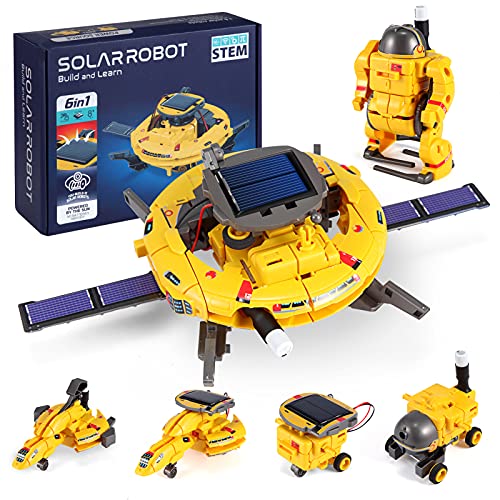
COBFDHA offers STEM projects aimed at kids age 8–14, presenting a selection of six building robots powered by solar or battery energy. This kit emphasizes sustainability and solar energy learning, along with motorized movement and engineering reasoning. The dual power option ensures functionality in varied environments, encouraging experimentation with different power sources. As a comprehensive kit, it supports self-guided exploration while aligning with classroom-style activities that highlight energy efficiency, circuit basics, and iterative design.
Key considerations include the balance between solar and battery operation, durability of components, and how projects scale in complexity. The solar option introduces environmental thinking, while battery-powered builds offer consistent performance regardless of sunlight. This combination can help young makers compare efficiency, energy use, and performance under different conditions.
Engino STEM Toys: Structures, Bridges & Buildings
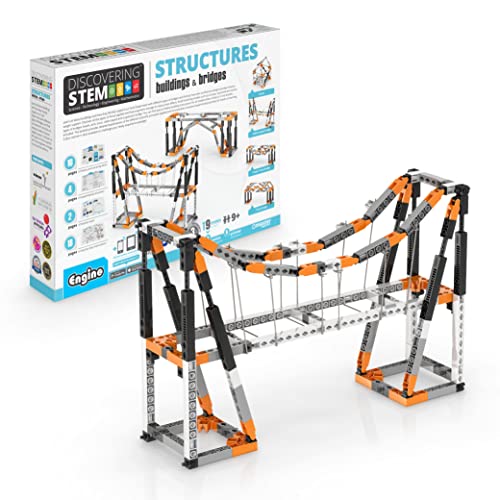
Engino’s Structures, Buildings & Bridges kit introduces young engineers to forces and structural design through nine working models. The kit includes accessible instructions and theory pages that explore core scientific principles, complemented by practical experiments and a concluding quiz section. It has earned recognition as a top STEM toy, reflecting its balance of creativity and foundational knowledge. The models enable hands-on learning about load distribution, truss systems, arches, and other architectural concepts, making it a strong option for students who enjoy building and testing ideas.
Considerations for this kit include the clarity of the learning materials, the durability of components, and how well models demonstrate real-world engineering challenges. The mix of theory and application supports a well-rounded understanding of how different structures respond to forces, helping children connect play with architectural reasoning and physics concepts.
Buying Guide: Key Purchase Considerations for 8-Year-Olds
When selecting engineering toys for eight-year-olds, consider how each kit supports core developmental areas: hands-on building, problem solving, basic programming or automation, and the ability to scale difficulty as skills advance. Here are several angles to weigh:
- Age appropriateness: Look for kits labeled for ages 8–12 that balance challenge with achievable milestones, avoiding models that require adult-level expertise.
- Skill progression: Favor kits with clear, progressive activities (from simple assemblies to more complex configurations) to maintain engagement over time.
- Multifaceted learning: Choose options that blend mechanics, electronics, and basic coding to build cross-disciplinary literacy.
- Durability and materials: Durable plastic parts and high-quality components reduce breakage and extend play value.
- Safety and ease of use: Ensure tools and components are safe for children, with simple instruction sets and age-appropriate safeguards.
- Guided versus open-ended play: Some kits provide structured lessons, while others encourage free exploration; assess what suits your child’s learning style.
- Expansibility: Consider whether the product supports expansion with additional modules or compatible accessories to grow with your child.
- Educational value: Look for clear explanations of scientific concepts, not just assembly steps, to reinforce learning outcomes.
Durability of parts, availability of replacement components, and support materials are practical factors to consider for long-term use. For families or classrooms, a mix of kits that cover different domains—mechanics, electronics, and energy—can provide a well-rounded engineering experience. Finally, assess whether the toy aligns with the child’s interests, such as robotics, solar power, or structural design, to maximize engagement and ongoing learning.